Introduction
At first glance, life in the 1970s looks incredibly affordable.
Homes under $30,000, gas for less than a dollar, and groceries that seem unbelievably cheap compared to today. It’s easy to think people had it much easier financially.
But here’s the reality: while prices were lower in absolute numbers, wages were also lower—and inflation became one of the biggest economic challenges of the decade.
So, was life actually cheaper, or did it just look cheaper?
In this article, you’ll learn:
- Typical living costs in the 1970s
- How wages compared to expenses
- The impact of inflation during the decade
- What life really felt like financially
- How it compares to today
A Snapshot of 1970s Living Costs
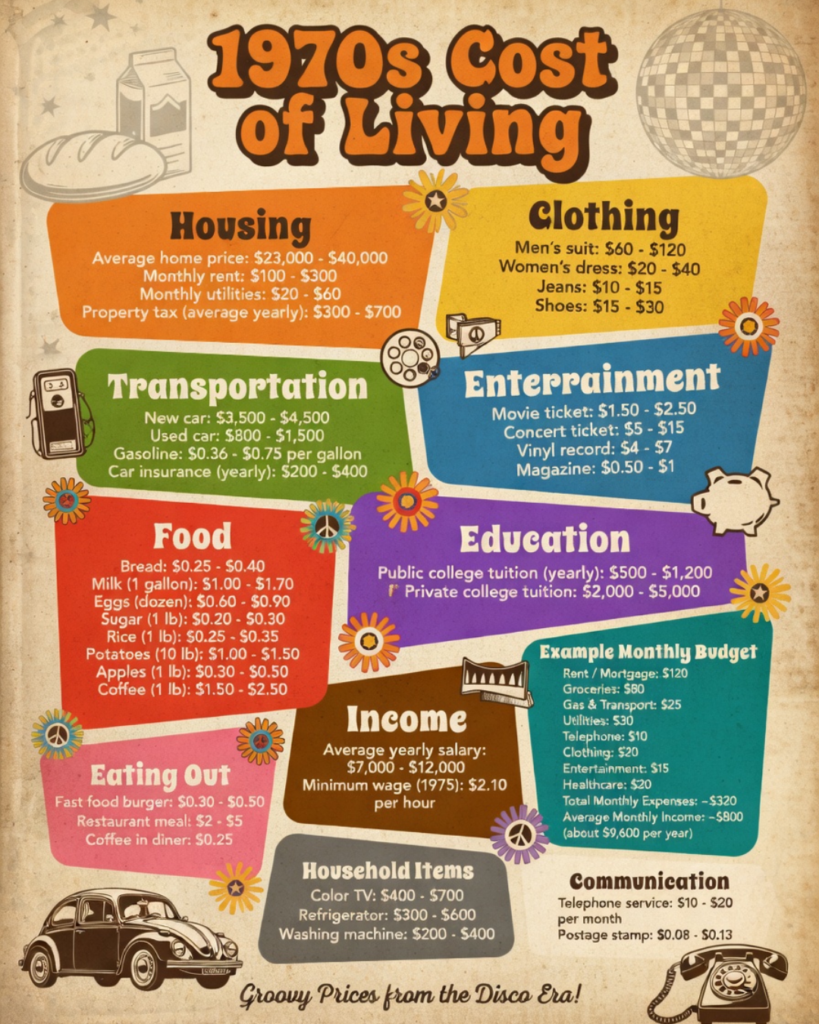
Here’s what everyday expenses looked like on average during the 1970s:
Housing
- Average home price: $20,000 – $30,000
- Monthly rent: $150 – $300
Transportation
- Gasoline: $0.30 – $0.70 per gallon
- New car: $3,000 – $5,000
Food & Groceries
- Bread: $0.25 – $0.50
- Milk: $1.00 – $1.50 per gallon
- Eggs: $0.60 – $1.00 per dozen
Utilities & Services
- Electricity: around $10–$20/month
- Telephone: $5–$10/month
Education
- College tuition (public): around $500–$1,000 per year
At a glance, these prices seem extremely low—but numbers alone don’t tell the full story.
What Were Wages Like?
To understand affordability, we need to look at income.
Average Income in the 1970s
- Annual salary: $8,000 – $12,000
- Minimum wage (early 1970s): around $1.60/hour
This means:
- A $25,000 home was about 2–3 times annual income
- Today, in many places, homes are 5–10 times annual income
So in some ways, big purchases like housing were actually more accessible relative to income.
The Inflation Problem
One of the defining economic issues of the 1970s was high inflation.
A major turning point was the 1973 oil crisis, which caused:
- Fuel prices to rise sharply
- Transportation costs to increase
- Prices of goods to go up across the economy
What Is Inflation?
Inflation means the general increase in prices over time.
During the 1970s:
- Inflation rates sometimes reached 10% or more
- The value of money decreased quickly
- People felt like their income couldn’t keep up
Why Life Didn’t Always Feel Cheap
Even with lower prices, people still faced financial pressure.
1. Rapid Price Increases
Prices didn’t just stay low—they were rising quickly.
2. Wage Growth Lagged Behind
Salaries didn’t always increase at the same speed as costs.
3. Limited Credit Access
Borrowing money wasn’t as easy or widespread as today.
4. Fewer Dual-Income Households
Many families relied on a single income, making budgeting tighter.
What Was More Affordable?
Despite challenges, some aspects of life were relatively easier:
✔ Housing
Buying a home required fewer years of income.
✔ Education
College was significantly cheaper, with less student debt.
✔ Healthcare
Costs were lower compared to today’s standards.
What Was Harder?
✖ Inflation Uncertainty
People struggled with constantly changing prices.
✖ Lower Purchasing Power Stability
Money lost value quickly during high inflation periods.
✖ Limited Job Benefits
Fewer workplace perks compared to modern standards.
Comparing the 1970s to Today
Then:
- Lower prices
- Lower wages
- High inflation
Now:
- Higher prices
- Higher wages
- More stable (but still rising) costs
The key difference is relative affordability, not just numbers.
The Real Lesson
Looking back at the 1970s teaches us something important:
Cheap prices don’t always mean an easy life.
Economic conditions—like inflation, wage growth, and job stability—matter just as much as the price of goods.
Conclusion
The 1970s may look like a time of low costs and simple living, but the reality was more complex.
While homes, food, and services were cheaper in absolute terms, rising inflation and lower wages created real financial challenges for many families.
Understanding this helps put today’s cost-of-living discussions into perspective.
Because in the end, it’s not just about how much things cost—it’s about what people can actually afford.