
Regrowing food from kitchen scraps in water transforms ordinary vegetable remnants into living testimony of nature’s generosity, proving that abundance emerges not from acquisition but from attention to the miraculous cycles already present in every discarded stem and root.
The first time I witnessed a celery base sprouting tender green shoots from its center—that humble end piece I had thoughtlessly thrown away countless times before—I experienced something approaching revelation. There, suspended in a shallow dish of water on my kitchen windowsill, what should have been compost was instead conducting photosynthesis, reaching toward light with the same determined vitality that had sustained it in distant agricultural fields. This moment cracked open an understanding: the boundary between waste and resource exists only in perception, not in botanical reality. Every carrot top, every onion base, every herb stem carries within it the complete genetic blueprint for regeneration, waiting only for the simple invitation of clean water and patience.
This comprehensive guide unveils the ten most reliable foods that regrow in water, transforming your kitchen into a perpetual garden where the line between consumption and cultivation dissolves. You’ll discover not merely which vegetables regenerate—though we’ll explore each in intimate detail—but the deeper principles governing this regeneration: how severed tissues mobilize stored energy reserves, how root primordia awaken from dormancy, how plants distinguish between survival and thriving, and the precise environmental choreography of light, temperature, and water quality that determines success. Whether you’re seeking to reduce food waste, cultivate a deeper connection with the sources of your nourishment, or simply marvel at the resilience encoded in every plant cell, this journey reveals that the most accessible garden might be the one already residing in your vegetable drawer.
Understanding the Science of Water-Based Regeneration: Botanical Resilience Revealed
Before your hands place scraps in water, before you witness the first root tendril emerging like a question into liquid space, understanding the cellular intelligence enabling this regeneration transforms simple technique into conscious participation in botanical miracle. Plants don’t merely regrow—they remember wholeness even when fragmented, activating ancient genetic programs that transform severed tissue into origin points for new life.
The Cellular Memory and Meristematic Potential
Every plant carries within specific tissues what botanists call meristematic cells—undifferentiated cells retaining the capacity to become any plant structure: roots, stems, leaves, flowers. These cellular time travelers exist concentrated in growth points: stem tips, leaf nodes, and particularly in the cambium layers where roots meet stems. When you cut a vegetable, you don’t kill it—you interrupt it, creating an emergency that triggers dormant growth programs evolved across millions of years to help plants survive herbivory, storm damage, and natural breakage.
The moment a stem enters water, a cascade of biochemical signals initiates. Auxins—plant hormones concentrated in growing tips—redistribute through remaining tissues, accumulating at the cut surface where they trigger cell division and elongation. Simultaneously, the plant mobilizes stored carbohydrates and proteins, converting them into the raw materials for new tissue synthesis. This isn’t passive survival; it’s active reconstruction, the plant essentially deciding that given adequate water, ambient light, and time, regeneration offers better odds than dormancy.
I’ve observed this cellular intelligence countless times, but understanding the biochemistry underlying it deepens rather than diminishes the wonder. Watching a green onion’s white base slowly, almost imperceptibly, extend green shoots upward while simultaneously producing a halo of white roots downward—this represents coordinated cellular communication across thousands of individual cells, each receiving and responding to chemical signals about position, resource availability, and developmental trajectory. The plant is thinking in the only language available to it: molecular conversation and tissue architecture.
Water Quality and the Invisible Foundation
Not all water proves equally hospitable to regenerating vegetables. The liquid medium becomes the plant’s entire universe—every molecule of oxygen for root respiration, every dissolved mineral for cellular construction, every waste product requiring dilution must pass through this aqueous environment. Understanding water quality transforms a simple glass of tap water into a carefully considered life support system.
Chlorine and chloramine—disinfectants common in municipal water supplies—inhibit root development while potentially damaging tender new tissues. These compounds, beneficial for human health by killing waterborne pathogens, exert similar antimicrobial effects on the beneficial bacteria and fungi that would naturally colonize root surfaces, creating symbiotic relationships that enhance nutrient uptake. The solution proves elegantly simple: let tap water sit uncovered for 24 hours before using it for vegetable regeneration, allowing chlorine to volatilize into the atmosphere.
Temperature matters profoundly though often invisibly. Cold water slows metabolic processes, extending the timeline for visible growth while potentially causing temperature shock to tissues accustomed to room temperature storage. Conversely, warm water—while accelerating initial responses—holds less dissolved oxygen and encourages bacterial proliferation that can cause rot. Room temperature water, 65-75°F, provides the Goldilocks zone where metabolic activity proceeds efficiently without stress or contamination risks.
The container itself participates in success or failure. Clear glass allows light penetration that stimulates photosynthesis in any chlorophyll-containing tissues while enabling you to monitor root development and water quality. However, excessive light promotes algae growth that competes for oxygen and nutrients. Translucent or lightly tinted containers offer compromise—enough transparency for observation, sufficient opacity to discourage algae. I’ve achieved best results with recycled glass jars positioned where indirect natural light reaches them without creating the greenhouse effect that clear glass in direct sunlight would generate.
The Ten Vegetables That Transform Kitchen Waste Into Living Gardens
Each vegetable carries its own regeneration story, its particular requirements and timelines, its characteristic way of responding to water and light. Understanding these individual narratives enables you to provide precisely what each plant needs for successful regrowth.
1. Green Onions (Scallions): The Gateway to Water Gardening
Green onions represent the perfect introduction to water-based regrowth—they regenerate reliably, visibly, and rapidly enough to maintain enthusiasm through the waiting period that defeats beginners attempting more challenging specimens. The white base with intact roots (or even without, though roots accelerate the process) placed in an inch of water will, within 3-5 days, produce green shoots from the central growing point.
The technique is elemental: position the white base in a shallow container—a shot glass, small jar, or even a repurposed yogurt container—with just enough water to submerge the root zone while leaving the growth point above the waterline. Change water every 2-3 days to prevent stagnation and bacterial buildup. Within a week, you’ll harvest new greens by snipping the desired length, leaving at least an inch of green growth to fuel continued regeneration.
I maintain a perpetual rotation of three green onion bases in water, harvesting from the most developed while allowing others to rebuild. This simple system provides fresh scallions for cooking throughout the year, eliminating those last-minute grocery runs when a recipe calls for green onion garnish. The plants themselves seem inexhaustible—I’ve maintained the same bases for 4-6 weeks before they begin showing signs of depletion, at which point composting them and starting fresh takes mere seconds.
2. Celery: Architectural Resurrection From the Heart
Celery regeneration demonstrates plant resilience at its most dramatic. That flat, seemingly dead base left after cutting away stalks carries in its center a tightly compressed crown of embryonic leaves waiting for the signal to emerge. Place this base in a shallow dish of water, ensuring the cut surface remains moist while the crown stays dry to prevent rot, and position in bright, indirect light.
The first signs of response appear within 3-4 days: the central crown begins swelling, tiny yellow-green leaves emerging like the petals of some exotic flower. Over subsequent weeks, these leaves expand and darken to the characteristic celery green, while roots proliferate from the base. After 7-10 days, when roots extend 1-2 inches, transplant into soil for continued growth. While the regenerated celery won’t match commercial stalk size, it produces tender, flavorful greens perfect for salads, stocks, and garnishes.
The key to celery success lies in patience and proper positioning. The base wants to float, bringing too much tissue above the waterline, or to sink, submerging the crown and inviting rot. I use small pebbles or glass beads to stabilize the base at optimal height—approximately ⅓ submerged, ⅔ above water. This creates the moisture gradient that encourages downward root growth while keeping the crown sufficiently dry for healthy leaf development.
3. Romaine Lettuce: Rosettes of Renewal
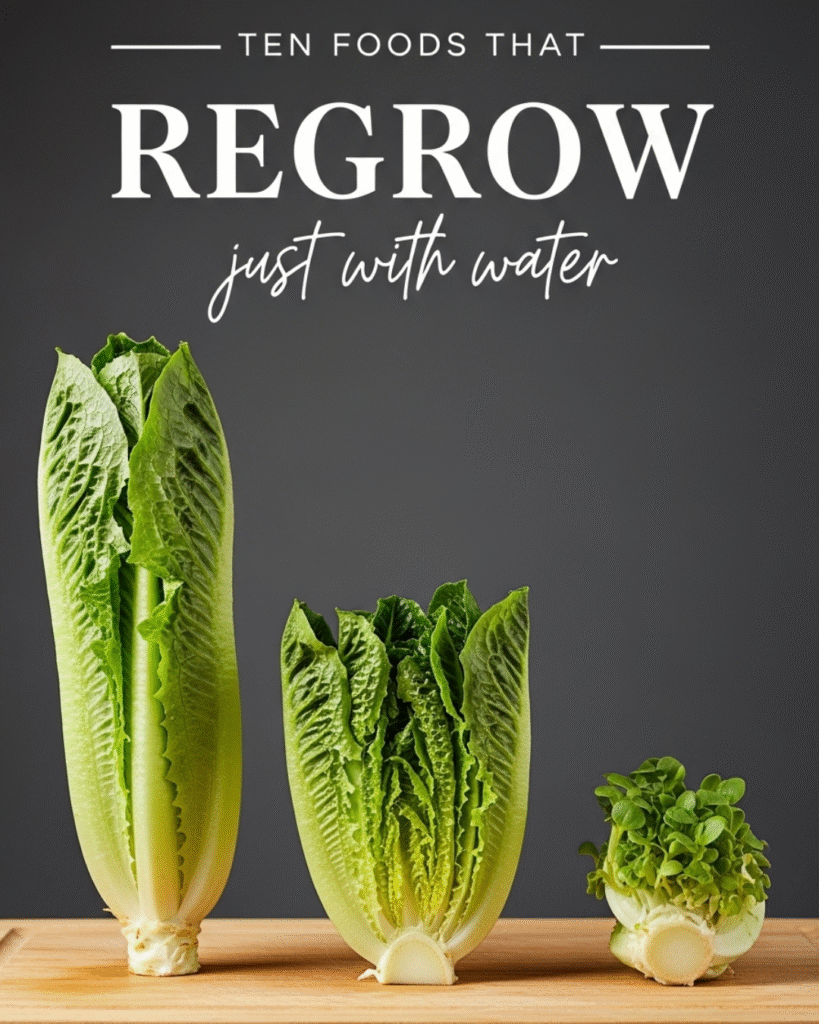
Romaine lettuce bases regenerate with the same enthusiasm as celery, though their growth pattern differs—rather than producing harvestable stalks, they create a rosette of small, tender leaves emerging from the center. These leaves, while not reaching the size of commercially grown lettuce, provide delicious microgreens and baby lettuce perfect for sandwiches and salads.
The process mirrors celery regeneration: place the base (the bottom 2-3 inches of the lettuce head with core intact) in ½ inch of water, positioning in bright light. Change water every 1-2 days—lettuce proves more susceptible to bacterial rot than more robust vegetables. Within a week, the central growing point activates, producing a cluster of new leaves with that characteristic romaine shape but in miniature.
I’ve discovered that lettuce regeneration succeeds best when started with the freshest possible bases—those from lettuce heads just purchased or harvested rather than from weeks-old refrigerator dwellers. The bases retain more stored energy and vital tissues show less degradation from cold storage. This observation underscores a broader principle: regeneration draws on internal reserves, and plants that enter water with greater energy stores demonstrate more vigorous regrowth.
4. Bok Choy: Asian Green Resilience
Bok choy regeneration follows patterns similar to celery and romaine but proceeds with characteristic Asian vegetable vigor. The base, preferably with some outer leaves still attached, regenerates prolifically when given bright light and frequent water changes. Within 5-7 days, new leaves emerge from the center, displaying the characteristic white stems and dark green leaf blades.
The challenge with bok choy involves managing its rapid growth and corresponding nutritional demands. Unlike green onions that seem content subsisting on internal reserves indefinitely, bok choy quickly depletes stored nutrients, producing progressively smaller, paler leaves if maintained solely in water. Transition to nutrient-rich soil or hydroponic solution after 10-14 days for sustained productivity.
Bok choy taught me an important lesson about the distinction between regeneration demonstration and sustained production. Water-based regrowth creates the initial structures—roots, leaves, stems—drawing on stored reserves. But continued growth requires external nutrient sources that pure water cannot provide. Understanding this distinction prevents the disappointment of watching initially vigorous regrowth gradually weaken as nutrient depletion catches up with cellular demands.
5. Leeks: Onion Family’s Stately Cousin
Leeks regenerate with the same reliability as their green onion relatives but on a larger, more impressive scale. The white base, even after the flavorful pale section has been trimmed away, retains remarkable regenerative capacity. Placed in water covering just the root zone, leeks produce both new root growth below and dark green leaf extensions above.
The timeline extends longer than green onions—expect 7-10 days before significant green growth appears, though root development begins within 3-4 days. The regenerated leeks produce greens perfect for stocks, soups, and stir-fries, though they won’t develop the thick, blanched white stems that require soil burial and months of growth.
I’ve maintained leek bases in water for up to eight weeks, harvesting the dark green portions periodically while leaving the central growing point intact. This extended timeline reflects leeks’ substantial energy reserves concentrated in their thick white bases—reserves that green onions’ more modest anatomy simply can’t match.
6. Garlic Sprouts: Pungent Microgreens
When garlic cloves begin sprouting during storage—that green shoot emerging from the clove’s tip—don’t discard them as past their prime. These sprouting cloves, placed root-end down in water, will extend their green shoots into garlic greens offering milder garlic flavor perfect for salads, pasta, and Asian dishes.
The key involves using cloves already showing sprouting intent rather than attempting to induce sprouting in dormant cloves, which requires specific temperature and moisture conditions water alone can’t provide. Once sprouting initiates, water simply supports the process already underway.
Position sprouted cloves in shallow water—just enough to wet the bottom without submerging the entire clove, which would encourage rot. Within days, the green shoot extends while roots emerge from the base. Harvest the greens when they reach 4-6 inches, cutting at the base. Many cloves will produce a second flush of growth, though subsequent harvests yield progressively less vigorous shoots.
7. Ginger Root: Tropical Rhizome Resurrection
Ginger represents one of the more challenging yet rewarding water regeneration projects. Fresh ginger rhizomes—particularly those already showing small buds—will sprout when suspended over water so that the root zone contacts moisture while the bulk remains dry. This requires careful setup, often using toothpicks to suspend the ginger over a container with water just touching the bottom.
The timeline extends considerably—expect 2-3 weeks before visible shoots emerge, during which nothing appears to happen. This apparent dormancy can test patience, but remember that internal processes proceed invisibly: cells divide, energy mobilizes, root primordia organize. Then suddenly, small pink-white shoots pierce the rhizome’s surface, followed by root development.
Once shoots and roots establish, transition to soil for continued growth. While water initiates regeneration, ginger’s long-term development requires the nutrients and structural support only soil provides. The regenerated ginger will eventually produce harvestable rhizomes, though this requires 8-10 months and considerable space—better suited for garden beds or large containers than continued water culture.
8. Lemongrass: Aromatic Grass Resurgence
Lemongrass stalks from the grocery store or Asian market, still bearing their root bases, regenerate beautifully in water. Place 3-4 stalks in a container with 2-3 inches of water, positioning in bright light. Change water every few days to prevent stagnation.
Within a week, you’ll notice small white roots emerging from the base—hair-fine initially, thickening and proliferating over subsequent weeks. After 2-3 weeks, when root systems establish robust growth, transplant into soil. Lemongrass continues growing indefinitely in appropriate conditions (warm temperatures, full sun, adequate water), eventually forming large clumps that can be divided for propagation.
I’ve found lemongrass particularly forgiving of variable water quality and less frequent water changes than leafy vegetables. This resilience likely reflects its origins in tropical monsoon regions where it evolved to handle fluctuating water availability and periodic flooding—conditions that would stress plants from more stable environments.
9. Mint Stems: Aromatic Invasion
Mint’s legendary invasiveness in gardens translates to enthusiastic regeneration in water. A single stem cutting, 4-6 inches long with several leaf nodes, placed in water will root within 7-10 days. The key involves stripping leaves from the portion that will be submerged while leaving several sets of leaves above water for photosynthesis.
Position the container in bright, indirect light—too much direct sun can wilt leaves before roots establish. Change water every 2-3 days initially, extending to weekly once vigorous roots appear. Mint proves so reliable that you can maintain it in water indefinitely, harvesting leaves as needed while the plant continues producing new growth.
I keep a perpetual mint jar on my kitchen windowsill, starting new cuttings whenever the parent plant begins looking leggy or crowded. The cuttings root faster than I can use mint in cooking, creating a self-sustaining cycle where fresh mint remains available year-round without requiring garden space or soil.
10. Basil: Tender Herb, Tenacious Spirit
Basil stems, like mint, root readily in water, transforming single harvested sprigs into full plants capable of providing continuous harvest. Select 4-inch stem cuttings from healthy plants, choosing stems just below a leaf node (the joint where leaves emerge from stems). Remove lower leaves, leaving 2-3 sets at the top.
Place cuttings in water, ensuring no leaves contact the liquid—submerged foliage rots quickly, contaminating water and potentially killing the cutting. Position in warm, bright location but out of direct afternoon sun that would scorch tender leaves.
Roots appear within 7-14 days, initially as tiny white bumps at leaf nodes, eventually developing into the characteristic fine, fibrous basil root system. Once roots reach 1-2 inches, transplant into soil or maintain in water with dilute liquid fertilizer added weekly to support continued growth.
Basil in water taught me the importance of hormonal balance in regeneration. The stems root most reliably when taken from vegetatively growing plants rather than those beginning to flower. Flowering triggers hormonal shifts prioritizing reproduction over vegetative growth, redirecting resources away from root formation toward seed development. This understanding applies across species—cuttings from vigorously growing, non-flowering stems regenerate more successfully than those from flowering or stressed plants.
Advanced Techniques for Maximum Regeneration Success
Once you’ve experienced the basic satisfaction of regrowing vegetables in water, refining your technique unlocks even greater success rates, faster regeneration, and extended plant longevity. These advanced strategies draw from hydroponic principles, plant physiology, and accumulated observational wisdom.
Light Optimization: Beyond Simple Windowsill Placement
While any bright location supports basic regeneration, understanding how light quality and duration affect plant development enables you to optimize growth. Natural sunlight contains the full spectrum plants evolved to utilize, but its intensity and duration vary with season, latitude, and window orientation.
South-facing windows in the Northern Hemisphere (north-facing in the Southern Hemisphere) provide the most consistent, intense light—ideal for light-hungry regenerators like celery and lettuce. East-facing windows offer gentler morning sun perfect for tender herbs like basil that wilt under intense afternoon heat. West-facing positions work well for robust vegetables like green onions and leeks that tolerate stronger light.
During winter months or in locations with limited natural light, supplemental LED grow lights transform regeneration success. Modern LEDs provide full-spectrum light at wavelengths plants use most efficiently (primarily blue for vegetative growth, red for flowering/fruiting) while consuming minimal electricity and generating negligible heat. Position lights 6-12 inches above plants, providing 12-16 hours of daily illumination.
I’ve achieved remarkable results using inexpensive LED grow bulbs in standard desk lamps, creating dedicated regeneration stations that maintain perfect conditions regardless of season or natural light availability. This controlled environment enables year-round regeneration and faster growth than even optimal windowsill positioning provides.
Nutrient Supplementation: Bridging Water and Soil
Pure water supports initial regeneration but contains no nutrients beyond dissolved minerals. Once plants deplete internal reserves—typically after 2-3 weeks—growth slows unless you supplement with external nutrition. This is where understanding basic hydroponics transforms simple water regeneration into sustained production systems.
Dilute liquid fertilizer, added to water at one-quarter to one-half the recommended strength, provides the nitrogen, phosphorus, potassium, and micronutrients plants need for continued growth. Begin supplementation when initial vigorous growth starts slowing—usually when leaves begin paling or new growth emerges noticeably smaller than previous leaves.
Change nutrient solution weekly to prevent salt accumulation and maintain balanced mineral availability. The solution should appear slightly cloudy or colored (depending on fertilizer type) but never murky or foul-smelling, which indicates decomposition or bacterial overgrowth requiring complete water change and container sterilization.
Hydroponic nutrients, specifically formulated for water culture, perform better than standard fertilizers designed for soil growing. The specialized formulations maintain appropriate pH and contain minerals in forms that remain soluble in water rather than precipitating out as unusable salts.
Temperature and Seasonal Considerations
Water temperature profoundly affects dissolved oxygen levels—the warmer the water, the less oxygen it holds, yet the faster plant metabolism proceeds. This creates a balancing act: warm temperatures accelerate growth but reduce oxygen availability potentially causing root suffocation, while cool temperatures maintain oxygen levels but slow metabolism to a crawl.
The optimal range of 65-75°F provides adequate oxygen while supporting reasonable metabolic rates. During summer, when room temperatures rise, place containers on cool surfaces (marble, ceramic tile) or in air-conditioned rooms. During winter, move containers away from cold windows where temperatures might drop below 60°F, potentially shocking tropical plants like basil and ginger.
Seasonal light variations affect regeneration timelines. Spring and summer’s longer days and more intense sun produce faster, more vigorous growth than winter’s short days and weak illumination. Adjust expectations accordingly—what regenerates in 7 days during June might require 14 days in December, not because your technique has declined but because fundamental environmental variables have changed.
Troubleshooting Common Regeneration Challenges
Even with careful attention, you’ll encounter occasional setbacks—vegetables that fail to regenerate, water that turns foul, or plants that begin promisingly but suddenly decline. Understanding the common challenges and their solutions transforms frustration into learning opportunities.
Bacterial Rot and Water Contamination
The most common failure mode involves bacterial contamination creating foul-smelling, cloudy water that damages plant tissues. This typically results from infrequent water changes, excessive organic matter in the container, or damaged plant tissue providing entry points for pathogens.
Prevention proves easier than cure: change water every 2-3 days, ensure containers are clean before use, remove any yellowing or dead leaves that fall into water, and ensure cut surfaces on vegetables heal slightly (become slightly dried/calloused) before placing in water—this 12-24 hour air-drying period allows wound responses that seal tissues against pathogen invasion.
If contamination occurs, immediately discard the water, rinse both container and plant thoroughly under running water, trim away any soft, discolored tissue, allow the plant to air-dry for several hours, then restart in fresh water in a sterilized container.
Inadequate Root Development
Sometimes stems or bases produce leaves but fail to develop roots, or root development proceeds so slowly that plants weaken before establishing. This usually indicates insufficient stored energy in the plant material, inadequate light for photosynthesis to support root formation, or water temperature too cold for metabolic activity.
Solutions include: selecting larger, more vigorous pieces of plant material with visible energy reserves (thick bases, multiple growth points, healthy coloration); improving light conditions; ensuring water temperature stays above 65°F; and for particularly challenging specimens, dipping the cut end in rooting hormone powder before placing in water—the synthetic auxins stimulate root formation even in reluctant subjects.
Premature Decline Despite Initial Success
Plants that regenerate enthusiastically initially but then begin yellowing, producing smaller leaves, or simply stopping growth have typically depleted internal nutrient reserves. This signals the transition point where supplemental nutrition becomes necessary for continued development.
Begin adding dilute liquid fertilizer weekly, monitoring plant response. Improved color and resumed vigorous growth indicate successful intervention. If decline continues despite feeding, the plant may simply have reached the limits of water culture’s capacity to support its needs—transplanting to soil often revives such specimens, providing the root zone structure and microbial associations that water alone cannot supply.
Conclusion: The Infinite Garden and the Practice of Mindful Abundance
The practice of regrowing food in water transcends its practical benefits—reduced waste, free food, convenient kitchen herbs—to become a meditation on sufficiency, cyclical thinking, and the profound resilience encoded in every plant cell. Each vegetable base that might have composted becomes instead an invitation to witness biological intelligence at work, to participate in regeneration rather than merely extraction and disposal.
You’ve discovered that the ten foods most reliably regrowing in water—green onions, celery, romaine, bok choy, leeks, garlic, ginger, lemongrass, mint, and basil—share certain characteristics: accessible meristematic tissues, adequate stored energy reserves, and evolutionary adaptations enabling recovery from damage or fragmentation. Understanding these shared traits allows you to experiment with additional species, approaching each new vegetable scrap as a potential regeneration candidate rather than automatic waste.
The techniques you’ve learned—proper water quality, strategic light positioning, temperature management, nutrient supplementation—represent foundational principles applicable far beyond these ten specimens. You’re developing not merely a collection of how-to instructions but genuine horticultural literacy, the capacity to observe plant responses, interpret their signals, and adjust conditions accordingly.
Begin your regeneration practice this week. Save those green onion bases, that celery core, those fresh herb stems. Set them in clean water, position them where light falls generously, and commit to the small daily act of observation. Check your regeneration stations each morning, noticing new roots, emerging shoots, the gradual transformation from inert scrap to living plant.
Document your successes and failures through photographs and notes, building personal knowledge of what works in your specific conditions—your water quality, your light patterns, your seasonal rhythms. Share your excess produce and rooted cuttings with friends and neighbors, spreading this practice of mindful regeneration through your community.
Transform your kitchen into a laboratory of perpetual renewal, where the boundary between consumption and cultivation blurs, where waste becomes impossible because everything carries the potential for continued life. Discover that the most sustainable garden might be the one that requires no ground at all—just water, light, patience, and the willingness to see food not as commodity but as living partner in the endless dance of growth, harvest, and regeneration.