
Are you struggling with persistent respiratory congestion, finding yourself constantly needing to clear mucus from the lungs naturally? Whether dealing with seasonal discomfort or seeking support for long-term respiratory health, herbal remedies offer a supportive, time-tested approach. This comprehensive Wellness Topics guide introduces 10 herbs to clear mucus from the lungs naturally, explaining the scientific backing behind their effectiveness. You will discover how these potent botanicals work as expectorants and demulcents, empowering you to transform your daily self-care routine and achieve easier breathing through sustainable lifestyle changes.
Important Disclaimer: This article is for informational purposes only and should not replace professional advice. For health-related topics, consult healthcare providers, especially if you have chronic respiratory conditions (like COPD or asthma), or if congestion is accompanied by fever or severe symptoms. Individual results may vary, and personal circumstances should always be considered when implementing any suggestions.
🌿 Section 1: Foundation First: Understanding How Herbs Clear Mucus
Before exploring the 10 herbs to clear mucus from the lungs naturally, it is crucial to build confidence with basic concepts by understanding the two primary ways herbs support the respiratory system.
H3: Key Components: Expectorants vs. Demulcents
Herbs used for respiratory health generally fall into one of two functional categories, often supporting each other for better results.
- Expectorants: These herbs help the body expel mucus. They work by thinning the phlegm (making it less sticky) or by stimulating the action of the cilia (tiny hairs in the airways) to move the mucus up and out of the lungs. Thyme and Elecampane are classic examples.
- Demulcents: These herbs are rich in mucilage, a gooey substance that soothes irritated and inflamed mucous membranes along the throat and lungs. This supportive, non-judgmental language approach reduces the urge to cough, allowing the body time to heal. Marshmallow root is a key demulcent.
H3: Addressing Common Concerns: Safety and Usage Methods
A common hesitation is knowing how to use these herbs safely and effectively.
- Usage Methods: Most of the 10 herbs to clear mucus from the lungs naturally are best consumed as warm herbal teas (infusions), which also provide hydration—a vital factor in thinning mucus. Some are also used as tinctures or steam inhalations (especially volatile oils like Eucalyptus).
- Encouraging Reassurance for Beginners: Always start with small doses and ensure you are using high-quality, organic herbs. If you are taking prescription medications, consult a pharmacist or healthcare provider before incorporating powerful herbs.
🍃 Section 2: Core Methods: 10 Herbs to Clear Mucus From the Lungs Naturally
Here are 10 herbs to clear mucus from the lungs naturally, broken down by their primary mechanism of action.
| Herb Name | Primary Action | Key Benefit / Scientific Backing |
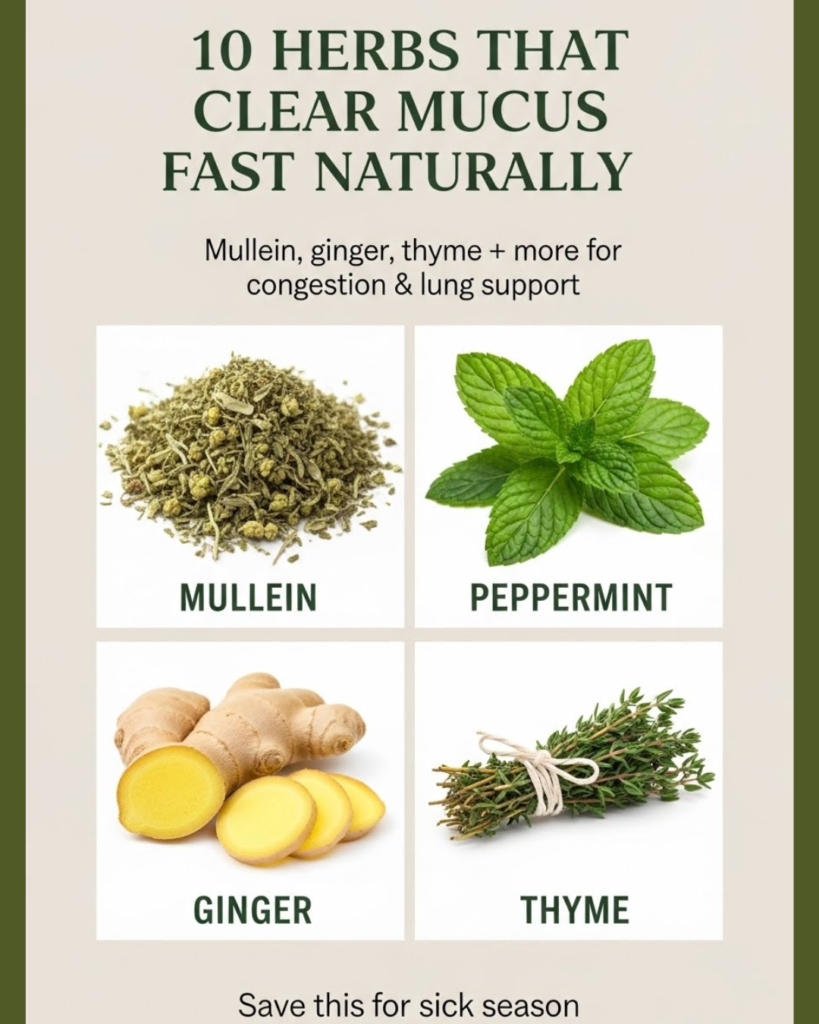
| 1. Thyme | Expectorant/Antiseptic | Rich in thymol, which is scientifically shown to relax the tracheal muscles and increase mucus flow, making it easier to cough up. |
| 2. Mullein | Expectorant/Demulcent | Traditionally used to help thin and loosen heavy phlegm; its soothing properties calm the airways. |
| 3. Eucalyptus | Expectorant/Antimicrobial | The compound cineole (eucalyptol) helps break down mucus; often used as a steam inhalation for direct access to the lungs. |
| 4. Licorice Root | Expectorant/Soothing | Contains glycyrrhizin, which supports adrenal function and acts as a powerful demulcent to coat the throat and lungs. |
| 5. Elecampane | Expectorant/Tonic | A classic respiratory herb; its inulin content supports beneficial gut flora, which is linked to immune health, while it loosens congestion. |
| 6. Marshmallow Root | Demulcent/Soothing | The high mucilage content immediately coats and protects the irritated membranes, reducing the reflexive cough. |
| 7. Osha Root | Expectorant/Circulatory** | Traditionally used to open airways and deepen breathing by stimulating better circulation to the lungs. |
| 8. Peppermint | Expectorant/Decongestant | Menthol provides a cooling sensation and helps relax the smooth muscles of the bronchial tree, aiding in the release of phlegm. |
| 9. Ginger | Mucolytic/Anti-inflammatory | Its active compounds (gingerols) help dissolve thick mucus and reduce overall inflammation in the respiratory tract. |
| 10. Horehound | Expectorant/Bitter Tonic | A stimulating expectorant known for encouraging the productive release of stubborn mucus and soothing dry coughs. |
H3: Core Methods: Simple Preparation (Achievable, Actionable Language)
For most of these herbs, preparation is simple and achievable.
- Standard Infusion (Tea): Place $1 \text{ teaspoon}$ of dried herbs (or $2 \text{ teaspoons}$ fresh) per cup of boiled water. Cover and steep for $10 \text{ to } 15 \text{ minutes}$. Covering is important to trap the volatile oils (like those in Thyme and Peppermint).
- Decoction (Roots): For hard roots like Marshmallow, Elecampane, or Licorice, simmer the root pieces in water for $20 \text{ to } 30 \text{ minutes}$ to properly extract the beneficial compounds.
⚗️ Section 3: Advanced Strategies: Creating Synergistic Mucus-Clearing Blends
While using the 10 herbs to clear mucus from the lungs naturally individually is effective, combining them creates a powerful, synergistic remedy that addresses multiple aspects of congestion simultaneously.
H3: Share Expert-Level Insights: The Power of Polarity
Effective herbal blending uses a “polarity” approach, mixing contrasting actions for a balanced effect.
- Creative Solutions and Variations – Congestion Clearing Formula: Combine a Stimulating Expectorant (Thyme or Horehound) + a Soothing Demulcent (Marshmallow or Licorice) + an Anti-inflammatory (Ginger). This blend helps you cough productively while soothing the resulting irritation.
- The Nighttime Soothe Blend (Stress Relief): Combine the gentle expectorant Mullein with the soothing demulcent Marshmallow and the relaxing nervine Lavender. This blend works gently to clear mucus from the lungs naturally without stimulating the body before sleep.
H3: Pro Tips for Customizing the Approach
- Customize for Taste: Many expectorant herbs (like Horehound) are naturally bitter. Provide ways to customize approach by balancing the bitterness with a highly palatable demulcent like Licorice root or simply adding a teaspoon of raw honey, which also has mild antiseptic properties.
- Targeted Inhalation: If using Eucalyptus or Peppermint, try steam inhalation. Add a few drops of the essential oil to a large bowl of hot water, cover your head with a towel, and inhale the therapeutic steam for $5 \text{ to } 10 \text{ minutes}$. This delivers the mucolytic action directly to the airways.
❓ Section 4: Troubleshooting: Dosage, Duration, and Safety
Understanding how long and how much to use these 10 herbs to clear mucus from the lungs naturally is crucial for safety and efficacy.
Featured Snippet Potential: “How long should I take herbs to clear mucus from the lungs?”
For acute congestion related to a cold or flu, you can generally use expectorant herbs like Thyme or Mullein 2-3 times daily for up to two weeks. For chronic issues, Licorice Root should be limited to 4-6 weeks due to its potential impact on blood pressure. Always focus on gradual progress; once symptoms subside, reduce the dosage and transition to supportive herbs like Ginger for maintenance.
Practical Troubleshooting Tips
- Problem: My cough feels dry and irritating after taking an expectorant herb.
- Obstacle: The expectorant (e.g., Thyme) thinned the mucus, but you lack sufficient demulcent action.
- Solution: Offer Alternative Approaches: Immediately follow up with a strong infusion of Marshmallow root or Licorice root tea. Increase the ratio of demulcent herbs in your next blend to ensure the airways are protected as you clear mucus from the lungs naturally.
- Problem: I am taking prescription blood pressure medication.
- Obstacle: Licorice Root can potentially raise blood pressure due to its effects on cortisol.
- Solution: Preventive Measures: Strictly avoid Licorice Root. Focus instead on other highly effective expectorants and demulcents like Mullein, Thyme, and Marshmallow root. This ensures you maintain scientific credibility and safety.
- Problem: I feel nauseous after taking a strong expectorant (e.g., Osha).
- Obstacle: Some potent expectorants can irritate sensitive stomachs.
- Solution: Take the herbal infusion with food, not on an empty stomach. Try steeping the herb for a shorter duration or reducing the dose by half. Encouragement for Setbacks: Finding the right dosage is a process; adjust slowly until you find what works best for your body.
📈 Section 5: Maximizing Results: Next Level Respiratory Wellness
Leveraging the 10 herbs to clear mucus from the lungs naturally works best when supported by holistic practices that emphasize maintenance and long-term considerations.
- Show How to Build Upon Basic Success: Therapeutic Hydration. Always pair your herbal regimen with increased fluid intake (water, broths). Hydration is the most effective natural mucolytic agent. By keeping your body well-hydrated, you help the herbs thin the mucus more effectively.
- Suggest Complementary Strategies: Dietary Support. Reduce consumption of dairy and refined sugars, which are known to increase mucus production in some individuals. Increase consumption of fresh ginger and garlic (natural antimicrobials) in your diet. (Internal Linking Opportunity: Explore our article on “Anti-Inflammatory Foods for Immune Support.”)
- Inspire Continued Growth and Learning: Breathing Exercises. Incorporate simple practices like diaphragmatic (belly) breathing daily. Deep breathing helps strengthen the muscles necessary to cough out mucus and supports the efficiency of your lungs. This is the gradual progress and self-care approach to respiratory health.
✅ Conclusion: Your Capability to Achieve Clear Breathing
You are now equipped with the knowledge of 10 herbs to clear mucus from the lungs naturally and the understanding of how to use them safely and effectively. By integrating these powerful expectorants and demulcents into your daily self-care routine, you are taking an empowered step toward sustainable lifestyle changes and maintaining respiratory wellness. Remember to listen to your body, consult your healthcare provider, and keep your body hydrated. You have the capability to succeed in breathing easier and feeling healthier!
Which three herbs will you combine for your personalized respiratory wellness tea?