
Meta Description (155–160 characters):
Arp 194 reveals how galactic destruction becomes creation in a blaze of blue light, showcasing powerful star formation triggered by cosmic collisions.
Introduction
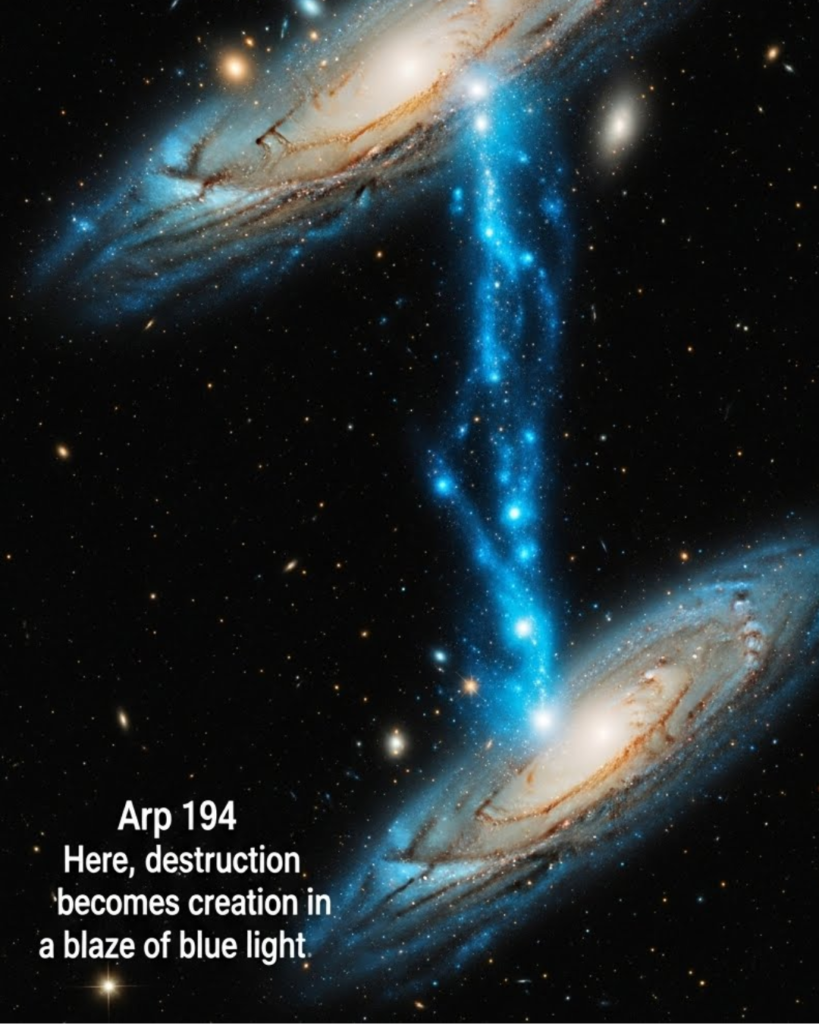
In the vastness of the cosmos, few scenes capture the duality of destruction and creation as vividly as Arp 194, a breathtaking system of colliding galaxies where gravitational chaos ignites brilliant blue bursts of newborn stars. Known for its iconic stream of glowing material—sometimes called a “cosmic waterfall”—Arp 194 illustrates how catastrophic galactic encounters can spark powerful waves of star birth. This article provides a rigorous, evidence-based exploration of what Arp 194 is, how it formed, and why its shimmering blue light reveals some of the universe’s most dynamic processes. Through structured scientific analysis and accessible explanations, you will understand how galactic collisions transform chaos into creation.
What Is Arp 194 and Why Is It Scientifically Significant?
Arp 194 is a galaxy system located approximately 600 million light-years away in the constellation Cepheus. It is part of the Atlas of Peculiar Galaxies, a catalog compiled by astronomer Halton Arp to document unusual and visually striking galactic formations.
Its significance lies in its dramatic structure:
- A disrupted spiral galaxy
- A smaller companion galaxy
- A brilliant blue “bridge” of gas, dust, and stars
- A trail of material falling like a cosmic stream across space
This configuration is the result of a high-velocity galactic collision, during which gravitational interactions stripped gas from one galaxy and elongated it into a luminous arc.
Why Astronomers Study It
Arp 194 provides insights into:
- Galaxy evolution, especially in interacting systems
- Starburst formation, where stars form at extremely high rates
- Gravitational tidal forces and their impact on galactic structure
- The recycling of galactic material through collision-driven rearrangements
The stunning blue light in Arp 194 is a direct indicator of newborn stars burning at extremely hot temperatures—evidence that destruction here leads to creation.
How Do Galactic Collisions Create New Stars in Systems Like Arp 194?
Galaxies themselves rarely collide directly because stars are spread far apart. However, their gas clouds, dark matter halos, and dust reservoirs do interact violently.
When two galaxies pass near each other:
- Gravity pulls gas clouds out of their original locations.
- These clouds compress and collapse.
- Collapsing gas forms dense pockets.
- These pockets ignite and become new stars.
In Arp 194, these steps produce the radiant blue arcs seen in high-resolution Hubble images.
The Role of Shockwaves
As gas clouds collide, shockwaves rapidly compress the material, making it easier for gravity to pull it together. This process fuels the starburst activity visible in the system.
The Blue Glow Explained
Newborn stars emit intense ultraviolet radiation. When this UV light interacts with surrounding gas, it causes the bright blue glow commonly associated with young stellar populations.
What Are the Structures That Make Arp 194 Unique?
Arp 194 consists of three primary components, often described as “A,” “B,” and “C” groups in scientific literature.
The Upper Galaxy (A)
This disrupted spiral galaxy shows:
- Warped arms
- Compressed gas lanes
- Bright star-forming knots
It appears to be the galaxy losing material into the bridge.
The Blue Tidal Stream (B)
The most visually striking element is a stream of blue material—sometimes called the “cosmic fountain” or “blue waterfall.” It is made of:
- Hot, young stars
- Ionized gas
- Dust pulled by tidal forces
This bridge is direct evidence of gravitational stripping.
The Lower Galaxy (C)
This smaller galaxy is interacting with the material flowing toward it. Some models suggest it may be absorbing part of the stream, potentially triggering star formation in its own structure.
Which Physical Processes Drive the Formation of the Blue “Bridge” in Arp 194?
The luminous bridge between the galaxies is the result of tidal interactions, ram-pressure effects, and hydrodynamic stripping.
Tidal Forces
As one galaxy passes near another, differential gravitational pulls stretch it. This forms long streams of stars and gas.
Hydrodynamic Stripping
Gas is removed as galaxies pass through each other’s gaseous halos. This amplifies the formation of the bridge.
Star Formation Along the Bridge
The blue star clusters along the bridge formed in situ—they were not pulled fully formed from the host galaxy. This means the collision actually created these stars midstream.
Evidence of Recent Star Birth
Astronomers estimate the stars forming in the bridge are only tens of millions of years old, which is extremely young on a cosmic scale.
How Does Arp 194 Help Researchers Understand Galaxy Evolution?
Arp 194 is a living laboratory that demonstrates how galaxy evolution is not linear but dynamic, chaotic, and often violent.
Key evolutionary insights include:
1. Collisions Are Common
In the early universe, galactic collisions were far more frequent, meaning systems like Arp 194 were foundational in shaping modern galaxies.
2. Starbursts Shape Morphology
Intense star formation can:
- Blow out gas through stellar winds
- Trigger supernovae
- Alter the shape and mass distribution
These events ultimately change the final form of the galaxies involved.
3. Material Redistribution
Galactic interactions move gas into new locations where future stars—and eventually planets—can form.
4. Mergers Create Larger Galaxies
Many spiral galaxies eventually merge and become elliptical galaxies over billions of years. Arp 194 may be on this path.
What Can the Colors in Arp 194 Tell Us About Its History?
Color is one of astronomy’s most powerful diagnostic tools.
Blue Regions
Indicate young, massive, hot stars formed recently from compressed gas.
Red or Yellow Tones
Reveal older star populations where star formation has slowed or ceased.
Diffuse White Glow
Shows interstellar dust reflecting starlight from multiple sources.
Arp 194’s dominance of blue tones makes it clear that starburst activity is currently at its peak.
How Was Arp 194 Observed and Analyzed by Modern Instruments?
Much of what we know comes from detailed imaging by the Hubble Space Telescope, particularly using:
- The Advanced Camera for Surveys (ACS)
- Multiple color filters capturing light across the visible spectrum
Additional Observational Tools
Astronomers also use:
- Spectroscopy to measure gas composition
- Redshift data to determine distance and velocity
- Infrared imaging to detect cool dust
- Ultraviolet imaging to study newborn stars
Together, these methods allow researchers to reconstruct the collision timeline and ongoing starburst processes.
What Future Discoveries Could Arp 194 Reveal?
Although Arp 194 has been studied for years, future telescopes will deepen our understanding.
JWST Observations
The James Webb Space Telescope can reveal:
- Hidden star formation behind dust
- Molecular gas distributions
- Early stages of planet-forming regions
Radio Observations
Facilities like ALMA can map cold hydrogen and CO emissions, helping scientists analyze where new stars may form next.
Merger Predictions
Simulations suggest that Arp 194’s galaxies may eventually coalesce, forming a larger, more stable structure.
Conclusion
Arp 194 stands as one of the universe’s most compelling examples of how destruction becomes creation. What appears as cosmic chaos is, in reality, a precise sequence of gravitational interactions forging new stars in radiant blue light. By studying this system, astronomers gain deep insights into galaxy evolution, starburst formation, and the life cycles of cosmic structures. Arp 194 is a reminder that even in the universe’s most turbulent moments, creation thrives.