Introduction (Meta Description):
A breathtaking new image reveals the “cosmic butterfly,” a spectacular celestial structure shaped by a dying star. Explore its origin, physics, and scientific significance.
What Is the Cosmic Butterfly and Why Has the New Image Captivated Astronomers?
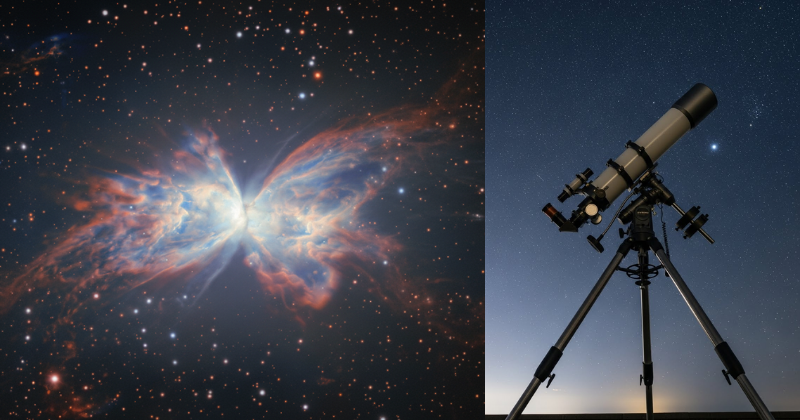
The newly released image of the “cosmic butterfly” has captured global attention, not merely for its visual beauty but for the extraordinary astrophysical processes it encodes. While the term “cosmic butterfly” sounds poetic, it describes a real and scientifically compelling structure: a bipolar planetary nebula whose elegant wings are carved by powerful stellar winds from a dying, sun-like star. Such nebulae represent one of the most dramatic final acts in the life cycle of stars, when outer layers are expelled into interstellar space and illuminated by the blazing core that remains.
The stunning new image—captured by advanced space telescopes using a combination of optical, infrared, and high-resolution spectroscopy—reveals delicate filaments, radiant gas clouds, and sharply defined lobes that stretch light-years from the nebula’s center. Its appearance resembles a butterfly spreading luminous, multicolored wings across the darkness of space. Yet beneath its beauty lies immense physical violence: shockwaves, ionized gases, and intense radiation sculpting a structure that will expand and evolve for thousands of years.
This cosmic butterfly, like others of its class, offers a rare opportunity to witness stellar transformation in progress.
What Are Planetary Nebulae and How Do They Give Rise to Cosmic Butterfly Structures?
Despite the name, planetary nebulae have nothing to do with planets. The term originated in the 18th century, when astronomers using early telescopes thought the small, round nebulae resembled the disks of planets. In reality, a planetary nebula forms when a sun-like star reaches the end of its life, shedding its outer layers into space.
A typical star spends billions of years fusing hydrogen into helium in its core. When the hydrogen runs out, the core contracts and heats up while the outer layers expand dramatically, forming a red giant. Eventually, unstable helium burning and pulsations drive off the star’s atmosphere. The newly exposed core, now a blazing pre–white dwarf, emits intense ultraviolet radiation that ionizes the drifting shroud of gas around it. The glowing shell becomes a planetary nebula.
Cosmic butterfly structures are a specific type of planetary nebula, known as bipolar nebulae, where the material does not disperse evenly in all directions. Instead, it forms two opposing lobes, often resembling wings.
How Does a Dying Star Produce the Distinctive “Wings” of the Cosmic Butterfly?
The “wings” seen in the cosmic butterfly result from interactions between the star’s final winds, magnetic fields, and the geometry of its surroundings.
1. Fast Stellar Winds Create Bipolar Lobes
As the core becomes hotter, it releases a fast, high-energy wind that slams into previously ejected material. Because the star may be surrounded by a dense equatorial disk or torus, the wind escapes more easily along the poles, forming elongated, wing-like lobes.
2. Magnetic Fields Shape the Outflow
Magnetic pressure can channel gas into narrow jets or guide expanding plasma along specific directions, sharpening the contours of the wings.
3. Binary Companions Transform the Nebula
If the dying star has a binary companion, gravitational interactions can dramatically reshape the outflow. This is considered one of the strongest explanations for symmetrical bipolar nebulae.
4. Shockwaves Sculpt Fine Structures
As winds collide, they generate shockwaves that heat, compress, and rearrange the gas into filaments, folds, and ripples visible in the new image.
Thus, the graceful shape of the cosmic butterfly is the product of astrophysical forces acting with mathematical precision, even as the star undergoes catastrophic transformation.
What Does the Stunning New Image Reveal About the Nebula’s Composition and Temperature?
The new image is more than a visual marvel—it is rich with scientific information. By observing the nebula in multiple wavelengths, astronomers can map its composition, temperature, and ionization structure.
1. Ionized Oxygen and Nitrogen
The blue and green regions often mark doubly ionized oxygen (O III), which glows at temperatures exceeding 10,000 K. These regions trace the fastest-moving winds and the zones closest to the hot central star.
2. Hydrogen Emission
Red and pink hues typically correspond to hydrogen-alpha emission, produced when electrons recombine with ionized hydrogen. These layers trace the nebula’s cooler, expanding outer shell.
3. Dust and Molecular Gas
Infrared observations reveal cooler dust grains forming in clumps and arcs. These dusty structures often sit near the equatorial plane, indicating previous mass-loss episodes.
4. Shock-Heated Regions
Bright knots, known as “ansae” or FLIERs (Fast Low-Ionization Emission Regions), mark areas where supersonic winds have collided with dense pockets of gas.
Together, these features provide a detailed map of the nebula’s evolution, helping scientists reconstruct the dying star’s final centuries.
How Does the Cosmic Butterfly Help Scientists Understand the Fate of the Sun?
Planetary nebulae serve as previews of what will eventually happen to our own solar system. In roughly five billion years, the Sun will swell into a red giant, engulfing Mercury and Venus and possibly Earth. After shedding its outer layers, it will become a white dwarf illuminating a faint nebula.
By studying the cosmic butterfly, astronomers can answer crucial questions about this future:
1. How much mass will the Sun lose?
Planetary nebulae provide clues about typical mass-loss rates during the red giant and asymptotic giant branch (AGB) phases.
2. What will the Sun’s nebula look like?
If the Sun has a companion (even a faint, undetected planet-sized one), it might form subtle bipolar structures.
3. How long will the nebula last?
Planetary nebulae fade within 10,000–20,000 years, giving insights into how long the Sun’s final display will remain visible to distant observers.
4. How will the solar system’s remnants evolve?
The white dwarf that remains will gradually cool for trillions of years, ultimately becoming a cold black dwarf.
Thus, the cosmic butterfly is not only a snapshot of another star’s death—it is a mirror into our distant future.
Which Factors Determine the Size, Shape, and Brightness of the Cosmic Butterfly?
Several astrophysical factors influence the final structure and appearance of bipolar planetary nebulae:
1. Stellar Mass
More massive stars produce stronger winds, leading to larger and more defined lobes.
2. Binary Companions
Close binaries can create disks, jets, and spirals that dramatically shape the nebula.
3. Rotation Rate
Rapidly rotating stars distribute material unevenly, contributing to asymmetry.
4. Magnetic Fields
Fields guide ionized gas into narrow channels, producing pinched waists and elongated lobes.
5. Surrounding Interstellar Medium
Nebulae expanding into denser regions slow down or compress more dramatically, altering their final shapes.
Each cosmic butterfly is therefore a unique combination of internal dynamics and environmental conditions.
What Cutting-Edge Techniques Did Telescopes Use to Capture the New Image?
The new image owes its clarity and detail to advanced astronomical techniques:
1. Multiwavelength Imaging
Combining data from optical, infrared, and ultraviolet wavelengths reveals structures invisible in a single band.
2. Adaptive Optics and Space-Based Observations
Space telescopes avoid atmospheric distortion, enabling crisp resolution of small-scale filamentary features.
3. Narrowband Filters
Filters tuned to specific emission lines—such as hydrogen-alpha or oxygen-III—highlight the chemical makeup of the nebula.
4. Spectroscopy
High-resolution spectra allow researchers to measure velocities, temperatures, and densities, reconstructing the nebula’s 3D structure.
5. Image Stacking and Data Fusion
Multiple exposures combined over time reduce noise and enhance subtle details.
These techniques turn raw light into a scientific portrait of extraordinary precision.
What Does the Cosmic Butterfly Teach Us About Galactic Chemistry and Star Formation?
Planetary nebulae are essential contributors to the chemical evolution of galaxies. The cosmic butterfly demonstrates how dying stars enrich their surroundings.
Key Contributions Include:
1. Recycling Elements
Carbon, nitrogen, oxygen, and heavier elements forged in the star’s interior are expelled into space, becoming raw material for new stars and planets.
2. Dust Formation
Dust grains form within the nebula and are later incorporated into molecular clouds, influencing the formation of complex molecules.
3. Energizing the Interstellar Medium
Ionizing radiation and shockwaves stir and heat interstellar gas, affecting the dynamics of nearby regions.
4. Triggering New Star Formation
When nebulae collide with molecular clouds, they can compress gas enough to initiate new stars.
The cosmic butterfly is thus not merely a remnant of a dying star—it is part of a larger galactic cycle that connects death with creation.
Conclusion
The cosmic butterfly, seen in a stunning new image, represents one of the most visually striking and scientifically rich planetary nebulae known to astronomy. Its luminous wings reveal a powerful interplay of stellar winds, magnetic fields, and radiation, offering a vibrant portrait of a star in its final transformation. Through detailed observations, scientists can trace the nebula’s chemical composition, reconstruct its evolutionary history, and draw parallels to the Sun’s distant future.
Beyond its beauty, the cosmic butterfly is a testament to the dynamic processes that shape galaxies, recycle stellar material, and illuminate the life cycles of stars across the universe. As imaging technologies continue to advance, structures like this will provide deeper insights into the forces that govern our cosmic environment and remind us of the profound transformations that occur in the celestial world.