Sensitive skin and chemical sunscreens often don’t mix well. Many commercial formulas contain oxybenzone, avobenzone, or fragrances that cause redness, stinging, or breakouts. If you’ve ever dealt with irritation, white cast, or the worry that store-bought sunscreens are absorbing into your bloodstream, a simple DIY zinc oxide sunscreen can be a game-changer. This natural, mineral-based recipe uses non-nano zinc oxide to sit on top of the skin and reflect UV rays — offering gentle, effective protection without harsh chemicals.
In this complete guide you’ll learn why zinc oxide is ideal for sensitive skin, the exact beginner-friendly recipe, step-by-step instructions, how to customize it for face or body, storage tips, safety notes, and common mistakes to avoid. Everything is made with pantry-friendly ingredients, costs under $1 per ounce, and gives you full control over what touches your skin. Perfect for the whole family (after 6 months old) and great for everyday use or travel.
Why Zinc Oxide Is the Best Choice for Sensitive Skin
Zinc oxide is a physical (mineral) sunscreen ingredient that works by reflecting and scattering UVA and UVB rays away from the skin rather than absorbing them. Unlike chemical filters that penetrate the skin, zinc oxide stays on the surface, making it far less likely to cause irritation or allergic reactions. The American Academy of Dermatology and studies in the Journal of Drugs in Dermatology confirm it is one of the safest and most effective options for sensitive, eczema-prone, or rosacea skin. Non-nano zinc oxide (particles larger than 100 nm) is the preferred form for DIY recipes because it doesn’t absorb into the bloodstream and provides a gentle, broad-spectrum barrier.
Additional perks:
- Naturally antibacterial and soothing
- Helps calm inflammation and redness
- Offers some protection against blue light from screens
Important note: Homemade sunscreen is not FDA-tested or rated with an official SPF number. It is best used as a complement to shade, clothing, and hats. Always patch-test and reapply every 2 hours when outdoors.
Key Benefits of This DIY Natural Sunscreen
- Gentle on sensitive, reactive skin
- No white cast when applied correctly (especially with added oils)
- Moisturizing and non-greasy
- Customizable scent and texture
- Reef-safe and eco-friendly
- Free from parabens, oxybenzone, and synthetic fragrances
- Costs pennies compared to $20+ store tubes
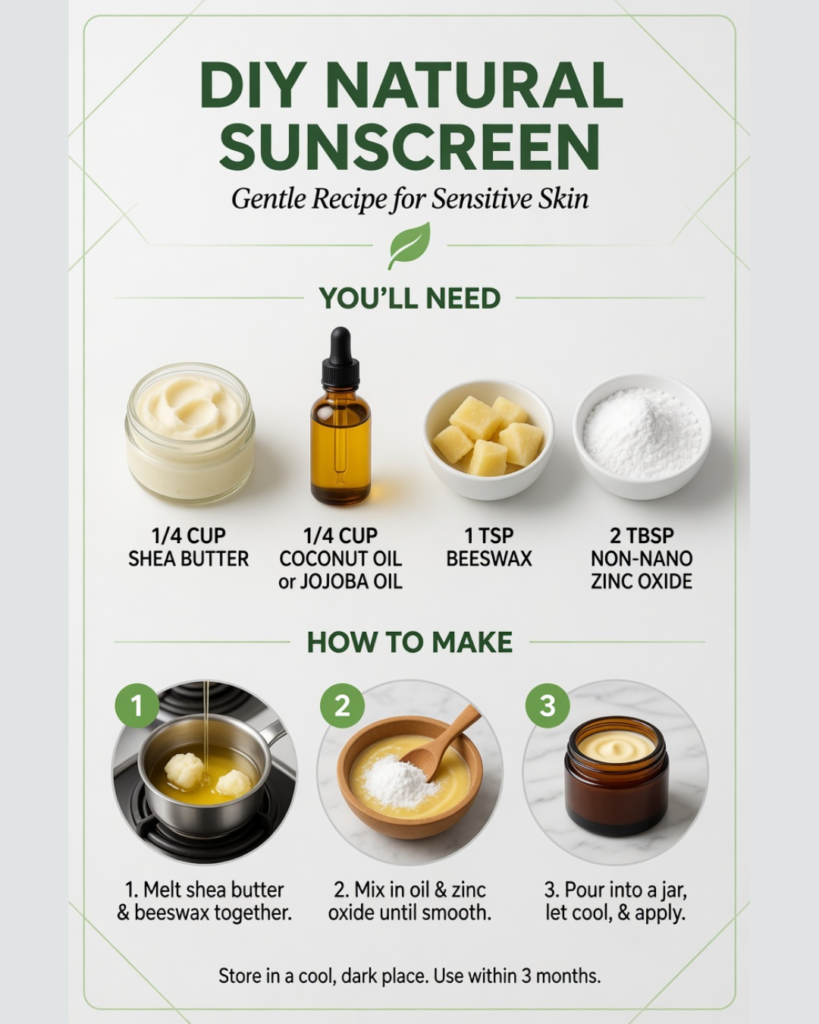
Simple DIY Zinc Oxide Sunscreen Recipe (Makes ~4 oz / 120 ml)
Ingredients:
- 2 tablespoons non-nano zinc oxide powder (uncoated, 20–25% concentration for light daily use; 25–30% for stronger protection)
- 3 tablespoons coconut oil or shea butter (carrier for moisture and spreadability)
- 1 tablespoon jojoba oil or sweet almond oil (light texture)
- 1 tablespoon beeswax pellets (for a creamy balm texture) or extra coconut oil for a lotion version
- 10–15 drops essential oil (lavender or frankincense for soothing; optional and skin-safe only)
Tools needed: Double boiler or heat-safe bowl + pot, whisk or spoon, dark glass jar or tin (protects from light).
Step-by-Step Instructions (10 minutes active time)
- Melt the base: In a double boiler or heat-safe bowl over simmering water, gently melt the coconut/she a butter, jojoba oil, and beeswax until fully liquid. Stir occasionally.
- Remove from heat: Take the bowl off the heat and let it cool slightly (still warm but not hot).
- Add zinc oxide: Slowly sprinkle in the zinc oxide powder while whisking constantly to avoid clumps. Mix until completely smooth.
- Add scent (optional): Stir in the essential oils.
- Pour and cool: Transfer to a clean dark glass jar or tin. Let it cool and solidify at room temperature (about 30–60 minutes).
- Label: Write the date and ingredients. Store in a cool, dark place.
Your DIY natural sunscreen is ready! It has a light balm texture that melts on contact with skin for easy application.
How to Use Your DIY Sunscreen Effectively
- Apply generously 15–20 minutes before sun exposure.
- Use about ½ teaspoon for face/neck and 1–2 teaspoons for each arm/leg.
- Reapply every 2 hours, or immediately after swimming or heavy sweating.
- For face only: Pat gently instead of rubbing to avoid eye irritation.
- Store in a cool place — it lasts 6–12 months.
Daily routine tip: Make it part of your morning skincare. Apply after moisturizer but before makeup.
5 Easy Variations to Customize Your Sunscreen
- Shea Butter Balm Version – Use all shea butter for extra dry or eczema-prone skin.
- Lighter Lotion Version – Skip beeswax and add 1 tbsp more jojoba oil for a thinner texture.
- Tinted Version – Mix in a tiny pinch of cocoa powder or beetroot powder for a natural tint (great for face).
- Baby-Safe Version (6 months+) – Use only zinc oxide, shea butter, and jojoba — no essential oils.
- Cooling Gel Version – Blend in 1 tbsp pure aloe vera gel after cooling for a soothing, lighter feel.
Common Mistakes to Avoid
- Using nano zinc oxide (it absorbs into skin — always choose non-nano).
- Adding zinc oxide to hot oil (it can clump).
- Skipping the patch test (inner arm for 24 hours).
- Not reapplying often enough (homemade formulas need frequent reapplication).
- Storing in direct sunlight or heat (shortens shelf life).
Safety Notes and Important Reminders
- This recipe is for external use only.
- Not recommended for babies under 6 months — use clothing and shade instead.
- Always do a patch test.
- Zinc oxide can leave a slight white cast on darker skin tones — blend well or use the tinted variation.
- This is not a replacement for medical advice. Consult a dermatologist for severe sun sensitivity or skin conditions.
- Combine with shade, hats, and UPF clothing for full protection.
Conclusion
Making your own natural sunscreen with zinc oxide is one of the easiest and smartest switches you can make for sensitive skin. This simple recipe gives you gentle, effective protection, deep moisture, and peace of mind knowing exactly what’s on your skin — all for a fraction of the cost of store-bought mineral sunscreens. With just a few pantry staples and 10 minutes of your time, you can create a custom balm that soothes, shields, and supports your skin’s natural barrier.
Try the basic recipe this weekend and enjoy your first application tomorrow. Small, natural choices like this add up to healthier, happier skin year-round. Here’s to glowing, protected skin without irritation or worry — you’ve got everything you need right in your kitchen.