
Dreaming of sinking your teeth into sweet, juicy blueberries picked right from your own patio? You don’t need acres of land or perfect native soil to enjoy a bumper crop! Learning how to grow blueberries in containers is a game-changing strategy for any gardener, especially if you have limited space or challenging soil conditions. Blueberries have very specific needs, particularly concerning soil acidity, but container gardening gives you complete control over their environment, making success achievable. This guide will provide you with the achievable, step-by-step instructions to select the best varieties, create the ideal acidic habitat, and nurture your bushes to transform your balcony or deck into a productive berry patch and achieve a fantastic harvest of your own “superfood.”
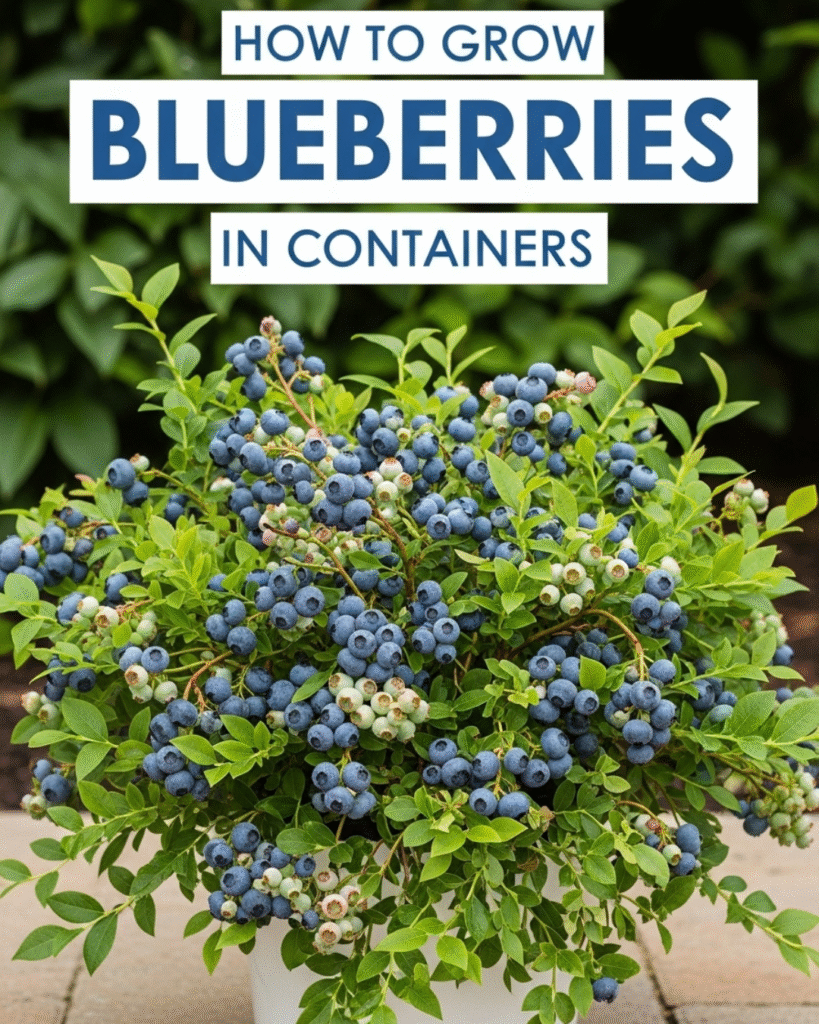
🫐 Foundation First: The Unique Needs of Container Blueberries
Blueberry bushes (Vaccinium species) are highly productive, long-lived plants, but they require two non-negotiable elements: intense sunlight and highly acidic soil. Container gardening makes it easy to satisfy both needs.
H3: Selecting the Right Blueberry Variety for Containers
Not all blueberry bushes are suited for permanent container life. Look for compact varieties bred specifically for patio cultivation. These are often easier to manage and less prone to rootbound issues.
- Dwarf Highbush Varieties: These are excellent choices. Look for cultivars like ‘Top Hat,’ ‘Sunshine Blue,’ or ‘Northland.’ They typically reach 2 to 4 feet in height, making them perfect for pots.
- Half-High Blueberries: A natural hybrid between highbush and lowbush, these are extremely cold-hardy and maintain a manageable size, thriving in containers across many regional variations.
- The Pollination Factor: For the best possible harvest, always plant at least two different varieties that bloom around the same time. While many blueberry bushes are self-pollinating, cross-pollination dramatically increases both fruit size and yield. This dual planting is the key to maximizing your harvest when you grow blueberries in containers.
H3: Understanding Acidic Soil (The pH Mandate)
Blueberries are acid-loving plants, thriving in a narrow $\text{pH}$ range of $\text{4.5}$ to $\text{5.5}$. Standard garden soil or general-purpose potting mix is usually $\text{pH 6.0}$ or higher, which will cause blueberry bushes to languish and die due to nutrient lockout.
- The Container Advantage: When you grow blueberries in containers, you circumvent native soil problems entirely. You control the mix from day one.
- The Ideal Mix: A perfect potting medium for blueberries should be a mix of:
- 50% Acidic Peat Moss: This naturally lowers the $\text{pH}$.
- 30% Pine Bark or Shredded Pine Needles: This provides aeration and continues to break down, releasing acidity.
- 20% Perlite or Coarse Sand: Ensures fast drainage, which is crucial for root health.
☀️ Step-by-Step Process: Planting Your Blueberry Bush
Getting the initial setup right is the most critical step in learning how to grow blueberries in containers. Focus on pot size and planting depth.
Core Methods: Potting and Placement
- Choose the Right Pot: Select a container that is large enough to accommodate the shrub for at least 2–3 years. Start with a pot that is at least 15 to 20 gallons (or about 18 to 24 inches wide). The container must have excellent drainage holes. Dark plastic containers absorb too much heat, so choose a lighter color, ceramic, or wooden barrel if possible.
- Planting: Fill the container about halfway with your acidic soil mix (peat moss/bark/perlite). Gently remove the blueberry plant from its nursery pot. Do not plant it deeper than it was in its original container. Blueberries have shallow root systems and planting them too deep can suffocate them.
- Watering In: Water the pot thoroughly until water streams freely from the drainage holes. This settles the soil around the root ball.
- Placement: Place the container in the sunniest spot you have, ideally receiving 6 to 8 hours of direct sunlight daily. Insufficient sun leads to poor flower and fruit production.
H4: Watering and Acidifying the Soil
Maintaining the acidic $\text{pH}$ is an ongoing task, especially since regular water (even rainwater) can raise the $\text{pH}$ over time.
- Watering Technique: Blueberries have shallow, fibrous roots, making them susceptible to drying out. Keep the soil consistently moist, but never waterlogged. Check the soil daily, especially during warm weather.
- Acid Maintenance: Use rainwater if possible, as it is naturally less alkaline than tap water. Every 2-4 weeks, acidify the water with white distilled vinegar (1-2 tablespoons per gallon of water) or use a commercial acid fertilizer formulated for azaleas or rhododendrons. This is an essential step to ensure your potted blueberry remains healthy.
(Internal Linking Opportunity: Read our detailed guide on “How to Naturally Lower Soil pH for Acid-Loving Plants.”)
💧 Advanced Strategies: Feeding and Winter Care
Once your blueberries are established, focus on specialized feeding and crucial winter protection to ensure consistent, heavy harvests year after year.
H3: Fertilizing for Fruit Production
Blueberry bushes need specific nutrients but are very sensitive to over-fertilizing, which can burn their shallow roots.
- Fertilizer Type: Use a slow-release, acid-specific fertilizer (such as those for rhododendrons or camellias). Look for an $\text{NPK}$ ratio where the nitrogen source is Ammonium Sulfate or Urea, as these are acidifying. Avoid fertilizers containing nitrates, as blueberries do not tolerate them well.
- Timing: Fertilize lightly in early spring before growth begins and again after the fruit has set (typically late spring/early summer). Do not fertilize late in the summer, as this encourages soft new growth that can be damaged by the winter cold.
H3: Container-Specific Winter Care
Because the roots of your blueberry bush are exposed to air in the container, they are far more vulnerable to cold damage than those planted in the ground. Winterizing is non-negotiable if you want to grow blueberries in containers for multiple seasons.
- The Chill Requirement (Chilling Hours): Blueberries need a specific number of chill hours (temperatures between $\text{32°F}$ and $\text{45°F}$ or $\text{0°C}$ and $\text{7°C}$) to set fruit. Choose a variety appropriate for your region (e.g., Highbush for cold regions, Rabbiteye for warmer southern regions).
- Insulation: Once the plant goes dormant (leaves drop), move the container to a protected, unheated location such as an unheated garage, shed, or cold frame. Alternatively, group the pots together and bury them in straw or mulch to insulate the roots from harsh freezing and thawing cycles. Do not bring the plant indoors where temperatures are consistently above $\text{50°F}$ ($\text{10°C}$), as this will negate the required chill period.
🐞 Troubleshooting and Common Challenges
Even when you grow blueberries in containers, you may encounter common issues, typically related to nutrition or water.
Featured Snippet Potential: “Why are the leaves on my container blueberry bush turning yellow (chlorosis)?”
The most common reason blueberry leaves turn yellow (chlorosis) is an iron deficiency caused by soil that is not acidic enough (pH too high, above 5.5). In alkaline or neutral soil, the blueberry bush cannot absorb iron and other essential nutrients, even if they are present in the soil. To fix this, confirm the $\text{pH}$ with a soil test kit and immediately apply an acidifying agent like elemental sulfur or an iron sulfate supplement to lower the $\text{pH}$ back into the ideal $\text{4.5}$ to $\text{5.5}$ range. Consistent use of acidifying water is the best prevention.
Practical Solutions for Common Blueberry Issues
| Problem | Likely Cause | Solution & Prevention |
| Bushes Not Fruiting | Insufficient chill hours or lack of cross-pollination. | Solution: Ensure you planted two different compatible varieties and provide proper winter chill (insulation in a cold, protected spot). |
| Birds Eating Berries | Unprotected harvest. | Solution: Cover the entire container and bush with bird netting immediately after the fruit begins to turn color. This is non-negotiable. |
| Tiny, Hard Berries | Inconsistent watering during fruit development. | Solution: Maintain consistent soil moisture once the berries begin to swell. Use mulch (pine needles or bark) on top of the soil to retain water. |
| Rootbound Bush | Container is too small for the plant’s age. | Solution: Repot the bush into a larger container (increase size by 5-10 gallons) during the winter dormancy period. Loosen and trim circling roots slightly. |
✂️ Maximizing Results: Pruning for High Yields
Proper pruning is essential for maximizing yields when you grow blueberries in containers. You must remove old wood to make way for new, fruit-producing canes.
Maintenance and Long-Term Considerations
- When to Prune: Prune during the dormant season, typically late winter or very early spring, before buds swell.
- The Goal: The goal of pruning is to maintain a balance of young, productive wood (1-4 years old). Blueberry bushes produce the best fruit on year-old wood.
- Three Types of Wood Removal:
- Remove Dead or Damaged Wood: Cut out any broken or diseased branches.
- Remove Low/Wimpy Growth: Cut out any twiggy, low-lying growth that is too close to the soil.
- Remove the Oldest Canes: Every year, remove 1-3 of the oldest, thickest, grayest canes right down to the ground. These are spent and need to be replaced by new suckers to revitalize the bush and unlock future harvests.
- Repotting Cycle: Plan to refresh the soil and move the bush to a slightly larger container every 3-4 years. Replace the old, depleted acidic mix with fresh material to maintain $\text{pH}$ and nutrient availability.
✅ Conclusion: Your Blueberry Harvest Awaits
You now have the complete blueprint for how to grow blueberries in containers successfully, mastering the crucial requirements of high acidity, intense sun, consistent moisture, and strategic winter protection. By choosing dwarf varieties and meticulously managing the $\text{pH}$ of your container soil, you’ve sidestepped common gardening challenges and achieved control over this rewarding crop.
The connection to nature, the cost-saving benefits, and the pride you’ll feel from harvesting those beautiful, sweet berries are immense rewards for your effort. Go ahead and start planting—your first sweet, tangy harvest is within reach!