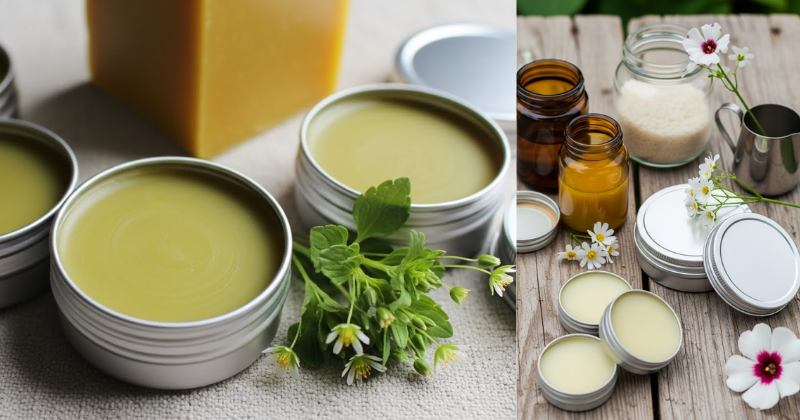
Ready to transform your approach to post-workout recovery or daily muscle tension? Learning to make your own salve Muscle Soothing Salve empowers you to control every ingredient that touches your skin. This Home Tips & DIY guide focuses on achievable, step-by-step guidance for crafting a natural, potent balm that provides warmth and relief exactly where you need it. By choosing pure ingredients and powerful essential oils, you will discover the cost-saving benefits and the immense satisfaction of completion that comes with creating your own self-care products.
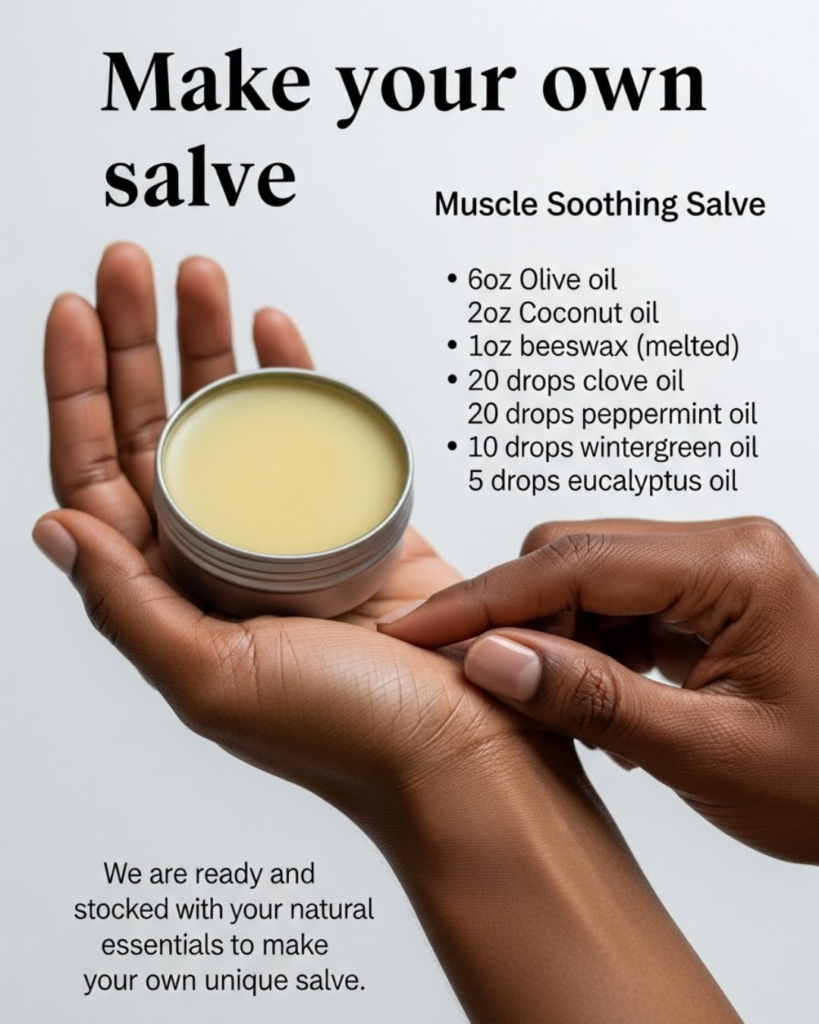
🩹 Section 1: Foundation First: Understanding Salve Components
Before you make your own salve Muscle Soothing Salve, it is vital to build confidence with basic concepts about the three key components that make a traditional salve work: the oil, the wax, and the active ingredients.
H3: Building Confidence with Basic Concepts: Oil and Wax
A salve is essentially a thick, medicinal ointment designed to stay on the skin’s surface for long-lasting absorption. Unlike lotions, salves contain no water.
- The Oil (The Carrier): This is the base that infuses the active herbal components and allows the essential oils to be applied safely. Common choices include olive oil, coconut oil, or sweet almond oil. They need to be infused with herbs to be effective.
- The Wax (The Thickener): Typically natural beeswax, the wax provides the structure, solidity, and protective barrier. It transforms the liquid oil into a semi-solid, spreadable balm. The ratio of oil to wax determines the final hardness of your Muscle Soothing Salve.
- Encouraging Reassurance for Beginners: This process is simple melting and mixing—if you can melt butter, you can make your own salve Muscle Soothing Salve!
H3: Addressing Common Concerns: Safety Considerations for Essential Oils
While essential oils provide the therapeutic kick for muscle relief, they must be used carefully.
- Scientific Backing: Active ingredients like menthol (from peppermint) and methyl salicylate (from wintergreen) provide analgesic and anti-inflammatory effects. However, they are highly concentrated and must be diluted properly.
- The Dilution Rule: Always calculate the total volume of your finished salve to ensure your essential oil concentration is safe. For a topical muscle rub, a $3\%$ to $5\%$ dilution rate is generally safe for adults. For an $8 \text{ ounce}$ batch ($240 \text{ ml}$), a $3\%$ dilution means adding approximately $144 \text{ drops}$ of essential oils. We will target a slightly lower, accessible concentration for the initial recipe.
🌿 Section 2: Step-by-Step Process: Core Methods and Recipe
Here is the achievable, step-by-step guidance on how to make your own salve Muscle Soothing Salve, focusing on a powerful blend of pain-relieving oils.
Step 1: Infusing the Carrier Oil (The Slow Burn)
The most potent salves start with an oil infused with supportive herbs.
- Herbal Choice: Choose dried herbs known for their soothing properties, such as Arnica (great for bruising and swelling, but never apply to broken skin), Calendula, or St. John’s Wort.
- The Double Boiler: Combine $1 \text{ cup}$ of your chosen carrier oil (e.g., olive oil) and $1/2 \text{ cup}$ of dried herbs in a double boiler or slow cooker.
- Timing and Planning Considerations: Gently heat the oil over low heat for $2 \text{-} 4 \text{ hours}$. Do not let it boil or smoke. This slow heat extracts the therapeutic compounds into the oil.
- Strain: Once infused, strain the oil through a fine-mesh sieve or cheesecloth, pressing out all the oil from the herbs. Discard the spent herbs.
Step 2: Melting the Wax (Actionable Language)
This step transforms your liquid oil into a spreadable salve.
- Tool Requirements: Use a clean double boiler or a glass measuring cup set in a small pot of simmering water (a homemade double boiler).
- Combine Oil and Wax: Return $3/4 \text{ cup}$ of the strained infused oil to the double boiler. Add $1 \text{ ounce}$ (approximately $2 \text{-} 3 \text{ tablespoons}$ of pastilles) of beeswax.
- Melt: Heat slowly, stirring gently until the wax is fully melted and incorporated into the oil.
Step 3: Adding the Active Essential Oils (Core Methods)
This is the point where you add the therapeutic, soothing scent and action to your Muscle Soothing Salve.
- Remove from Heat: Once the wax is fully melted, remove the mixture from the heat immediately.
- Essential Oil Blend: Wait about $2 \text{ minutes}$ for the mixture to cool slightly (if it’s too hot, the essential oils will evaporate). Add your chosen essential oil blend (see table below).
- Pour: Pour the liquid salve mixture quickly into your prepared storage containers (small tins or glass jars).
H4: Recommended Soothing Essential Oil Blend (for $8 \text{ oz}$ total salve)
| Essential Oil | Therapeutic Property | Quantity (Drops) |
| Peppermint | Cooling, counter-irritant (Menthol) | 60 |
| Wintergreen | Deep penetrating warmth (Methyl Salicylate) | 30 |
| Lavender | Calming, mild anti-inflammatory | 30 |
| Rosemary | Circulation booster, analgesic | 20 |
| Total Drops | 140 ($\sim 3\%$ dilution) |
🔥 Section 3: Advanced Strategies: Customizing and Potency
Once you master the basic steps, you can share expert-level insights and provide ways to customize approach to your Muscle Soothing Salve recipe.
H3: Creative Solutions: Adjusting the Salve Consistency
The ratio of oil to wax dictates the final firmness. Different applications may require different consistencies.
- A Softer Salve (Lip Balm/Lotion Bar Texture): If you prefer a softer, quicker-absorbing balm, use less beeswax. Try a ratio of $4 \text{ parts oil}$ to $1 \text{ part wax}$ by weight (e.g., $4 \text{ ounces}$ oil, $1 \text{ ounce}$ wax).
- A Harder Salve (Sturdy Stick): If you want a hard balm that holds up in warm weather or is intended for use in a push-up tube, increase the wax. Try a ratio of $3 \text{ parts oil}$ to $1 \text{ part wax}$ by weight.
- The Test: Encourage experimentation by spooning a small amount of the hot mixture onto a cold plate. Place it in the freezer for $30 \text{ seconds}$. Test the texture. If it’s too hard, add a splash more oil. If too soft, add more wax pastilles and remelt.
H3: Pro Tips: Enhancing Therapeutic Action
For a truly powerful Muscle Soothing Salve, you can add extra active ingredients.
- Adding Menthol Crystals: For a store-bought, icy-hot intensity, add a small amount of menthol crystals (pure menthol extracted from peppermint). Add $1/2 \text{ teaspoon}$ of crystals per $8 \text{ ounce}$ batch along with your essential oils, ensuring they fully dissolve in the hot oil before pouring. Safety note: Menthol is very strong; use gloves when handling.
- Botanical Infusion: If you have access to fresh Cayenne pepper (or powder), infuse a small amount into your carrier oil during the heating phase. The capsaicin creates a pleasant, deep warming sensation that is effective for chronic muscle aches.
🧊 Section 4: Troubleshooting and Common Challenges
Even after taking precautions, you might face some common issues when you make your own salve Muscle Soothing Salve.
Featured Snippet Potential: “How do I fix a grainy texture in my homemade muscle salve?”
A grainy texture in homemade muscle salve is usually caused by the oils, especially Shea butter or coconut oil, cooling too slowly. This slow cooling allows the fat molecules to crystallize. To fix a grainy salve, gently reheat the entire batch in a double boiler until it is completely liquid again. Then, remove it from the heat and place the container into an ice bath, stirring constantly until the mixture thickens and becomes opaque. This rapid cooling prevents crystal formation, resulting in a smooth, silky finish.
Practical Troubleshooting Tips
- Problem: The salve has a weak scent.
- Obstacle: The essential oils evaporated because they were added when the oil/wax mixture was too hot.
- Solution: Provide encouragement for setbacks—it still works! For the next batch, ensure the mixture cools to approximately $140^\circ\text{F}$ ($60^\circ\text{C}$) before adding the essential oils. You can also re-melt the current batch and carefully add $10 \text{-} 15$ more drops of essential oil before quickly repouring.
- Problem: The finished salve separated (looks oily on top).
- Obstacle: Improper mixing, or the essential oils were too cold when added.
- Solution: Preventive Measures: Ensure the beeswax is fully melted. Once essential oils are added, stir for an extra $30 \text{ seconds}$ to ensure full integration before pouring. If separation occurs, gently reheat and remix.
- Problem: The salve is too greasy and doesn’t rub in well.
- Obstacle: Too much heavy carrier oil (like high concentration olive oil).
- Solution: Use a lighter carrier oil, such as grapeseed oil, in future batches. For the current batch, you can add a thickening agent like a natural starch (e.g., cornstarch) to your salve—re-melt the mixture, add $1 \text{ teaspoon}$ of cornstarch per $4 \text{ ounces}$ of salve, and stir well before pouring.
🚀 Section 5: Maximizing Results: Beyond the Muscles
Your ability to make your own salve Muscle Soothing Salve opens the door to creating a whole range of DIY home wellness products.
- Show How to Build Upon Basic Success: Chest Rub Transformation. By altering the essential oil ratio, your Muscle Soothing Salve recipe can easily become a powerful decongestant chest rub. Increase the concentration of Eucalyptus and Peppermint oil and remove the Wintergreen for a respiratory-focused blend.
- Maintenance and Long-Term Considerations: Long-Term Storage. Because salves contain no water, they are incredibly shelf-stable. Stored in an airtight container in a cool, dark place, your salve can easily last $1 \text{-} 2$ years. This is a huge sustainable lifestyle change toward creating non-toxic home products.
- Suggest Complementary Strategies: Gift Giving and Personal Use. Homemade salves make exceptional, personalized gifts for friends, family, or gym partners, emphasizing the satisfaction of completion and the thoughtfulness of a personalized Wellness Topics product. (Internal Linking Opportunity: Read about “The Best Essential Oil Dilution Rates for Daily Use.”)
✅ Conclusion: Your Capability to Craft Comfort
You have successfully learned how to make your own salve Muscle Soothing Salve, mastering the balance of oils, wax, and potent botanicals. This knowledge unlocks a world of sustainable, high-quality, and cost-effective self-care products you can create right in your kitchen. Remember, the journey to natural wellness is a gradual progress, and every batch you make refines your skills and deepens your commitment to healthy living.
Ready to start infusing? Will you use Arnica and Olive Oil for your first batch, or jump straight to adding cooling Menthol Crystals to make your own salve Muscle Soothing Salve?