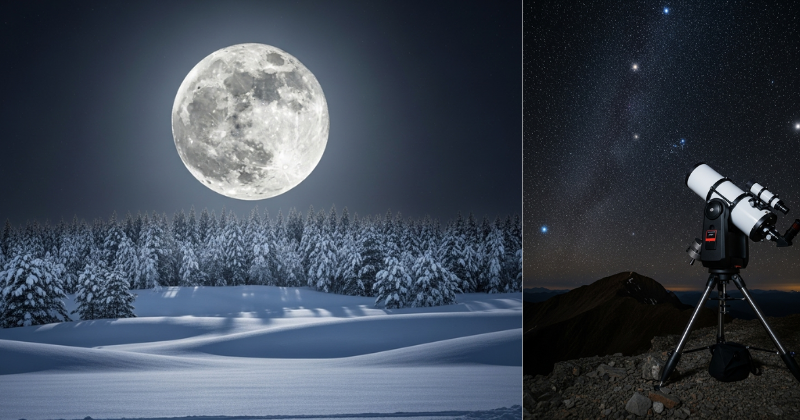
Mark your calendar on February 1, 2026, the Full Snow Moon rises, illuminating winter landscapes with a calm, silvery glow and offering a prime view of lunar geography.
The celestial mechanics of our solar system are set to provide a spectacular display as the second month of the year begins. On February 1, 2026, the Full Snow Moon will reach its peak illumination, serving as a beacon in the cold winter sky. This astronomical event is more than just a visual marvel; it is a manifestation of the complex orbital relationship between the Earth, Moon, and Sun. As the Moon reaches opposition—the point in its orbit where it sits directly opposite the Sun from our perspective on Earth—the entire lunar disk becomes visible, casting a distinctive high-albedo light across the Northern Hemisphere’s snowy terrains. This article provides a methodical exploration of the science, history, and observation techniques associated with this upcoming lunar event.

What is the scientific significance of the Full Snow Moon?
The term “Full Snow Moon” traditionally refers to the full moon occurring in February, a month historically associated with the heaviest snowfall in temperate northern climates. Scientifically, this event represents a specific lunar phase known as “syzygy.” This occurs when three celestial bodies—in this case, the Sun, Earth, and Moon—are configured in a nearly straight line.
During the full moon on February 1, 2026, the Moon will be at a celestial longitude 180° from the Sun. This positioning allows the lunar hemisphere facing Earth to be fully illuminated by sunlight. Because the Moon’s orbit is tilted at approximately 5.1° relative to the ecliptic (the path of the Earth around the Sun), the Moon usually passes above or below the Earth’s shadow, preventing a lunar eclipse while still allowing for total illumination of the lunar surface. For researchers and hobbyists alike, this phase provides the maximum amount of reflected sunlight, known as moonlight, which is actually sunlight reflected off the lunar regolith.
How does the lunar orbit influence the timing of the February 1 rise?
The timing of the Full Snow Moon is dictated by the synodic month, which is the average time between successive full moons, lasting approximately 29.53 days. While the Gregorian calendar months vary in length, the lunar cycle remains constant in its rhythm. The rise of the Full Snow Moon on February 1, 2026, is a result of this mathematical cadence.
Because the Moon’s orbit is elliptical rather than perfectly circular, its distance from Earth varies. This distance influences the apparent size and brightness of the Moon, a phenomenon often discussed in the context of “supermoons” or “micromoons.” In February 2026, the Moon’s position in its orbit will determine its exact perigee (closest approach) or apogee (farthest point). Observations indicate that the February 1 rise will provide a standard, clear view of the lunar disk, rising in the east around sunset and reaching its highest point in the sky at midnight, as is typical for full moons in mid-winter.
Which factors contribute to the “silvery glow” of winter landscapes?
One of the most compelling aspects of the Full Snow Moon is the specific quality of light it casts over the Earth. This “silvery glow” is the result of several physical and atmospheric factors working in unison. First is the albedo effect of snow. Fresh snow has an incredibly high albedo, meaning it reflects up to 90% of the light that hits it. When the Full Snow Moon rises on February 1, 2026, its light will hit the frozen landscape and bounce back, creating an illuminated environment that can appear nearly as bright as twilight.
Furthermore, winter air is typically drier and colder than summer air. Cold air holds less water vapor, which reduces atmospheric “haze” or turbidity. This clarity allows lunar photons to travel through the atmosphere with less scattering, resulting in a sharper, whiter light. The combination of high-reflectivity ground cover and low-humidity atmospheric conditions makes the Snow Moon one of the most visually striking astronomical events of the year.
How can observers best prepare for the February 1 lunar event?
To fully appreciate the Full Snow Moon on February 1, 2026, observers must consider both timing and geography. The most dramatic views of any full moon occur during “moonrise,” when the Moon is near the horizon. This is due to the “moon illusion,” a psychological and optical phenomenon where the Moon appears significantly larger when viewed next to terrestrial objects like trees or buildings.
Methodical preparation involves the following steps:
- Identify the exact moonrise time: For February 1, 2026, check local astronomical charts, as the time varies by latitude and longitude.
- Select a clear eastern horizon: Find a location with minimal obstruction to see the Moon as it first breaks the horizon line.
- Monitor meteorological forecasts: Clear skies are essential. High-pressure systems often bring the cold, stable air necessary for the best viewing.
- Acquire basic optics: While the full moon is easily visible to the naked eye, 10×50 binoculars or a basic telescope can reveal lunar maria and craters that are particularly prominent under full illumination.
What is the historical and cultural context of the Snow Moon?
The naming of the Full Snow Moon is rooted in the cultural history of North American and European peoples. Many indigenous tribes, specifically the Algonquin, used the lunar cycles to track the seasons. February was traditionally a time of scarcity and deep cold, leading to names like the “Hunger Moon” or the “Bony Moon,” reflecting the difficulty of hunting in deep snow.
By marking your calendar for February 1, 2026, you are participating in a tradition that spans millennia. In ancient cultures, the rising of the mid-winter moon signaled the midpoint between the winter solstice and the spring equinox. It was a time for internal reflection and community survival. Understanding this historical narrative adds a layer of human connection to the objective scientific reality of the lunar phase, transforming a celestial coordinate into a shared global experience.
Which lunar features are most visible during the Full Snow Moon?
Observing the Moon when it is 100% illuminated offers a unique perspective on lunar geography. Unlike the quarter phases, where shadows cast along the “terminator” (the line between light and dark) highlight the depth of craters, a full moon emphasizes differences in albedo and composition.
During the rise on February 1, 2026, look for these specific features:
- The Lunar Maria: The large, dark basaltic plains formed by ancient volcanic eruptions. The Mare Tranquillitatis (Sea of Tranquility) and Mare Imbrium (Sea of Rains) will be highly visible.
- Ray Systems: Craters like Tycho and Copernicus will display brilliant “rays”—streaks of ejecta material blasted out during impact. These rays are best seen during a full moon when the Sun is shining directly down on them.
- The Aristarchus Plateau: One of the brightest spots on the lunar surface, this area stands out due to its high reflectivity and unique geological composition.
How does the Full Snow Moon affect Earth’s biological rhythms?
The presence of a full moon has documented effects on both animal behavior and human perception. This field, known as chronobiology, examines how light cycles influence biological clocks. The intense light provided by the Full Snow Moon on February 1, 2026, can disrupt the circadian rhythms of nocturnal animals, often leading to changes in hunting and mating patterns.
In humans, while the “lunar effect” on behavior is often debated in psychology, the physical reality of increased light can impact sleep quality. The silvery glow penetrating through windows can suppress the production of melatonin, the hormone responsible for sleep. From an ecological standpoint, the Snow Moon provides a “extended day” for predators that rely on vision, such as owls and wolves, creating a temporary shift in the predator-prey dynamic across winter landscapes.
What are the future lunar trends following the February 2026 event?
The rise of the Full Snow Moon on February 1, 2026, is just one point in a continuing series of lunar cycles. Following this event, the Moon will enter its waning gibbous phase, eventually leading to the New Moon later in the month. Astronomers track these cycles to predict future eclipses and “Blue Moon” events.
In the years following 2026, the timing of the Snow Moon will continue to drift through the month of February. Analyzing these long-term trends allows scientists to calibrate satellite instruments using the Moon’s consistent light and helps historians synchronize ancient calendars with modern astronomical data. This February 1 event serves as a reminder of the clockwork precision of our corner of the universe.
Conclusion: Synthesizing the Lunar Experience
Mark your calendar on February 1, 2026, the Full Snow Moon rises, offering a rare intersection of peak celestial illumination and the stark beauty of mid-winter. This event is a testament to the laws of orbital mechanics and the atmospheric physics that define our experience of the night sky. From the high-albedo reflection of snowy landscapes to the intricate ray systems visible on the lunar surface, the Snow Moon provides a wealth of data for the scientist and a moment of profound calm for the casual observer. By understanding the scientific underpinnings of this event—from syzygy to atmospheric scattering—we can more deeply appreciate our place within the solar system.