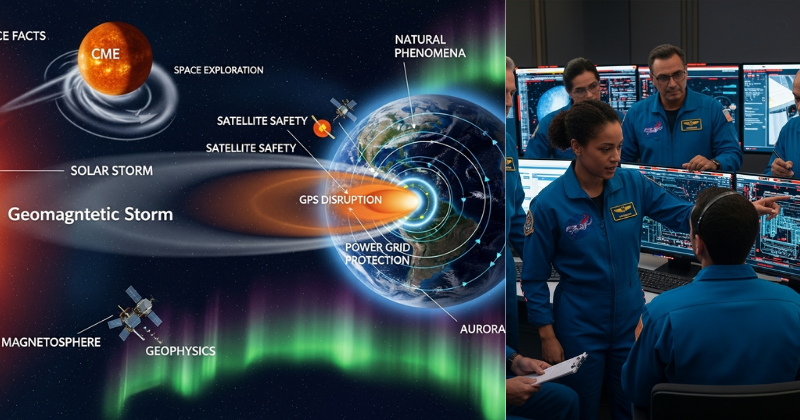
A rare solar storm is striking Earth, triggering intense geomagnetic activity and vibrant auroras. Discover the scientific implications for technology and the power grid.
The sun has recently unleashed a series of powerful coronal mass ejections (CMEs), leading to a significant astronomical event: a rare solar storm is striking Earth. This phenomenon occurs when solar wind shock waves interact with the Earth’s magnetic field, creating a complex interplay of energy that can be felt from the upper atmosphere to the surface of the planet. While these events are a natural part of the solar cycle, the intensity of the current activity has drawn the attention of space weather agencies and scientific institutions worldwide. Understanding the mechanics of this rare solar storm striking Earth is essential for navigating the potential disruptions to our modern, interconnected infrastructure.
Important Disclaimer: This article is for informational purposes only. For safety procedures regarding power outages or electronic protection during geomagnetic events, verify current best practices with local emergency management and utility providers.
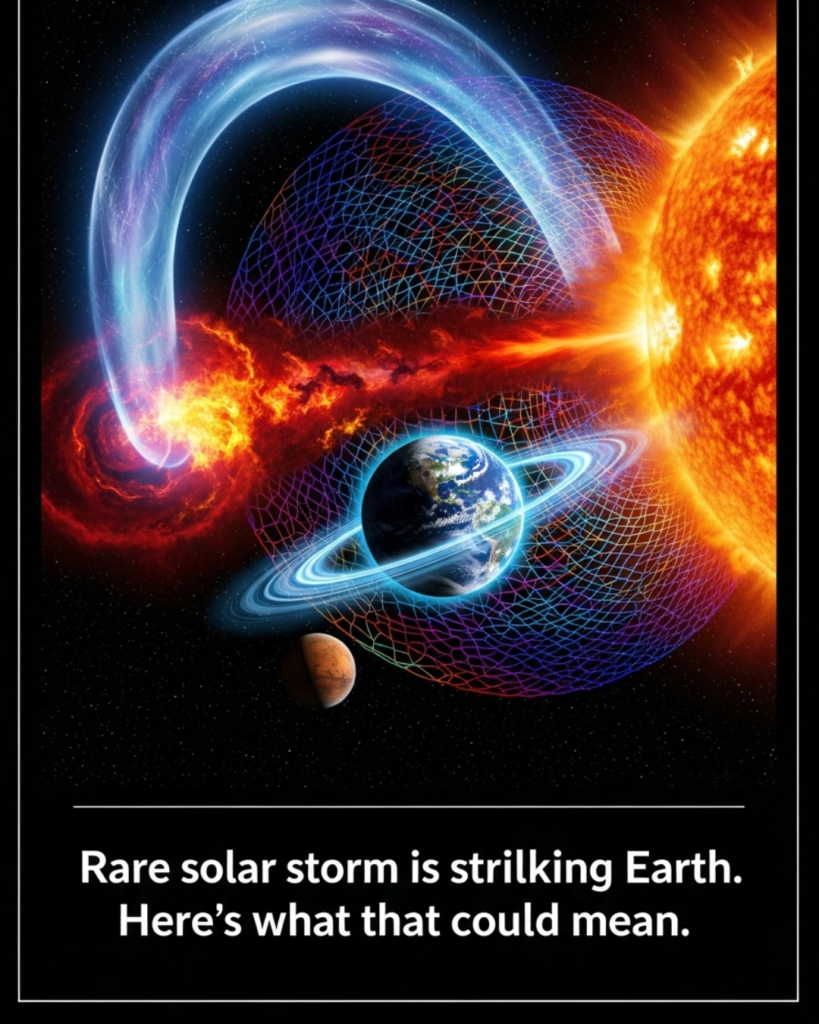
What causes a rare solar storm to strike Earth?
At the heart of every geomagnetic event is the sun’s complex magnetic cycle. Approximately every 11 years, the sun transitions between solar minimum and solar maximum, a period characterized by an increase in sunspots and solar flares. A rare solar storm striking Earth typically originates from “active regions” on the solar surface—areas where magnetic field lines become tangled and snap, releasing vast amounts of energy.
There are two primary drivers of these storms: solar flares and coronal mass ejections (CMEs). While a solar flare is a burst of light and X-rays that reaches Earth in eight minutes, a CME is a massive bubble of plasma and magnetic fields. When multiple CMEs are released in quick succession, they can “cannibalize” one another, merging into a single, high-energy front. When this front makes contact with the Earth’s magnetosphere, it triggers the geomagnetic disturbance we are currently experiencing.
How does a geomagnetic storm interact with the Earth’s magnetosphere?
When a rare solar storm is striking Earth, our planet’s first line of defense is the magnetosphere. This teardrop-shaped region of magnetic influence shields us from the bulk of solar radiation. However, during a powerful event, the incoming solar plasma can cause a phenomenon known as magnetic reconnection. This occurs when the magnetic field lines of the solar wind point in the opposite direction of Earth’s magnetic field lines, allowing solar energy to “leak” into the magnetosphere.
As this energy enters, it accelerates particles along Earth’s magnetic field lines toward the poles. This process creates the Birkeland currents, which can intensify the ionosphere. The physical compression of the magnetosphere on the day-side of the planet and the stretching of the “magnetotail” on the night-side create a dynamic environment that fluctuates rapidly, leading to the erratic magnetic readings observed by ground-based magnetometers during the storm.
Which factors determine the severity of a solar storm?
The National Oceanic and Atmospheric Administration (NOAA) uses the G-scale to categorize geomagnetic storms, ranging from G1 (minor) to G5 (extreme). Several critical factors determine where a rare solar storm striking Earth falls on this scale. The first is the speed of the CME; faster-moving plasma clouds carry more kinetic energy and deliver a sharper “blow” to the magnetosphere.
The second factor is the orientation of the Interplanetary Magnetic Field (IMF). Scientists look specifically at the $B_z$ component. If $B_z$ is pointing south, it aligns poorly with Earth’s northward-pointing field, leading to maximum energy transfer. Finally, the density of the plasma and the total magnetic field strength ($B_t$) contribute to the storm’s longevity and intensity. A storm that maintains a strong southward $B_z$ for many hours is far more likely to cause significant infrastructure issues than a brief, high-speed pulse.
How does a rare solar storm affect satellite communications and GPS?
One of the most immediate impacts of a rare solar storm striking Earth is the degradation of satellite-based services. High-energy particles can penetrate satellite shielding, causing “bit flips” in onboard computers or damaging sensitive solar panels. Furthermore, the storm causes the Earth’s upper atmosphere to heat up and expand.
This atmospheric expansion increases the thermospheric density at the altitudes where Low Earth Orbit (LEO) satellites reside. The resulting “orbital drag” can cause satellites to lose altitude or shift their trajectory, requiring frequent station-keeping maneuvers that deplete fuel. For GPS users, the storm creates turbulence in the ionosphere, a layer of charged particles. These “scintillations” delay the time it takes for a signal to travel from a satellite to a receiver, leading to positioning errors that can range from a few meters to significant deviations, impacting precision agriculture, aviation, and maritime navigation.
What are the risks to the global power grid during solar activity?
The risk to ground-based infrastructure is primarily driven by Geomagnetically Induced Currents (GICs). When the Earth’s magnetic field fluctuates rapidly because a rare solar storm is striking Earth, it induces electric currents in long, grounded conductors like power lines and pipelines. This is a direct application of Faraday’s Law of Induction.
In high-voltage power grids, GICs can enter transformers through their grounding points. These DC-like currents can cause “half-cycle saturation” of the transformer core, leading to overheating, increased vibration, and potential permanent damage. In extreme cases, this can cause a cascade of transformer failures, resulting in widespread and prolonged power outages. Grid operators now monitor space weather closely, often reducing the load on long-distance transmission lines during high-activity periods to provide a safety buffer against these induced currents.
Why does a solar storm create the Aurora Borealis and Aurora Australis?
The most visible sign that a rare solar storm is striking Earth is the intensification of the auroras. As the solar wind pours energy into the upper atmosphere, electrons collide with oxygen and nitrogen molecules. These collisions “excite” the atoms, pushing their electrons to higher energy levels. When the electrons return to their ground state, they release photons of light.
The color of the aurora depends on the gas involved and the altitude of the collision:
- Green: Caused by oxygen atoms at altitudes of about 100 to 150 kilometers.
- Red: Caused by oxygen at higher altitudes (above 200 kilometers), often seen during the most intense storms.
- Blue/Purple: Caused by nitrogen ions at lower altitudes.During a rare and powerful storm, the “auroral oval” expands significantly, allowing the Northern and Southern Lights to be visible at much lower latitudes than usual, providing a spectacular display for millions who normally live far from the poles.
How can we protect technology from the impacts of space weather?
Protecting our modern world from the effects of a rare solar storm striking Earth requires a multi-layered approach involving early warning systems and hardware hardening. Spacecraft like the Deep Space Climate Observatory (DSCOVR) sit at the L1 Lagrange point—about a million miles toward the sun—providing a 15-to-60-minute warning of incoming solar wind changes.
On the ground, engineers implement “hardening” strategies. Power companies install GIC blockers or neutral-current capacitors to prevent induced currents from entering transformers. Satellite designers use “radiation-hardened” electronics and redundant systems to survive the harsh environment of the magnetosphere. Additionally, the development of sophisticated AI models is improving our ability to predict the specific arrival time and impact of CMEs, allowing organizations to power down sensitive systems before the storm hits.
What long-term lessons can scientists learn from this rare event?
Every time a rare solar storm is striking Earth, it provides a wealth of data for heliophysicists and geophysicists. These events act as a natural laboratory for studying the “Sun-Earth Connection.” By analyzing the data from ground-based magnetometers, ionospheric sensors, and orbiting telescopes, researchers can refine their models of solar wind propagation and magnetospheric response.
Furthermore, these storms highlight the vulnerabilities in our increasingly digital society. They drive international cooperation in space weather policy, leading to the creation of more resilient communication protocols and emergency response frameworks. As we move deeper into the current solar cycle, the insights gained from this specific storm will be instrumental in preparing for future solar maximums and the inevitable “super-storms” that occur on longer historical timescales.
Conclusion
The reality that a rare solar storm is striking Earth serves as a powerful reminder of our planet’s place within a dynamic and sometimes volatile solar system. While the primary concerns involve potential disruptions to GPS, satellite communications, and power grid stability, the scientific community is better equipped than ever to monitor and mitigate these risks. Through the combination of advanced satellite early-warning systems and robust engineering, we can continue to benefit from our technological advancements while respecting the immense power of our star. As the storm continues to interact with our magnetosphere, it provides not only a scientific goldmine of data but also a stunning visual testament to the invisible forces that shape our environment.