
Introduction (meta description)
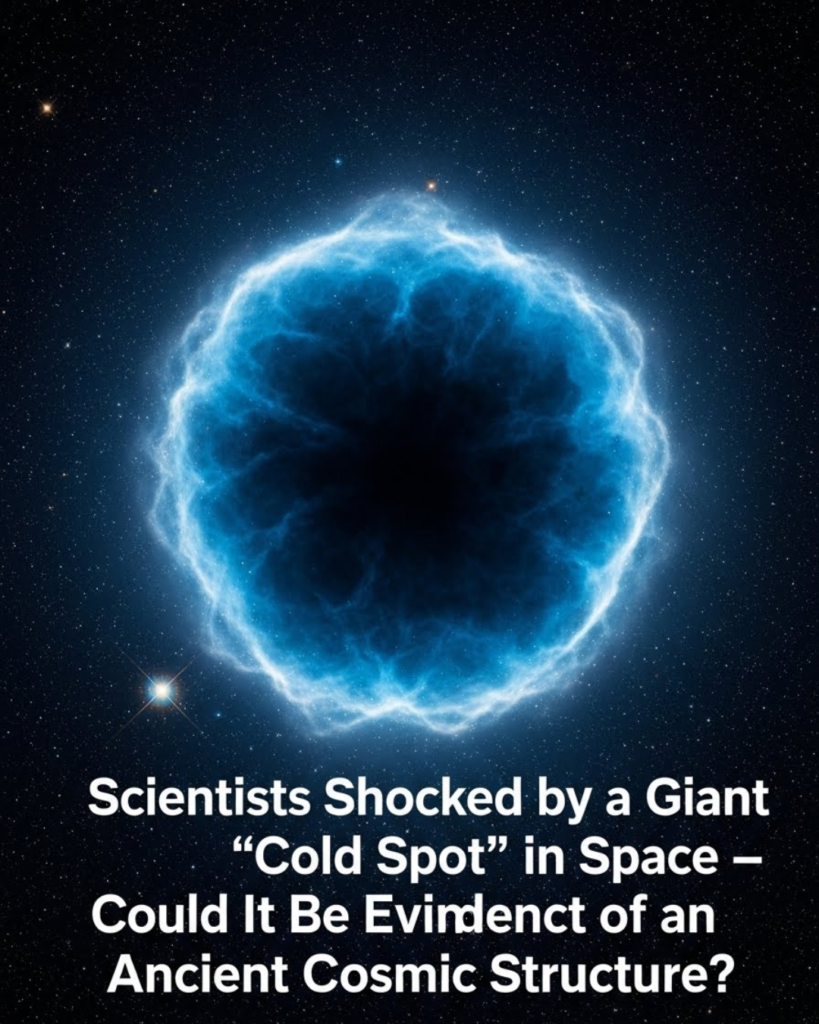
Scientists are investigating a giant cold spot in space that challenges current models of the universe. Could this anomaly reveal evidence of an ancient cosmic structure?
The discovery of an enormous, unusually cold region in the cosmic microwave background (CMB) has puzzled astrophysicists for nearly two decades. This phenomenon, often called the CMB Cold Spot, deviates sharply from the expected uniform temperature distribution left behind by the Big Bang. Its size—approximately 1.8 billion light-years across—continues to inspire debate and new research.
The mystery surrounding this region raises profound questions. Is the cold spot merely a statistical fluke? Evidence of a vast cosmic void? Or could it point toward something more radical: traces of an ancient cosmic structure or collisions between universes?
This article delivers a comprehensive scientific analysis of the cold spot, explaining leading theories, research methods, observational tools, and implications for cosmology. Through cutting-edge insights and rigorous interpretation, we explore why scientists remain stunned by this anomaly and what it could mean for our understanding of the cosmos.
What is the Cosmic Microwave Background Cold Spot?
The cosmic microwave background is the faint afterglow of the Big Bang, permeating all of space at a nearly uniform temperature of 2.725 Kelvin. Small temperature fluctuations in the CMB represent tiny variations in density from the early universe that later seeded galaxies and large-scale cosmic structures.
The CMB Cold Spot is a region noticeably cooler than its surroundings by roughly 70 microkelvin. The Wilkinson Microwave Anisotropy Probe (WMAP) first detected this anomaly in 2004, and the European Space Agency’s Planck satellite later confirmed its existence with higher precision.
The cold spot is striking not only because of its temperature deviation, but also because of its staggering scale. Its angular diameter spans about 5 degrees of the sky, corresponding to billions of light-years across in physical space if the feature is real and not statistical noise.
This raises a fundamental question: could such a large-scale anomaly arise naturally from standard cosmological models?
How do scientists measure and analyze the cold spot?
To investigate the cold spot, researchers analyze temperature maps of the microwave background using space-based telescopes such as WMAP and Planck. These instruments detect microwaves across multiple frequencies to remove foreground contamination from the Milky Way and intergalactic media.
Data processing includes several steps:
- Multi-frequency observation – distinguishing true CMB signals from dust and gas emissions.
- Statistical temperature analysis – comparing the cold spot to expected temperature distributions predicted by inflationary models.
- Monte Carlo simulations – determining whether such an anomaly could appear randomly.
- Cross-correlation – comparing CMB maps to galaxy distribution surveys to identify potential cosmic structures linked to the cold region.
Planck data suggests that chance alone is unlikely to produce a feature of this magnitude, although the probability remains debated. Studies estimate that the cold spot could be a one-in-10,000 anomaly if standard ΛCDM cosmology holds.
This statistical improbability motivates theories invoking large-scale structures or new physics beyond the standard model.
Which theories explain the origin of the cold spot?
1. The supervoid hypothesis
The most widely discussed explanation proposes that the cold spot corresponds to a vast underdense region or “supervoid” between galaxies. These supervoids can cause photons traveling through them to lose energy due to the integrated Sachs–Wolfe effect, resulting in a colder appearance in the CMB.
However, surveys using the Dark Energy Survey (DES) and VISTA Hemisphere Survey have produced inconclusive results. A void large enough to create the cold spot would exceed the scale predicted by standard structure formation models.
2. Cosmic texture hypothesis
Cosmic textures are topological defects that could arise from symmetry-breaking phase transitions in the early universe. If such a defect interacted with the CMB photons, it could produce a localized cold region.
Although textures remain theoretical, this explanation aligns with predictions from inflationary cosmology. Some studies estimate that textures could explain features like the cold spot without resorting to exotic modifications.
3. Multiverse collision hypothesis
The most speculative of all interpretations is that the cold spot represents evidence of a collision between our universe and another bubble universe. Some inflation models predict multiple expanding universes. A collision event could leave an imprint resembling the observed cold spot.
This hypothesis attracts public attention but remains unproven and controversial among physicists.
Could the cold spot be evidence of an ancient cosmic structure?
If the cold spot corresponds to an exceptionally large underdense region or fossil structure from early cosmic development, it could represent an ancient imprint of the universe before inflation completed.
Possible scenarios include:
- remnants of primordial density waves
- regions where inflation slowed unevenly
- relic cosmic textures
- early dark energy fluctuations
The significance lies not simply in the anomaly, but in what a verified ancient structure would imply. It would challenge aspects of cosmic homogeneity and isotropy, foundational assumptions of cosmology.
An ancient cosmic structure might also explain other discrepancies, such as the Hubble tension or large-scale matter distribution anomalies. Current models assume statistically smooth conditions at large scales. The cold spot, if structural, would demand reconsideration of these assumptions.
What observational evidence supports or contradicts structural explanations?
Studies have sought correlations between the cold spot and galaxy distribution. If a supervoid exists, surveys should reveal underdensity signatures.
Findings include:
- Some surveys detect a mild underdensity extending billions of light-years.
- The detected void appears insufficient to account fully for the cold temperature shift.
- Foreground contamination appears unlikely, based on Planck’s multi-band filtering.
- Simulations do not fully reproduce the observed amplitude based on standard ΛCDM assumptions.
The mismatch between observations and predictions fuels continued investigation.
Efforts to examine gravitational lensing in the region may provide new insights. If spacetime curvature differs, it could reveal whether the anomaly corresponds to a large-scale void or exotic mass-energy distribution.
How do current cosmological models accommodate or challenge this anomaly?
Standard cosmological models assume homogeneity and isotropy across sufficiently large scales. However, anomalies like the cold spot challenge the assumption that inflation completely erased primordial irregularities.
Possible implications include:
- inflation may have been non-uniform
- primordial quantum fluctuations may have been larger in certain regions
- dark energy might vary spatially
- topological defects may exist
- multiverse models may require serious examination
Much depends on future observational precision. If additional anomalies emerge or the cold spot proves consistent with large-scale structure distributions, cosmology may need revisions.
For now, most physicists view the cold spot as a rare but statistically possible feature, not conclusive evidence of new physics.
What future missions and technologies could reveal the cold spot’s origin?
Upcoming telescopes and surveys promise greater resolution and sensitivity capable of addressing unresolved questions.
Key instruments and missions include:
- Simons Observatory
- CMB-S4 project
- Euclid space telescope
- Vera Rubin Observatory
- Square Kilometre Array
These missions will enable:
- improved mapping of CMB polarization
- deeper galaxy distribution surveys
- refined gravitational lensing analysis
- enhanced modeling of void evolution
If a massive supervoid exists, improved redshift surveys should detect it. If textures or primordial structures are responsible, polarization signatures in the CMB may provide clues.
Conclusion
The giant cold spot discovered in the cosmic microwave background remains one of cosmology’s most compelling anomalies. While standard cosmological models suggest the CMB should be nearly uniform at large scales, this region defies expectations. Its immense size, unusual temperature deviation, and unclear origins continually surprise scientists.
Multiple theories attempt to explain the cold spot, ranging from supervoids and cosmic textures to multiverse collisions. Evidence remains inconclusive, though recent surveys provide tantalizing hints that structural explanations may be plausible. The possibility that the cold spot represents an ancient cosmic structure challenges assumptions about homogeneity and inflation in the early universe.
Future missions promise greater clarity through high-resolution mapping, polarization measurements, and large-scale surveys. Until then, the cold spot continues to provoke questions without definitive answers, reminding us that the universe still holds mysteries beyond the limits of current scientific understanding.