Meta description (condensed 155–160 chars):
A vast invisible cosmic structure larger than the Milky Way surrounds us. Discover what it is, how it was found, and why it reshapes our view of the universe.
Introduction
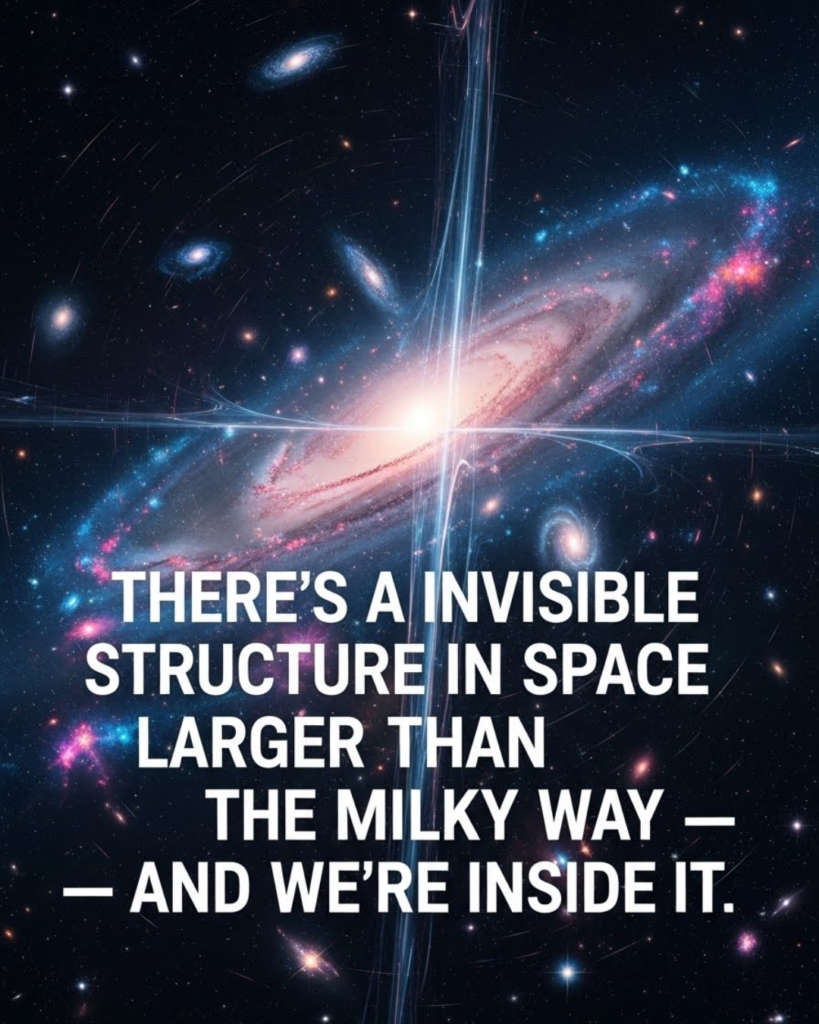
There’s a giant invisible structure in space larger than the Milky Way — and we’re inside it. This statement sounds like science fiction, yet it reflects one of the most profound discoveries in modern cosmology. Our galaxy is not drifting alone through empty space. Instead, it is embedded within an immense, largely unseen cosmic structure defined by gravity, motion, and dark matter. This revelation has fundamentally changed how astronomers understand the large-scale architecture of the universe and our place within it.
What Is the Giant Invisible Structure We Live Inside?
The structure scientists refer to is known as the Laniakea Supercluster, a colossal assembly of galaxies bound together by gravity. The name Laniakea, meaning “immeasurable heaven” in Hawaiian, reflects its staggering scale. This supercluster spans approximately 520 million light-years and contains more than 100,000 galaxies, including our own Milky Way.
Unlike galaxies or nebulae, Laniakea is invisible to the naked eye and even to most telescopes because it is not a solid object. It is a gravitationally defined region of space where galaxies move along similar cosmic flows, drawn toward a common gravitational basin. Its boundaries are not walls or edges but subtle transitions in the direction of galactic motion.
How Was This Massive Cosmic Structure Discovered?
The discovery of Laniakea did not come from direct imaging but from mapping galaxy velocities. Astronomers measured how galaxies move relative to the cosmic expansion, identifying deviations caused by gravitational attraction. By analyzing these motions, researchers reconstructed the invisible gravitational landscape shaping them.
This work relied heavily on redshift surveys and advanced computational modeling. Galaxies are generally moving away from each other due to cosmic expansion, but small deviations in their speeds reveal the influence of massive structures. When scientists visualized these motions in three dimensions, a vast, coherent structure emerged — one that included the Milky Way as a minor constituent.
What Makes This Structure “Invisible” to Traditional Observation?
The invisibility of this giant structure stems from its composition and definition. Laniakea is not marked by glowing gas or bright stars. Instead, it is dominated by dark matter, which does not emit or reflect light. Dark matter interacts primarily through gravity, shaping the motion of galaxies without being directly observable.
Additionally, superclusters do not have sharp physical edges. Their boundaries are defined by gravitational influence rather than material density. This makes them conceptually different from objects like galaxies, which have visible stars and gas clouds. Laniakea is best understood as a gravitational map rather than a physical object.
How Does the Milky Way Move Within This Enormous Structure?
Our galaxy is not stationary within Laniakea. The Milky Way is traveling at approximately 600 kilometers per second toward a region known as the Great Attractor, a dense gravitational zone within the supercluster. This motion is subtle and imperceptible on human timescales but measurable through precise astronomical observations.
The Great Attractor itself is obscured by the dense dust of the Milky Way’s plane, making it difficult to observe directly. However, its gravitational pull is unmistakable. The motion of thousands of galaxies points toward it, revealing the underlying mass distribution shaping the cosmic flow.
Why Is This Structure Larger Than the Milky Way by Such an Extreme Margin?
To grasp the scale, consider that the Milky Way is about 100,000 light-years across. Laniakea is more than 5,000 times larger. This disparity exists because the universe organizes matter hierarchically. Stars form galaxies, galaxies form groups, groups form clusters, and clusters form superclusters.
Superclusters represent some of the largest known coherent structures in the universe, though even they are part of an even greater cosmic web of filaments and voids. Laniakea is not the largest structure known, but its discovery was revolutionary because it redefined how astronomers categorize galactic neighborhoods based on motion rather than proximity alone.
Which Scientific Methods Confirm the Existence of Such Vast Structures?
Several independent lines of evidence support the existence of superclusters like Laniakea:
- Redshift measurements reveal deviations from uniform cosmic expansion.
- Cosmic flow mapping shows coherent galaxy motion toward gravitational centers.
- Dark matter simulations reproduce similar large-scale structures when gravity is applied to early-universe conditions.
- Cosmic microwave background data provides a reference frame for measuring galaxy velocities.
Together, these methods form a consistent picture of a universe shaped by invisible gravitational scaffolding. Laniakea is not an anomaly but a natural outcome of cosmic evolution governed by gravity and dark matter.
How Does This Discovery Change Our Understanding of the Universe?
Before this discovery, astronomers often categorized galaxies based solely on spatial proximity. Laniakea introduced a dynamic definition, grouping galaxies by shared motion and gravitational destiny. This shift has profound implications for cosmology.
It suggests that the universe’s structure is best understood not as static clusters but as flowing systems shaped by invisible forces. It also reinforces the central role of dark matter in cosmic evolution. Without dark matter, structures of this scale could not have formed within the age of the universe.
What Does Living Inside This Giant Structure Mean for Humanity?
On a practical level, being inside Laniakea has no immediate impact on daily life. However, philosophically and scientifically, it reshapes our cosmic perspective. Humanity often views Earth as orbiting the Sun, the Sun within the Milky Way, and the Milky Way as a vast island universe. Laniakea reveals that even this is not the full story.
We are participants in a grand cosmic flow, moving with billions of other stars and galaxies through an invisible gravitational landscape. This understanding underscores both the insignificance and the interconnectedness of our place in the universe — a humbling reminder that even our galaxy is just one thread in a much larger cosmic tapestry.
Conclusion
There’s a giant invisible structure in space larger than the Milky Way — and we’re inside it. The discovery of the Laniakea Supercluster represents a milestone in modern astronomy, revealing that our galaxy is part of an immense gravitational system defined by motion, dark matter, and cosmic evolution. Though invisible to our eyes, this structure shapes the journey of galaxies across hundreds of millions of light-years. By uncovering it, scientists have not only expanded our map of the universe but also deepened our understanding of how everything — including us — is connected on the largest scales imaginable.