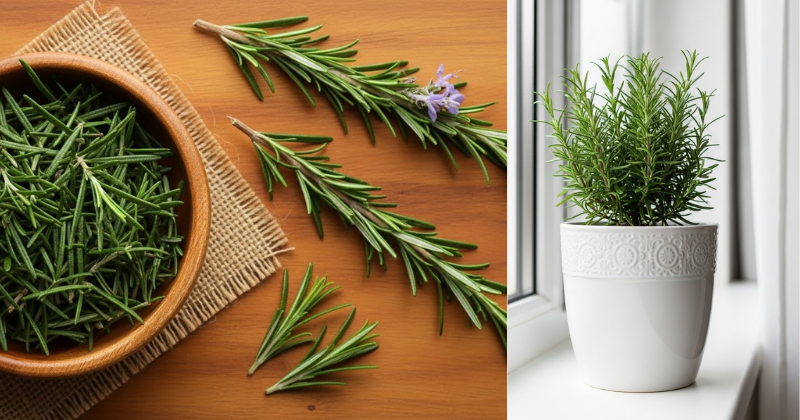
Do you dream of having a huge, fragrant rosemary bush but hate spending money on nursery plants? Here is the answer! This Gardening Topics guide reveals this insanely simple propagation method that allows you to root rosemary cuttings in nothing but water, giving you endless rosemary for free. You will discover the secret to activating root growth easily and quickly, enabling you to transform a small sprig into a robust, thriving plant. This is the most achievable, step-by-step guidance for beginners to experience the joy and satisfaction of completion that comes from growing and nurturing your own aromatic herb garden.

🌿 Section 1: Foundation First: Understanding Rosemary Cuttings
Before you begin this insanely simple propagation method, it’s essential to understand why rosemary roots so readily and how to select the perfect cutting.
H3: Building Confidence with Basic Concepts: Softwood vs. Hardwood
Rosemary (Salvia rosmarinus) is a woody perennial, and success depends on choosing the right type of growth.
- Softwood Cuttings (Best Choice): These are taken from the new, flexible green growth at the tip of the branches. They root fastest because the tissues are still actively dividing. This is the growth you want for this insanely simple propagation method.
- Semi-Hardwood Cuttings (Good): Taken from growth that is slightly firmer and starting to turn woody near the base. They take longer but are more resilient.
- Encouraging Reassurance for Beginners: Don’t worry about being perfect! Rosemary is generous. Even slightly mature pieces of new growth often root easily in water.
H3: Key Components: What Rosemary Needs to Root for Free
The goal of water propagation is to fool the cutting into thinking it needs to grow a new root system quickly to survive.
- Water: Provides hydration and acts as a sterile environment.
- Hormones: Every cutting contains natural rooting hormones; the water method concentrates these hormones at the cut end.
- Wound: The cut itself creates a wound that triggers the plant’s natural repair and regeneration mechanisms, telling it to form roots.
💧 Section 2: Step-by-Step Process: The Water Rooting Method
This process is straightforward and requires minimal tool requirements. You can start your journey to endless rosemary for free today!
Tool Requirements and Preparation
- Sharp, clean scissors or pruners
- Small, clear glass jar or test tube
- Fresh, filtered water (tap water is usually fine)
- Rosemary plant or fresh sprigs (purchased from the grocery store is acceptable!)
Step 1: Taking the Cuttings (Actionable Language)
Precision in cutting gives you the best chance of success with this insanely simple propagation method.
- Select: Choose healthy, vigorous, non-flowering stems, preferably softwood, about $4 \text{ to } 6 \text{ inches}$ long.
- Cut: Using your clean shears, cut the stem just below a leaf node (the little bump where a leaf meets the stem). This node is where the rooting hormones are concentrated.
- Strip: Remove the leaves from the bottom $2 \text{ inches}$ of the stem. It is crucial that no leaves sit below the waterline, as submerged foliage will rot and contaminate the water.
Step 2: Setting Up the Water Environment (Core Methods)
This is a key phase for successful water rooting.
- Place in Water: Fill your clean jar with fresh water. Place the cuttings into the jar so that the bottom $1 \text{ to } 2 \text{ inches}$ of the stripped stem are fully submerged. Keep the upper leaves dry.
- Placement: Place the jar in a warm location that receives bright, indirect light. A windowsill is ideal, but avoid intense, direct afternoon sun, which can cook the cuttings. Timing and planning considerations: Avoid placing the jar near drafts or air vents, which can stress the cutting.
- Maintenance: Change the water every $2 \text{ to } 3 \text{ days}$. This prevents bacterial growth and replenishes oxygen, which is vital for root development.
Step 3: Transplanting to Soil (Practical Tips and Shortcuts)
You will see tiny white roots emerge in as little as $3 \text{ to } 4 \text{ weeks}$. Don’t leave them in the water too long!
- When to Transplant: Wait until the roots are at least $1 \text{ inch}$ long and branching slightly. Roots that are too small may struggle in soil; roots that are too long can suffer from shock.
- Soil Preparation: Use a well-draining succulent or herb potting mix. Pot the rooted cuttings gently into a small pot ($4 \text{ to } 6 \text{ inches}$) and water thoroughly.
- Acclimation: Place the newly potted rosemary in a sheltered spot with bright, indirect light for the first week to allow it to acclimate before moving it to a sunny spot. This is the final step to achieving endless rosemary for free.
🪴 Section 3: Advanced Strategies: Pro Tips for Faster Rooting and Growth
Want to speed up this insanely simple propagation method? These expert-level insights will maximize your success rate and lead to a quicker harvest.
H3: Share Expert-Level Insights: The Hormone Boost
While the water method is simple, you can use natural materials to give your cuttings a rooting advantage.
- Willow Water (Creative Solution): Willow branches contain natural salicylic acid, which is a powerful rooting hormone. Chop up a few willow twigs and soak them in the propagation water for $24 \text{ hours}$ before adding your rosemary cuttings. This gives a natural boost to encourage root formation.
- Aloe Vera Gel: Before placing the cutting in the water, dip the cut end into fresh Aloe Vera gel. Aloe acts as an antibacterial shield and provides concentrated growth hormones directly to the wound site.
H3: Pro Tips for Customizing the Approach
- The Humidity Dome (Encourage Experimentation): To prevent the top leaves from drying out while the cutting is trying to root, place a clear plastic bag loosely over the jar and cutting. This traps humidity and provides a tropical environment for faster rooting. Just ensure you remove it daily for a few minutes to provide air circulation.
- Seasonal Advantage (Regional Variations): The best time to propagate rosemary is late spring or early summer, as the combination of warm weather and active growth ensures the quickest root development.
🐛 Section 4: Troubleshooting: Common Challenges in Water Rooting
Even the simplest methods can present challenges. Here are practical troubleshooting tips to address setbacks and ensure you grow your endless rosemary for free.
Featured Snippet Potential: “Why is my rosemary cutting rotting in the water?”
Rosemary cuttings typically rot in water due to two main reasons: 1) Leaves were left submerged below the waterline, contaminating the water, or 2) The water was not changed frequently enough, allowing anaerobic bacteria to build up. To fix this, cut off the rotten section with sterilized shears, strip more leaves, place the cutting in fresh water, and commit to changing the water every two days.
Practical Troubleshooting Tips
- Problem: Roots are developing, but the leaves look yellow and are dropping.
- Obstacle: The cutting is running out of nutrients, which were stored in the stem, and it needs to be potted soon.
- Solution: Offer Alternative Approaches: If the roots are less than $1 \text{ inch}$, give the water a very small “feeding” by adding one drop of liquid houseplant fertilizer. If the roots are ready, pot it immediately—the soil will provide the nutrients the cutting needs.
- Problem: No roots after $6 \text{ weeks}$.
- Obstacle: The cutting may have been too old (hardwood) or the light level is too low.
- Solution: Encouragement for Setbacks: Cut a new set of cuttings, ensuring they are from the flexible, green tips. Move the jar to a spot that receives more indirect light. You can try scoring the base of the stem lightly with a knife before placing it in the water to create a new wound.
- Problem: Potted cutting wilts dramatically after transplant.
- Obstacle: Transplant shock. The cutting struggled to switch from water roots (designed for water) to soil roots (designed for soil).
- Solution: Place a clear plastic bag over the pot immediately to create a high-humidity environment for $2 \text{ to } 3 \text{ days}$. This gives the roots time to adjust. Keep the soil evenly moist (not soggy) during the first week.
🥇 Section 5: Maximizing Results: Next Level Rosemary Harvest
You’ve achieved success with this insanely simple propagation method. Now, let’s learn how to turn those rooted cuttings into a magnificent rosemary hedge.
- Show How to Build Upon Basic Success: Pruning for Bushiness. Once your new rosemary plant starts growing, prune the tips often. When you snip the terminal bud (the very tip), the plant releases hormones that encourage growth from side shoots, resulting in a dense, beautiful, bushy plant rather than a leggy stalk. This maximizes your endless rosemary for free harvest.
- Maintenance and Long-Term Considerations: Soil Composition. Rosemary hates wet feet. Ensure the pot has excellent drainage and use a gritty, sandy soil mix. This is vital for the long-term health of your plant, especially if you plan on bringing it indoors for seasonal considerations during winter.
- Suggest Complementary Strategies: Companion Planting. Once your cuttings are robust, plant them alongside cabbages, carrots, or beans. Rosemary is a natural insect repellent and helps protect vulnerable vegetables, emphasizing the connection with nature and ecosystem benefits. (Internal Linking Opportunity: Discover the benefits in our article, “The Best Companion Plants for an Organic Vegetable Garden.”)
✅ Conclusion: Your Capability to Achieve Abundance
You have successfully mastered this insanely simple propagation method, granting you the power to cultivate endless rosemary for free. By following the specific steps for water rooting and transplanting, you have experienced the incredible satisfaction of completion that comes from propagation. Remember the simple rules: choose soft cuttings, change the water frequently, and provide bright, indirect light. You have the capability to succeed and maintain a continuous supply of fresh, aromatic rosemary for all your cooking and gardening needs!
Ready to start snipping? Go find your favorite jar and get ready to watch the roots grow!