
Have you ever wondered if your daily cup of tea could do more than just warm your soul? If you’re like me, you probably toss your used tea bags straight into the compost or trash. But smart gardeners know that a brewed tea bag is a hidden goldmine for plants! Understanding why smart gardeners bury used tea bags in their pots is the key to unlocking a surprisingly potent, cost-saving benefit that supports thriving plant life. This simple act of recycling your brew can transform the health of your soil, boost nutrient availability, and deepen your connection with nature through zero-waste practices. Get ready to discover an achievable gardening topics hack that will supercharge your potted plants and improve your garden’s overall ecosystem benefits.
☕ Section 1: Foundation First: The Basic Benefits of Tea in Soil
The simple act of adding used tea bags to your soil is a form of upcycling that provides numerous ecosystem benefits. Let’s build confidence with basic concepts regarding this green gardening practice.
H3: Building Confidence with Basic Concepts: Nutrient Boost for Acid Lovers
Tea leaves naturally contain several compounds that plants crave.
- Tannic Acid and pH Balance: Brewed tea leaves release mild tannic acid as they break down. While not a dramatic pH changer, this slight acidity is incredibly beneficial for acid-loving plants, such as ferns, hydrangeas, azaleas, and many berries, helping them better absorb essential nutrients.
- Micronutrients and Nitrogen: Tea leaves are rich in important micronutrients like potassium, phosphorus, and small amounts of nitrogen. As they decompose, they release these elements slowly and gently, providing a gradual progress feeding source for your potted plants.
- Encouraging Reassurance for Beginners: You don’t need to be a soil scientist! Simply adding the used tea bags provides a gentle, organic feed that is nearly impossible to overdo, making it a perfect gardening topics starter tip.
H3: Addressing Common Concerns: Tea Bag Materials
A crucial step in successfully using this hack is knowing what your tea bag is made of. This addresses a common safety consideration.
- The Golden Rule: Only use tea bags made from natural, biodegradable materials like paper, cotton, or silk mesh. Many commercial tea bags, especially pyramid shapes, are made with polypropylene plastic, which will not break down and should not be buried.
- The Staple and String: Remove any metal staples or synthetic strings before burying the bag, even if the bag itself is biodegradable. This practical tip ensures pure organic decomposition.
🪴 Section 2: Step-by-Step Process: Burying Used Tea Bags Correctly
Knowing how to bury used tea bags in your pots correctly is key to maximizing the benefits for your plant’s roots and soil structure. Follow this achievable, step-by-step guidance.
Step 1: Prepare the Used Tea Bag
- Cool Completely: Allow the used tea bag to cool down completely after brewing.
- Squeeze Gently: Lightly squeeze the bag to remove excess water, but don’t dry it out completely. The moisture helps kickstart the decomposition process.
- Check Materials: Verify the bag is biodegradable and remove staples/strings, as discussed in the previous section.
Step 2: Placement and Burial Method
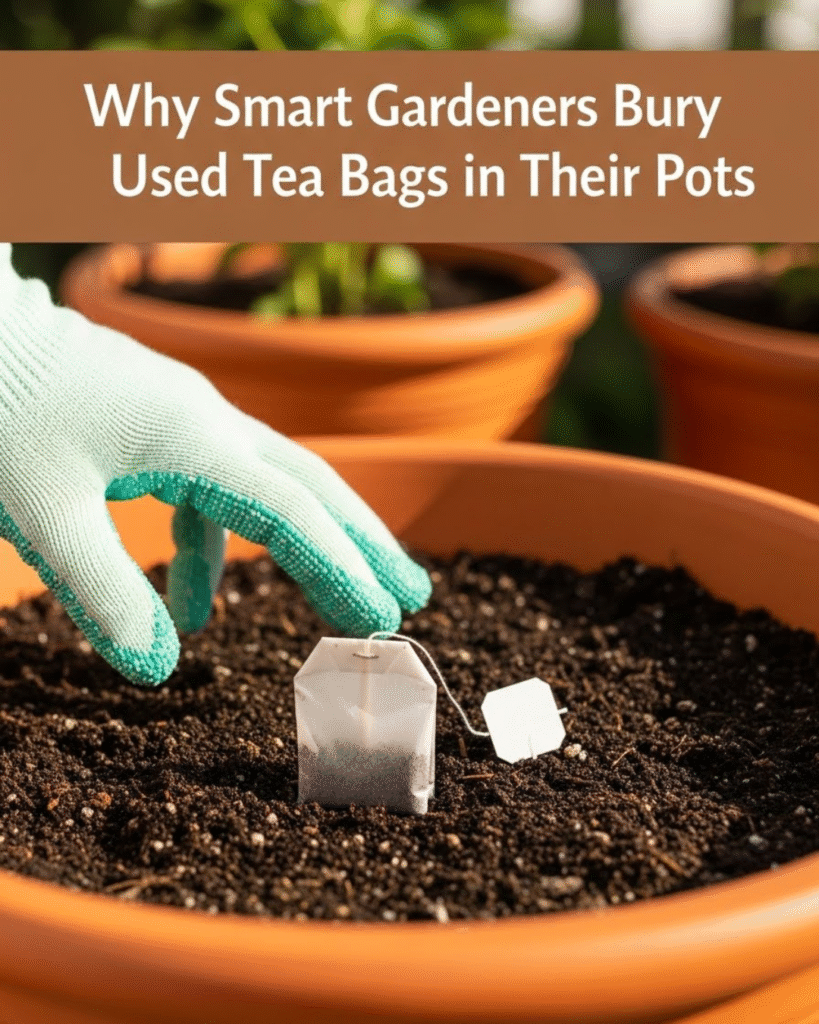
- Timing and Planning Considerations (Actionable Language): This method works best during potting or repotting. When preparing your pot, place 2-3 used tea bags along the bottom layer, just above the drainage material (or soil, if you don’t use a drainage layer).
- Alternative Top-Dressing Method: For already established potted plants, use the step-by-step guidance of a ‘tea bag trench.’ Use a small trowel to carefully dig a shallow trench or hole near the edge of the pot, avoiding the main root ball. Place the contents of the bag (or the entire bag) into the trench and cover lightly with soil.
Step 3: Water and Decomposition
- Watering: Water your plant as usual. The moisture is essential for the decomposition process, which is carried out by beneficial microorganisms in the soil.
- Decomposition (Practical Examples): Over the next few weeks and months, the tea bag will slowly decompose. The paper/fiber provides carbon, and the leaves provide nitrogen, creating humus that slowly feeds the plant. This continuous, gradual progress feeding is gentler than single-dose chemical fertilizers.
🐛 Section 3: Advanced Strategies: Beyond Basic Tea Leaf Benefits
Smart gardeners leverage the used tea bags for more than just simple nutrition. These expert-level insights turn this hack into a powerful soil amendment.
H3: Creative Solutions: Enhancing Soil Structure and Drainage
The paper and fibrous tea leaves offer powerful physical benefits to the soil, especially crucial for potted plants.
- Water Retention: Tea bags, particularly the fibrous material and spent leaves, act like tiny sponges. When mixed into the soil, they help the potting medium retain moisture longer, reducing the frequency of watering. This is a brilliant creative solution for dry-prone pots or during seasonal considerations like hot summers.
- Aeration and Drainage: The decaying fibrous material prevents soil compaction, especially in containers where soil density is a frequent problem. Better soil structure means better oxygen delivery to the roots and improved drainage.
- Encourage Experimentation: Try using two tea bags for every $6 \text{ inches}$ of pot diameter. This simple calculation helps you scale the benefit appropriately for larger containers.
H3: Ways to Customize Approach: The Pest Deterrent Effect
Certain components in tea have been noted to help deter common garden pests.
- The Caffeine Factor: The residual caffeine in the tea leaves can act as a natural deterrent against certain soil-dwelling pests like fungus gnats or slugs. While not a chemical pesticide, it adds a layer of natural defense, improving the overall health of the ecosystem benefits.
- Ways to Customize Approach: If you are dealing with a recurring issue of gnats or general fungus, consider sprinkling the dry contents of the used tea bags (after allowing them to dry completely) directly on top of the potting soil. This provides a fine, light top layer that helps prevent fungal growth and pest eggs from thriving on the moist surface.
🚫 Section 4: Troubleshooting and Common Challenges
Even the most straightforward gardening topics hacks have potential pitfalls. Here are practical troubleshooting tips to ensure your tea bag strategy succeeds.
Featured Snippet Potential: “Can burying tea bags in pots cause mold or attract pests?”
Burying used tea bags in pots can cause mold or attract pests if the tea bags are not fully buried or if the soil is chronically overwatered. Exposed tea leaves on the surface of the soil retain too much moisture and are prone to surface mold or mildew growth. Always ensure the used tea bags are covered with a light layer of soil, and practice appropriate watering techniques to avoid a saturated environment.
Practical Troubleshooting Tips (Gardening Focus)
- Problem: Mold or white fuzz appears on the surface of the soil.
- Obstacle: Tea bag material or tea leaves were left exposed on the soil surface, providing a perfect home for saprophytic fungi.
- Solution: Immediately scrape off the affected area and bury the tea bag deeper in the soil. Preventive Measures: Next time, always ensure at least half an inch of fresh soil covers the tea material. Mold is usually harmless but signals a moisture issue.
- Problem: Ants seem to be nesting near the tea bags.
- Obstacle: Ants are sometimes attracted to sweet tannins or simply the structure of the decaying material.
- Solution: Remove the tea bag and use the alternative approach of making “tea water.” Steep 5-6 used tea bags in a gallon of water overnight and use this as your regular watering source. This delivers the nutrients without leaving solid material for the ants to investigate.
- Problem: Plant seems unhappy after application (rare).
- Obstacle: High caffeine content from a high-caffeine tea (like black tea) or overapplication on a caffeine-sensitive plant.
- Solution: Remove the tea bags. Next time, use milder teas like chamomile or herbal blends. Chamomile is actually known for its calming effect on seedlings! This provides an alternative approach suitable for more delicate plants.
🚀 Section 5: Maximizing Results: Next Level Tea Recycling
You’ve learned why smart gardeners bury used tea bags in their pots. Now, let’s explore maintenance and long-term considerations that turn your tea habit into a powerhouse sustainable lifestyle change.
- Show How to Build Upon Basic Success: Combine tea with coffee grounds. Both provide gentle nitrogen and organic matter. Mix your ground coffee and tea leaves in a small container and use this blend as a top-dressing soil amendment every month. This supercharges your soil’s organic matter content, demonstrating how to build upon basic success through simple addition.
- Maintenance and Long-Term Considerations: Keep a small “Tea Jar” near your kitchen sink to collect the used tea bags. By doing this, you are ensuring a continuous supply of nutrient-rich amendments throughout the season, transforming waste into a valuable resource—a key cost-saving benefit of gardening topics.
- Suggest Complementary Strategies: Use tea to propagate cuttings! Take $2 \text{-} 3$ used tea bags and place them at the bottom of a container before adding potting mix. Plant your cuttings directly into this enriched medium. The mild acid environment is believed to aid in rooting, combining two powerful gardening topics techniques. (Internal Linking Opportunity: Learn about “Best Methods for Propagating Houseplant Cuttings.”)
✅ Conclusion: Your Capability to Master Zero-Waste Gardening
You have now unlocked the simple, yet profound secret of why smart gardeners bury used tea bags in their pots. By recycling your tea, you are nurturing your potted plants with organic matter, improving soil structure, and providing a slow, steady stream of vital nutrients. This small DIY act is a powerful testament to your capability to succeed in zero-waste gardening and deepening your connection with nature.
Embrace this easy, effective, and free gardening topics hack. Your soil will thank you with lush, vibrant growth!
Will you start collecting your used tea bags today to nourish your acid-loving ferns, or will you try the “tea water” alternative for your delicate seedlings?