
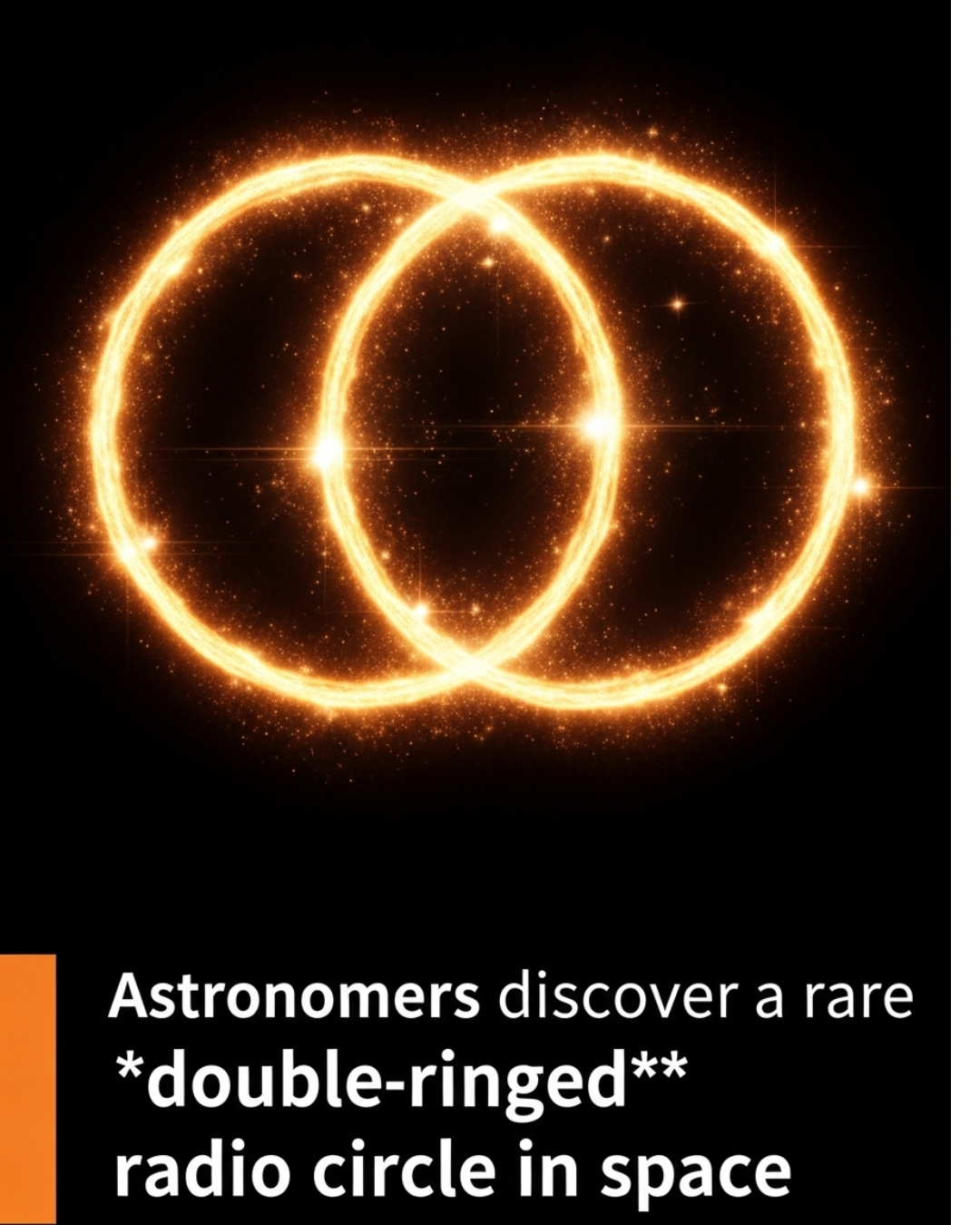
Astronomers have unveiled the detection of an extraordinary celestial phenomenon: a double-ringed odd radio circle, representing only the second such structure ever observed in the cosmic landscape. This unprecedented discovery challenges our understanding of galactic evolution and high-energy astrophysical processes, opening new avenues for investigating the mysterious mechanisms that sculpt the universe’s large-scale architecture.
What Are Odd Radio Circles and Why Do They Matter to Modern Astrophysics?
Odd radio circles, designated ORCs in astronomical nomenclature, constitute a recently identified class of diffuse, circular radio emission structures that appear exclusively at radio wavelengths. First catalogued in 2019 through data acquired by the Australian Square Kilometre Array Pathfinder telescope, these enigmatic formations measure hundreds of thousands of light-years in diameter, dwarfing entire galaxies in their spatial extent.
The fundamental significance of ORCs extends beyond their visual peculiarity. These structures represent potential signatures of previously unrecognized astrophysical processes operating on galactic and intergalactic scales. Unlike supernova remnants, planetary nebulae, or other well-characterized circular radio sources, ORCs exhibit distinctive morphological and spectral properties that defy conventional classification schemas. Their preferential association with massive elliptical galaxies suggests a connection to evolutionary processes in mature galactic systems, potentially involving supermassive black hole activity or cumulative stellar feedback mechanisms.
The rarity of double-ringed configurations amplifies their scientific value exponentially. With fewer than ten confirmed ORCs documented in the literature prior to this discovery, and only one previous instance of concentric ring structures, each new detection provides irreplaceable empirical constraints for theoretical models attempting to explain their formation physics. The double-ringed morphology implies either multiple distinct ejection events separated temporally, or complex interactions between expanding shock fronts and the surrounding intergalactic medium.
How Was This Remarkable Double-Ringed Structure Detected and Characterized?
The identification of this extraordinary double-ringed radio circle emerged through systematic analysis of deep radio survey data, employing advanced signal processing algorithms designed to detect extended, low surface brightness features against the cosmic radio background. Radio interferometric techniques, which synthesize observations from multiple antenna elements to achieve superior angular resolution and sensitivity, proved essential for resolving the intricate structural details characterizing this formation.
The observational methodology involved multi-frequency radio imaging across several gigahertz of bandwidth, enabling spectral analysis that discriminates between various emission mechanisms. Differential spectral indices measured between the inner and outer rings provide critical diagnostic information regarding the physical conditions, magnetic field configurations, and particle acceleration processes operating within each component. Supplementary observations at optical and infrared wavelengths facilitated identification of the host galaxy positioned at the geometric center of the concentric structures.
Advanced data reduction pipelines implemented sophisticated calibration procedures to remove instrumental artifacts and terrestrial radio frequency interference that might mimic or obscure genuine astronomical signals. Three-dimensional visualization techniques reconstructed the spatial distribution of radio emission, revealing the precise morphological characteristics and establishing the concentricity of the dual ring system with unprecedented clarity. Integration times exceeding hundreds of hours accumulated sufficient photon statistics to detect the faint outer ring, which exhibits surface brightness levels approaching the sensitivity thresholds of current-generation radio telescopes.
Which Physical Mechanisms Could Generate Concentric Radio Emission Rings?
Theoretical frameworks proposed to explain ORC formation invoke several competing astrophysical mechanisms, each predicting distinct observational signatures. The double-ringed morphology constrains these models significantly, potentially eliminating scenarios incapable of producing multiple discrete shells.
The galactic wind shock model posits that powerful outflows driven by supermassive black hole accretion or intense starburst activity generate expanding shock waves propagating into the intergalactic medium. These shocks accelerate charged particles to relativistic velocities through diffusive shock acceleration, producing synchrotron radiation as energetic electrons spiral within magnetic fields threading the shocked plasma. Multiple rings could arise from episodic activity cycles in the central engine, with each outburst launching a distinct shock front that subsequently expands and radiates independently.
Alternative hypotheses invoke merger-triggered phenomena, wherein gravitational interactions between colliding galaxies generate complex gas dynamics and shock structures. The coalescence of supermassive black hole binaries during major merger events releases enormous gravitational wave energy, potentially coupling to the surrounding plasma and driving large-scale perturbations. Numerical simulations incorporating detailed magnetohydrodynamic physics demonstrate that such interactions can indeed produce extended radio-emitting structures, though reproducing the observed ring morphologies remains computationally challenging.
More exotic proposals suggest connections to cosmological phenomena, including interactions between galaxies and the intergalactic medium during cosmic structure formation epochs. Forward shocks from ancient starburst-driven superwinds, encountering density discontinuities in the surrounding environment, might generate reflected or transmitted waves that manifest as nested ring structures when viewed in projection. Each theoretical framework makes specific predictions regarding polarization characteristics, spectral energy distributions, and environmental correlations that observational programs can test empirically.
What Does the Host Galaxy Reveal About Formation Conditions?
Comprehensive multi-wavelength characterization of the central galaxy provides essential context for interpreting the double-ringed radio circle phenomenon. Spectroscopic observations yield precise redshift measurements establishing the cosmic epoch during which these structures formed, while stellar population synthesis models constrain the galaxy’s age, mass, and star formation history.
Preliminary analysis indicates the host constitutes a massive elliptical galaxy with stellar mass exceeding several hundred billion solar masses, having completed its primary star formation phase billions of years ago. This quiescent evolutionary state aligns with theoretical expectations for ORC-producing systems, suggesting formation mechanisms linked to late-stage galactic processes rather than ongoing vigorous star formation. Deep optical imaging reveals no obvious morphological disturbances or tidal features that might indicate recent merger activity, though subtle asymmetries detectable only through careful photometric decomposition could preserve evidence of ancient interactions.
Radio continuum observations at higher angular resolution resolve compact nuclear emission consistent with an active galactic nucleus, indicating ongoing supermassive black hole accretion despite the galaxy’s overall quiescence. The luminosity and spectral characteristics of this central component suggest moderate accretion rates insufficient to power the most luminous quasar phenomena, yet capable of driving significant energy injection into the surrounding environment over extended timescales. Correlation between the nuclear activity level and the energetics required to generate the observed radio rings supports scenarios invoking black hole feedback as the primary driving mechanism.
Examination of the galaxy’s large-scale environment through wide-field imaging identifies several companion galaxies within projected distances suggesting potential gravitational interactions. However, spectroscopic confirmation of physical associations versus chance alignments requires additional observations to measure precise three-dimensional positions. Environmental density measurements indicate the system resides in a moderately rich group environment rather than isolation, consistent with statistical trends emerging from the limited sample of known ORCs.
How Do Spectral Properties Constrain the Emission Physics?
Spectral analysis across the radio frequency domain provides powerful diagnostics for discriminating between competing physical models. The spectral energy distribution, characterized by measuring flux densities at multiple wavelengths, encodes information about the particle energy distribution and magnetic field properties pervading the emitting regions.
Both rings exhibit spectral indices consistent with synchrotron radiation from power-law electron distributions, with measured values indicating moderately steep spectra characteristic of aged cosmic ray populations. The inner ring displays a marginally flatter spectrum than its outer counterpart, suggesting either younger particle ages or enhanced reacceleration processes maintaining higher-energy electron populations. These spectral gradients align qualitatively with expectations for expanding shock structures, wherein continuous injection occurs at the leading edge while radiative and adiabatic losses progressively steepen the spectrum in trailing regions.
Spectral curvature measurements at high frequencies probe the maximum energy attained by accelerated electrons, constraining the efficiency of particle acceleration mechanisms and the strength of magnetic fields confining the radiating plasma. Detection of steepening toward millimeter wavelengths would indicate electron energy cutoffs imposed by synchrotron and inverse Compton cooling, enabling estimates of the magnetic field strength through equipartition arguments. Current observational constraints remain insufficient to definitively detect such curvature, motivating future high-frequency campaigns with submillimeter facilities.
Polarization observations provide complementary insights into magnetic field structure and geometry. Linear polarization fractions and position angle distributions map the orientation and degree of order characterizing magnetic fields within the rings. Preliminary polarimetric data suggest partially ordered fields aligned tangentially with respect to the ring boundaries, consistent with magnetic field amplification and ordering through shock compression. The polarization degree varies azimuthally around each ring, potentially reflecting asymmetries in the shock properties or magnetized intergalactic medium through which the structures expand.
What Are the Implications for Understanding Galaxy Evolution?
The discovery of double-ringed radio circles carries profound implications for theories of galaxy evolution and the feedback processes regulating cosmic structure formation. Energetic outflows from active galactic nuclei and stellar populations represent critical mechanisms through which galaxies self-regulate their growth, expelling gas that might otherwise collapse to form new stellar generations.
Quantitative estimates of the energy required to generate such enormous radio structures indicate that cumulative energy injection over timescales of tens to hundreds of millions of years must reach levels comparable to the binding energy of the galaxy’s interstellar medium. This substantial energy budget implies either exceptionally powerful individual outburst events or sustained moderate-level activity integrated over extended periods. Either scenario demands significant coupling efficiency between the central energy source and the surrounding gas, challenging theoretical models of feedback physics that often struggle to achieve such effective energy transfer.
The morphological evidence for multiple discrete episodes encoded in the dual ring structure suggests intermittent rather than continuous activity, consistent with observed variability in active galactic nuclei across cosmic time. This episodic behavior may reflect fundamental accretion physics, wherein thermal-viscous instabilities in accretion disks naturally produce duty cycles alternating between high and low states. Alternatively, merger-driven scenarios inherently predict episodic activity as successive pericentric passages during the orbital decay process trigger transient accretion episodes.
Large-scale simulations of galaxy formation incorporating sophisticated subgrid prescriptions for black hole feedback increasingly recognize the importance of kinetic-mode outflows in regulating massive galaxy evolution. Observational confirmation that such outflows can indeed generate the extended structures predicted theoretically validates key assumptions underpinning these computational frameworks, while simultaneously revealing complexities not captured by simplified parameterizations. The existence of concentric rings demonstrably produced by multiple events challenges single-burst models and demands incorporation of time-dependent feedback histories.
Which Observational Campaigns Will Further Illuminate This Phenomenon?
Comprehensive characterization of this double-ringed radio circle and elucidation of the underlying formation physics require coordinated multi-wavelength and multi-messenger observational campaigns spanning the electromagnetic spectrum and potentially extending to other astrophysical messengers.
Deep X-ray observations with current-generation observatories can detect hot shocked plasma that may permeate the radio-emitting structures, providing independent temperature and density diagnostics. The spatial correlation between X-ray and radio emission would directly test shock-heating scenarios, while spectroscopic measurements of emission line ratios constrain the ionization state and metallicity of the swept-up material. Non-detection of X-ray emission would instead favor models invoking highly efficient particle acceleration with minimal thermal heating, or scenarios wherein the shocked gas has cooled significantly since the initial outburst.
Infrared observations probe cooler gas and dust components potentially associated with the radio structures. Far-infrared and submillimeter photometry can detect molecular gas entrained in outflows or compressed at shock boundaries, while mid-infrared spectroscopy reveals the presence of specific molecular and atomic species through their characteristic emission features. Such measurements constrain the total gas mass affected by the feedback process and assess the potential for triggered star formation in compressed regions.
Spectroscopic campaigns targeting ionized gas emission lines provide kinematic information essential for establishing the three-dimensional geometry and dynamics of the system. Detection of blueshifted or redshifted emission components would confirm the interpretation of expanding structures and enable direct measurement of outflow velocities. Comparison with dynamical models then constrains the energetics and timescales characterizing the phenomenon.
Long-term monitoring programs tracking potential variability in the radio structures or central nucleus over multi-year baselines could detect ongoing evolution, testing predictions that the rings continue expanding and fading as they age. Coordinated observations of additional ORC candidates discovered through ongoing radio surveys will establish whether double-ringed morphologies represent rare variations or a common evolutionary phase, fundamentally shaping our understanding of these mysterious cosmic structures.
How Does This Discovery Fit Within the Broader Context of Radio Astronomy?
The identification of this rare double-ringed radio circle exemplifies the transformative impact of next-generation radio surveys on astrophysical discovery. The proliferation of sensitive, wide-field radio interferometers operating at frequencies optimized for detecting diffuse emission has revolutionized our census of the radio sky, revealing previously unknown classes of objects that challenge conventional taxonomies.
The Australian Square Kilometre Array Pathfinder, MeerKAT in South Africa, and precursor observations for the future Square Kilometre Array have collectively expanded the discovery space for extended radio phenomena by orders of magnitude compared to previous-generation facilities. These instruments combine large collecting areas enabling detection of faint sources with wide fields of view facilitating efficient surveys of substantial sky regions, while advanced correlator systems provide the broad bandwidth essential for spectral characterization.
Odd radio circles represent one among several new classes of radio sources emerging from these surveys, including peculiar transient phenomena, ultra-steep spectrum sources, and exotic morphologies defying straightforward interpretation. Each discovery underscores the incompleteness of our census of the radio universe and the potential for fundamentally new astrophysics lurking within unexplored parameter spaces. The serendipitous nature of many such discoveries emphasizes the importance of unbiased survey strategies complementing targeted observations of known source populations.
Integration of artificial intelligence and machine learning methodologies into data analysis pipelines promises to accelerate the discovery rate by automatically identifying unusual morphologies within vast survey datasets. Convolutional neural networks trained on simulated or previously identified sources can efficiently scan millions of radio images, flagging candidates for human expert verification. Such approaches will prove essential for exploiting the full scientific potential of upcoming surveys that will generate data volumes exceeding traditional analysis capabilities.
The double-ringed radio circle discovery also highlights the synergistic power of multi-wavelength astronomy. While radio observations revealed the extended structures themselves, complementary optical, infrared, and potential X-ray observations provide essential context for physical interpretation. Future facilities spanning the electromagnetic spectrum will enable increasingly comprehensive characterizations of such phenomena, transforming isolated discoveries into systematic investigations of new astrophysical domains.
Conclusion
The announcement of this extraordinary double-ringed odd radio circle marks a significant milestone in observational astrophysics, providing rare empirical evidence for episodic energetic processes operating on galactic scales. With only one previous example of concentric ring structures documented in the astronomical literature, this discovery substantially expands the observational foundation upon which theoretical models must be constructed and tested.
The implications extend across multiple domains of astrophysical inquiry, from the microphysics of particle acceleration in astrophysical shocks to the role of feedback in regulating galaxy evolution across cosmic time. The challenge of explaining how galaxies generate such enormous structures demands sophisticated theoretical frameworks integrating diverse physical processes ranging from black hole accretion dynamics to magnetohydrodynamic shock propagation through magnetized plasma.
Future observational campaigns employing multi-wavelength strategies will progressively refine our understanding of the formation mechanisms, environmental conditions, and evolutionary trajectories characterizing these enigmatic radio circles. Each additional detection and detailed characterization incrementally constrains theoretical parameter spaces, guiding the development of increasingly realistic models capable of reproducing the full complexity of observed phenomenology.
As next-generation radio facilities achieve full operational capability and systematic surveys probe deeper into the radio universe, the discovery rate of odd radio circles and their morphological variants will accelerate dramatically. The double-ringed configuration observed in this latest discovery may represent either a rare evolutionary phase or a common feature detectable only under optimal observational conditions, a question that expanded samples will definitively resolve. Regardless, this discovery reaffirms that the cosmos continues to reveal phenomena that surprise and challenge our theoretical frameworks, driving scientific progress through the iterative interplay between observation and theory that defines the astronomical enterprise.