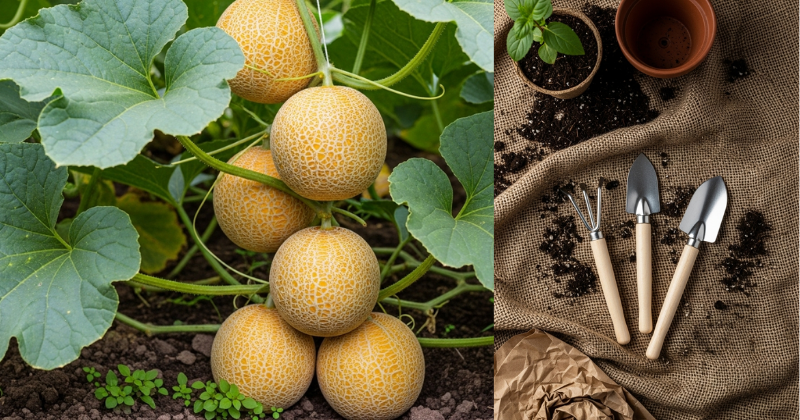
There is nothing quite like slicing into a perfectly ripe, homegrown cantaloupe on a hot summer day—the flavor simply can’t be matched by store-bought fruit. Learning How To Grow Cantaloupe From Seeds is an achievable gardening project that rewards patience with delicious, sun-sweetened bounty. This guide provides step-by-step guidance to transform tiny seeds into sprawling vines laden with fragrant fruit. We will cover seasonal considerations, planting techniques, and effective care methods, empowering you to nurture these heat-loving melons and achieve a fantastic harvest right in your backyard.
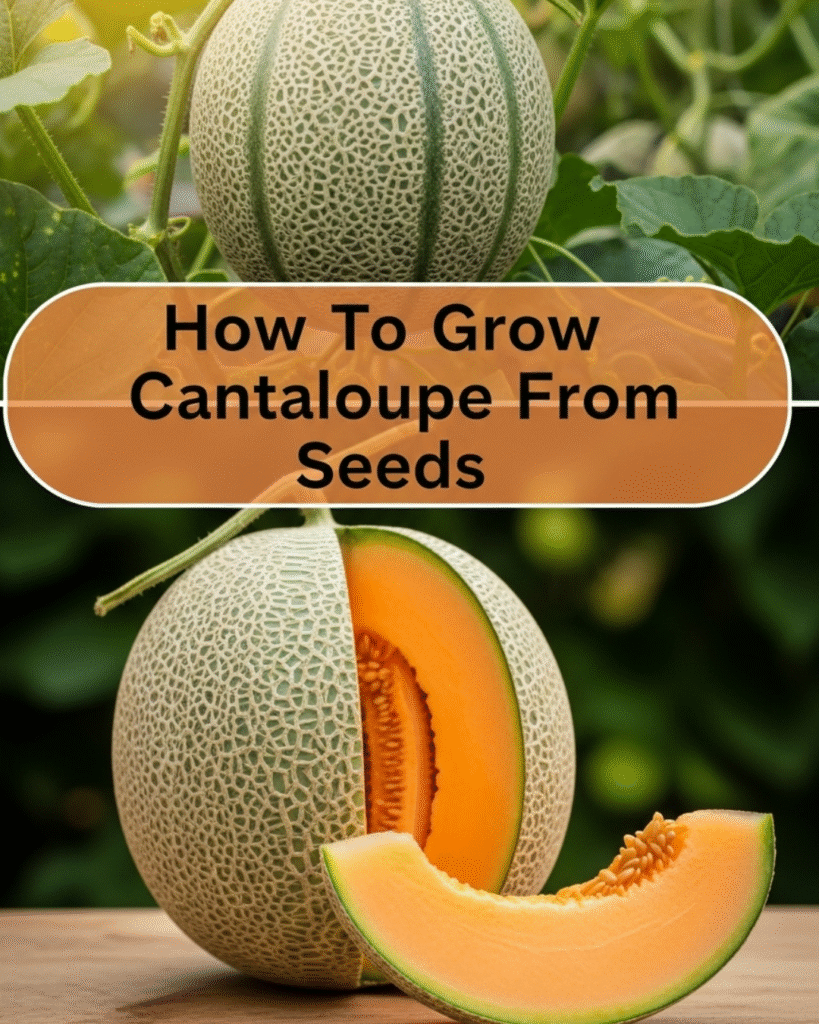
☀️ Foundation First: Understanding Cantaloupe’s Needs
Cantaloupes (Cucumis melo), often called muskmelons, are summer-long growers that demand specific conditions. Getting the fundamentals right will build confidence in your ability to grow these rewarding fruits.
H3: Building Confidence with Basic Concepts: Temperature and Sunlight
Cantaloupes are warm-weather annuals and thrive only when the heat is consistently high.
- Soil Temperature is Key: Cantaloupe seeds require warm soil to germinate and grow successfully. Never sow seeds until all danger of frost has passed, and the soil temperature consistently reaches at least $65^\circ\text{F}$ ($18^\circ\text{C}$). Ideal soil temperature is closer to $70^\circ\text{F}-80^\circ\text{F}$ ($21^\circ\text{C}-26^\circ\text{C}$).
- Sunlight: They are sun worshippers! Cantaloupe vines need at least 6 to 8 hours of direct, intense sunlight daily. Full sun is non-negotiable for producing sweet, high-sugar content fruit.
- Encouraging Reassurance for Beginners: While they require warmth, modern hybrid varieties often have shorter growing seasons, making it possible to grow cantaloupe from seeds even in cooler regional variations.
H3: Addressing Common Concerns: Soil Preparation and Type
Cantaloupes are heavy feeders and require rich, well-draining soil to support their vigorous growth.
- Rich, Organic Matter: Before planting, amend your soil generously with compost or well-rotted manure. This improves drainage and provides the necessary nutrients for nurturing the vines.
- Optimal $\text{pH}$: Cantaloupes prefer a slightly acidic to neutral $\text{pH}$ of $6.0$ to $6.8$. If your soil is very heavy clay, consider growing in raised beds or hills to prevent waterlogging, which is a major cause of melon failure.
🌱 Section 2: Core Methods: Planting Your Cantaloupe Seeds
When it comes to planting, the choice is between direct sowing and starting indoors. The best method often depends on your climate and the length of your warm season.
Step-by-Step Guidance: Direct Sowing vs. Starting Indoors
Direct Sowing (The Preferred Method)
- Timing and Planning Considerations: Wait until the soil is reliably warm (late spring/early summer).
- Prepare Hills (Actionable Language): Prepare planting “hills” about 4 to 6 feet apart. Hills improve drainage and help concentrate nutrients. Mix a spade-full of compost into the center of each hill.
- Sow the Seeds: Plant 4 to 6 seeds about $1$ inch deep in each hill. Actionable language: Cover lightly with soil and water gently.
- Thinning: Once the seedlings develop their first true leaves (about $10$ days later), thin the group down to the 2 or 3 strongest plants per hill.
Starting Seeds Indoors (For Shorter Seasons)
- When to Start: Begin $3-4$ weeks before your last expected frost date. Melons transplant poorly, so timing is critical.
- Use Peat Pots (Practical Tip): Sow 2 seeds per peat pot or biodegradable pot. Peat pots can be planted directly into the ground, eliminating transplant shock, a useful practical tip.
- Transplanting: Harden off the seedlings over a week, and transplant them to the garden (still in their biodegradable pots) only when the outside night temperatures are above $55^\circ\text{F}$ ($13^\circ\text{C}$).
H4: Seed Saving and Variety Selection
- Heirloom vs. Hybrid: If you want to save seeds for next year, use heirloom (open-pollinated) varieties. Hybrid seeds (F1) won’t reliably produce true-to-type fruit. Look for varieties suited to your regional variations (e.g., ‘Hale’s Best Jumbo’ is popular for its hardiness).
💧 Section 3: Advanced Strategies: Watering, Feeding, and Training
Once your seedlings are established, proper care for cantaloupe focuses on consistent moisture and ensuring successful pollination for abundant fruit set.
H3: The Importance of Consistent Watering
Cantaloupe vines require a lot of water throughout the growing season, particularly during the flowering and fruiting stages.
- Deep Watering: Water deeply and regularly (1 to 2 inches per week), especially during dry spells. Focus water at the base of the plant; avoid wetting the leaves, which can lead to fungal diseases.
- The Crucial Cutback: Pro Tip: About one week before the expected harvest, cut back on watering. This creative solution concentrates the sugars in the fruit, resulting in a significantly sweeter cantaloupe.
H3: Effective Feeding and Trellising Techniques
- Feeding: Cantaloupe needs high nitrogen early on for vine growth, and then higher potassium and phosphorus for fruit development. Apply a balanced fertilizer (e.g., 10-10-10) when planting, and switch to a high-potassium fertilizer (low N) once the fruits begin to set.
- Trellising (Creative Solutions): Melons sprawl, which takes up a lot of space. Ways to customize approach: If you have limited space, train the vines up a strong trellis or fence. Once the fruits develop, support them with slings made from old pantyhose or fabric strips to prevent the weight from breaking the vine.
🐛 Section 4: Troubleshooting and Common Challenges
Melons can face issues, primarily from pests and diseases that thrive in warm, humid conditions. Knowing the solutions ensures you can nurture your crop to maturity.
Featured Snippet Potential: “When is the best time to harvest a homegrown cantaloupe?”
The best time to harvest a homegrown cantaloupe is when the stem easily separates from the vine with gentle pressure, known as ‘full slip.’ The melon should also have a distinct, sweet, musky aroma and its netting (the webbed pattern on the skin) should be well-defined. Avoid harvesting if the stem requires forceful cutting, as this means the melon is not fully ripe.
Practical Troubleshooting Tips (Gardening Focus)
- Problem: Lots of flowers, but no fruit (or tiny fruit that drops).
- Obstacle: Lack of pollination. The first flowers are usually male and will drop naturally. Fruit is set by female flowers, which need bees.
- Solution: Alternative approaches: Hand-pollinate! Use a small paintbrush or cotton swab to gently collect yellow pollen from the male flowers (which grow on long, thin stalks) and transfer it to the sticky center of the female flowers (which have a tiny melon swelling at the base). This encourages ecosystem benefits even when nature falls short.
- Problem: Powdery Mildew: White, dusty patches on the leaves.
- Obstacle: Common in high humidity and when leaves stay wet.
- Solution: Preventive measures: Water at the base of the plant, not over the leaves. If mildew appears, apply an organic fungicide or a mixture of 1 teaspoon baking soda and 1 quart of water with a few drops of dish soap.
🚀 Section 5: Maximizing Results: The Sweetness Factor and Next Steps
Once you master how to grow cantaloupe from seeds, the focus shifts to ensuring every melon tastes as sweet as possible.
- The Power of Heat and Sugar: The sweetness of your cantaloupe is directly correlated with the amount of sunlight and heat it receives during the final ripening stage. Maximize sun exposure (using reflective mulch is a next level tip) and follow the watering cutback rule (Section 3) to concentrate sugars.
- Maintenance and Long-Term Considerations: After harvest, remove old vines immediately. This prevents the spread of disease spores and clears the area. Melons thrive in crop rotation; plant them in a new location next year to prevent soil-borne diseases. (Internal Linking Opportunity: Learn about “The Benefits of Crop Rotation for Vegetable Gardens.”)
- Inspire Continued Growth and Learning: Don’t stop at cantaloupe! The achievable principles learned here apply to other cucurbits. Try growing watermelons or honeydew next year.
✅ Conclusion: Your Capability to Harvest Sweet Melons
You are now fully equipped with the knowledge on How To Grow Cantaloupe From Seeds, mastering the essential steps from ensuring warm soil to perfecting the crucial harvest moment. By remembering to plant deep, water consistently, and cut back on water before the ‘full slip,’ you transform a small seed into a bountiful harvest.
Embrace the delicious reward of these sweet, fragrant melons. Your capability to succeed in nurturing a successful cantaloupe crop is clear.
Will you start your cantaloupe seeds early indoors in biodegradable pots, or will you wait for the soil to warm up for a direct-sow into prepared planting hills?