
Struggling with shin splints, knee pain, or feeling wiped out after every run—even though you’re putting in the miles? The problem is rarely your fitness level. It’s almost always your running form. Poor technique wastes energy, puts extra stress on joints, and turns enjoyable runs into painful ordeals. The great news? You can perfect your running form in just a few weeks with simple, no-equipment drills that fit into any healthy lifestyle.
Good running form isn’t about looking pretty—it’s about efficiency, injury prevention, and faster times. Runners who improve their form often cut their injury risk by up to 50 % and shave minutes off their pace without running harder. This guide gives you the exact science, the seven most important fixes, step-by-step drills, common mistakes to avoid, and an easy weekly plan that builds on the daily walking habit and stomach-care routines we’ve already covered. Start today and you’ll feel lighter, stronger, and more energized on every run.
Why Running Form Matters More Than Most People Realize
Your body is designed to run efficiently when aligned properly. Bad form forces muscles to work harder, increases impact forces on joints, and wastes oxygen. A 2023 study in the British Journal of Sports Medicine found that runners with optimized form use 4–8 % less energy at the same pace. That extra energy can mean longer runs, faster finishes, or simply feeling better afterward.
Perfect form also protects your knees, hips, and lower back—the areas that take the biggest beating when posture collapses. Plus, better mechanics improve breathing, reduce side stitches, and help you recover faster so you can stay consistent with your healthy lifestyle goals.
The Science in Simple Terms
Running form affects three key things: ground reaction force (how hard you hit the ground), stride efficiency, and muscle recruitment. When your posture is tall and your foot lands under your hips, impact forces drop and your glutes and core do more of the work instead of your quads and calves. Cadence (steps per minute) around 170–180 reduces over-striding, while relaxed shoulders and a slight forward lean from the ankles (not the waist) keep you moving forward instead of bouncing up and down.
These changes happen quickly because your nervous system learns new movement patterns through repetition—exactly like the daily walking habit that already improves your posture and circulation.
7 Key Elements of Perfect Running Form
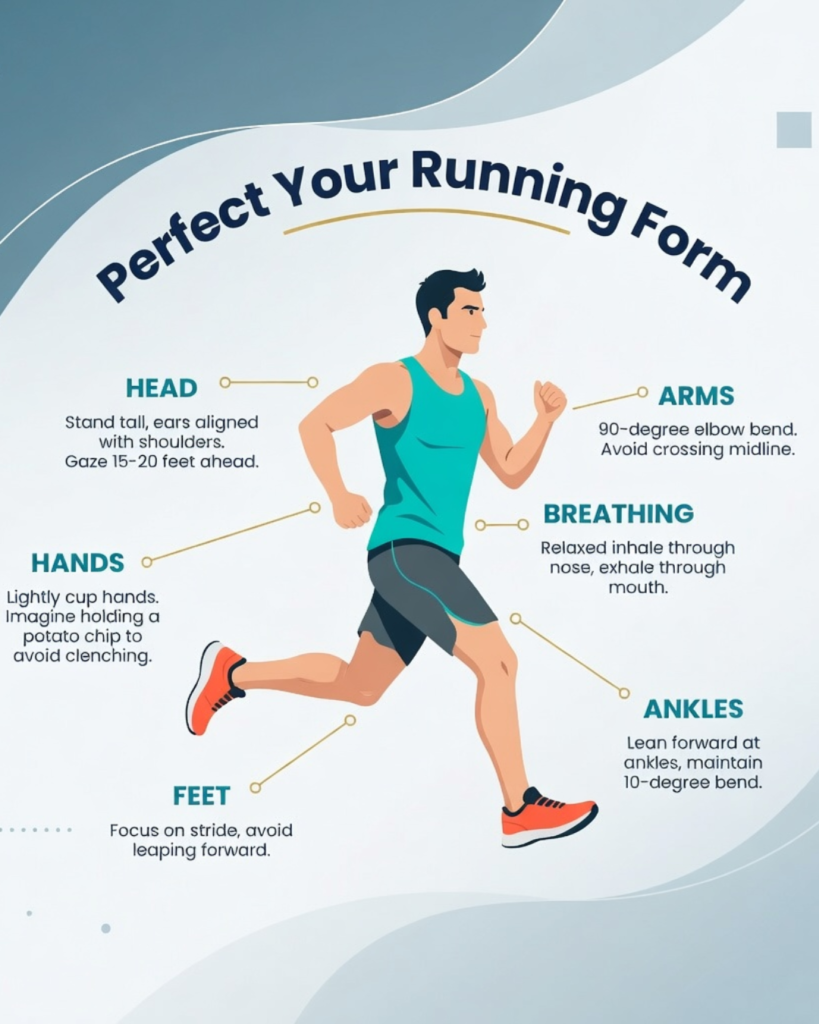
- Tall Posture Imagine a string pulling the top of your head toward the sky. Keep your chest open, shoulders relaxed and down, and gaze 10–20 feet ahead. This prevents slouching that compresses your lungs and strains your lower back.
- Slight Forward Lean Lean from your ankles—not your waist—so your body is in a straight line from ear to ankle. This uses gravity to propel you forward instead of pushing against it.
- Relaxed Shoulders and Arms Keep shoulders low and swing your arms forward and back (not across your body) at about 90-degree angles. Relaxed hands (imagine holding a butterfly) reduce tension that travels all the way to your legs.
- Quick Cadence Aim for 170–180 steps per minute. Shorter, quicker steps reduce braking forces and over-striding. Count for 30 seconds and multiply by 4 to check your cadence.
- Mid-Foot Strike Under Hips Land with your foot directly under your hips, not out in front. A gentle mid-foot or forefoot landing (not heel-striking) absorbs shock better and engages your glutes and calves naturally.
- Engaged Core Keep a light brace in your core—like you’re about to get lightly punched in the stomach. This stabilizes your pelvis and prevents excessive side-to-side rocking.
- Relaxed Face and Jaw Tension in your face travels down your body. Keep your jaw soft and breathe rhythmically through your nose and mouth.
Step-by-Step Drills to Perfect Your Running Form
Do these drills 2–3 times per week for 10–15 minutes after an easy warm-up walk or jog. They take almost no extra time and deliver fast results.
- Posture Walk (5 minutes) Walk tall with exaggerated good posture while swinging arms. Focus on the string-from-the-head feeling. Then transition to a light jog while holding that posture.
- High-Knee March (3 minutes) March in place lifting knees to hip height. This teaches quick foot turnover and upright posture. Add a light jog forward after 30 seconds.
- Butt Kicks (2 minutes) Jog forward while kicking heels toward your glutes. This improves hamstring activation and quick cadence.
- Cadence Drill Run for 1 minute while counting steps (aim for 85–90 per foot). Rest 30 seconds and repeat 4 times. Use a free metronome app set to 170–180 beats per minute.
- Single-Leg Balance Hops (3 minutes) Stand on one foot and hop gently in place for 20 seconds per side. This strengthens the stabilizing muscles that keep your form clean.
- Wall Lean Drill Stand facing a wall, lean forward from ankles until you feel the correct running lean, then jog in place for 30 seconds. Feel the difference?
Common Mistakes That Ruin Running Form (And Easy Fixes)
- Over-striding → Fix: Shorten your stride and focus on landing under hips.
- Heel striking hard → Fix: Think “light feet” and increase cadence.
- Slouching or looking down → Fix: Gaze ahead and imagine the string on your head.
- Tense shoulders or clenched fists → Fix: Shake arms out every few minutes and relax hands.
- Bouncing too much vertically → Fix: Lean slightly forward from ankles and keep steps quick.
- Running with arms crossing the body → Fix: Swing arms straight forward and back like pistons.
Film yourself running sideways on your phone once a week. You’ll see improvements almost immediately.
How to Incorporate Perfect Form Into Your Healthy Lifestyle
Start with 1–2 short runs per week focusing only on form—no speed or distance goals. Combine with your daily one-hour walk to build posture and cadence naturally. Use the stomach-care timing rules: run after an early lunch so digestion is calm. Finish with your magnesium lotion on calves and feet to speed recovery and prevent tightness. The same ginger tea that settles your stomach before runs also reduces inflammation afterward.
Track your runs in a simple notes app: note how your body feels and any pain. Most runners see fewer aches and better energy within 10–14 days.
Conclusion
Perfecting your running form is one of the smartest investments you can make in your health. With tall posture, quick cadence, mid-foot landing, and relaxed arms, you’ll run farther, faster, and with far less pain—while protecting the healthy lifestyle you’ve built with daily walks, better meal timing, stomach-soothing foods, and natural remedies like magnesium lotion.
Start small this week: film one run, practice the posture walk drill twice, and focus on cadence during your next easy jog. The changes feel subtle at first but add up quickly. Your knees, hips, and lungs will thank you, and you’ll finally enjoy running the way it’s meant to feel—light, powerful, and free.
You already have the foundation. Now give your body the efficient form it was designed for. Lace up, stay tall, and run happy—one perfect step at a time.