Meta Description: Explore preclinical research on melittin peptides and their targeted activity against breast cancer cells, including mechanisms, laboratory findings, and therapeutic potential.
Breast cancer remains one of the most extensively studied cancers worldwide, and researchers are continuously exploring new molecular strategies to target tumor cells more precisely. Among emerging bioactive compounds, melittin peptides, derived from bee venom, have gained scientific attention for their potent biological activity in preclinical settings.
The preclinical evaluation of melittin peptides for targeted activity against breast cancer cells focuses on understanding how this small peptide interacts with cancer cell membranes, induces cytotoxic effects, and may be engineered for selective targeting.
In this article, we explore the mechanisms, laboratory evidence, challenges, and future perspectives of melittin-based research in oncology.
Understanding Melittin Peptides
Melittin is the principal active component of bee venom (Apis mellifera). It is a small, amphipathic peptide composed of 26 amino acids.
Key properties of melittin
- Strong membrane-disrupting ability
- High biological activity at low concentrations
- Ability to interact with lipid bilayers
Why it is studied in cancer research
Melittin can:
- Disrupt cancer cell membranes
- Trigger apoptosis (programmed cell death)
- Interfere with cellular signaling pathways
Featured Snippet: What is melittin’s role in breast cancer research?
Melittin is a bee venom-derived peptide studied in preclinical research for its ability to disrupt cancer cell membranes and induce cell death, showing potential targeted activity against breast cancer cells in laboratory models.
Mechanisms of Action Against Breast Cancer Cells
Research suggests multiple biological mechanisms through which melittin may affect tumor cells.
1. Membrane disruption
Melittin integrates into lipid membranes and forms pores.
Effects
- Loss of membrane integrity
- Leakage of cellular contents
- Rapid cell death in vitro
2. Induction of apoptosis
Melittin can activate programmed cell death pathways.
Key pathways involved
- Caspase activation
- Mitochondrial dysfunction
- DNA fragmentation
3. Inhibition of cancer cell proliferation
Studies show melittin may:
- Slow cell division
- Disrupt signaling pathways involved in growth
4. Anti-inflammatory signaling effects
Chronic inflammation is linked to cancer progression.
Melittin may influence:
- NF-κB signaling
- Cytokine expression
Preclinical Evidence in Breast Cancer Models
1. In vitro studies
Laboratory experiments using breast cancer cell lines have shown:
- Reduced viability of cancer cells
- Dose-dependent cytotoxic effects
- Selective sensitivity in certain tumor types
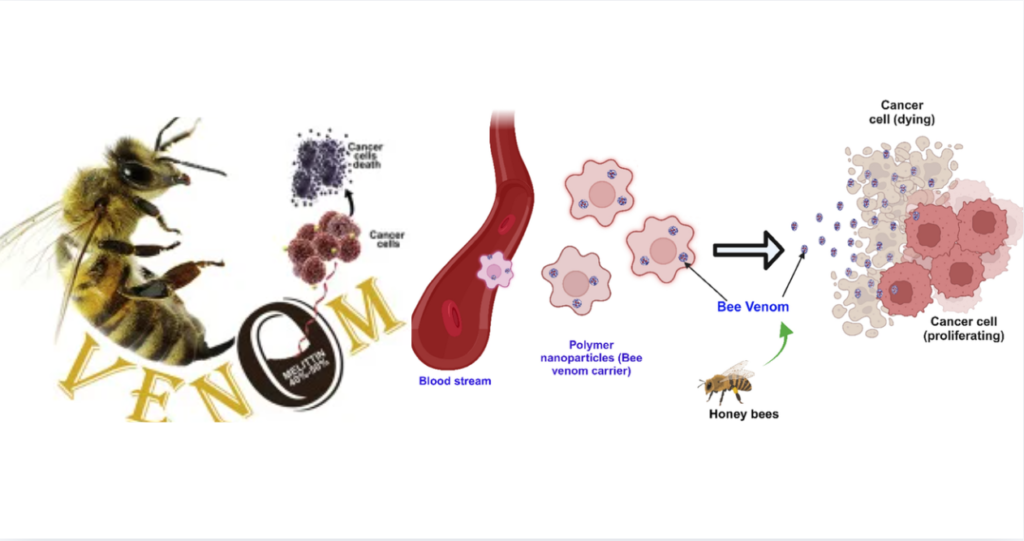
2. Nanoparticle delivery systems
To reduce toxicity to healthy cells, researchers explore:
- Liposomal melittin
- Nanoparticle conjugates
- Targeted delivery systems
3. Animal model studies
Early-stage studies in animals aim to evaluate:
- Tumor size reduction
- Systemic toxicity
- Target specificity
Featured Snippet: Is melittin safe for cancer treatment?
Melittin shows strong anticancer activity in laboratory studies, but it is toxic to normal cells as well, so current research focuses on targeted delivery systems to improve safety before any clinical use.
Challenges in Using Melittin as a Therapeutic Agent
Despite promising results, several limitations exist.
1. High toxicity to normal cells
Melittin is not selective in its natural form and can damage healthy tissues.
2. Delivery challenges
Without modification, melittin:
- Degrades quickly in the body
- Lacks tumor specificity
3. Risk of systemic side effects
Potential issues include:
- Hemolysis (red blood cell destruction)
- Inflammatory reactions
4. Need for clinical validation
Most evidence remains:
- Preclinical (cell and animal studies)
- Not yet confirmed in large human trials
Advanced Strategies in Melittin Research
1. Targeted drug delivery systems
Researchers are developing:
- Antibody-linked melittin
- Tumor-specific peptides
- Nanocarriers
These aim to reduce toxicity while improving precision.
2. Combination therapy approaches
Melittin may be studied alongside:
- Chemotherapy agents
- Immunotherapy drugs
- Radiation therapy
3. Genetic and molecular targeting
New research explores targeting tumor-specific markers to improve selectivity.
Biological Rationale for Cancer Targeting
Cancer cells differ from normal cells in several ways:
- Altered membrane composition
- Increased metabolic activity
- Abnormal signaling pathways
Melittin’s ability to disrupt membranes makes it particularly interesting in this context.
Internal Linking Opportunities
This topic connects well with:
- Cancer cell biology and apoptosis mechanisms
- Targeted drug delivery systems
- Natural compounds in oncology research
- Membrane biology and peptide therapeutics
- Experimental cancer therapies and preclinical studies
Conclusion
The preclinical evaluation of melittin peptides for targeted activity against breast cancer cells highlights an exciting area of biomedical research. Laboratory studies suggest that melittin has strong anticancer potential due to its ability to disrupt cancer cell membranes and trigger cell death pathways.
However, its natural toxicity to healthy cells presents a major challenge, making targeted delivery systems essential for future development. While promising, melittin-based therapies remain in the experimental stage and require further research before any clinical application.
As science advances, this peptide may contribute to the development of more precise and effective cancer treatment strategies in the future.