Meta Description: Discover how human hearing works from sound waves entering the ear to neural perception in the brain. Learn the science of auditory processing and sound interpretation.
Human hearing is one of the most sophisticated sensory systems in the body. It allows us to interpret sound, communicate, recognize danger, and experience music and language. But behind this effortless experience lies a highly complex process that transforms sound waves into neural signals interpreted by the brain.
Understanding human hearing from sound waves to neural perception helps explain not only how we hear, but also why hearing loss occurs and how the auditory system processes information in real time.
In this article, we’ll explore the anatomy of the ear, the physics of sound, and how the brain turns vibrations into meaningful perception.
How Human Hearing Begins: The Nature of Sound Waves
Sound is a mechanical vibration that travels through a medium such as air, water, or solids.
Key properties of sound waves
- Frequency (pitch)
- Amplitude (loudness)
- Wavelength
- Speed of transmission
How sound travels to the ear
- Vibrations in air create sound waves
- Waves enter the outer ear
- They are funneled toward the eardrum
Featured Snippet: How does human hearing work?
Human hearing works by converting sound waves into mechanical vibrations in the ear, which are then transformed into electrical signals by the cochlea and interpreted by the brain as sound.
The Anatomy of the Human Ear
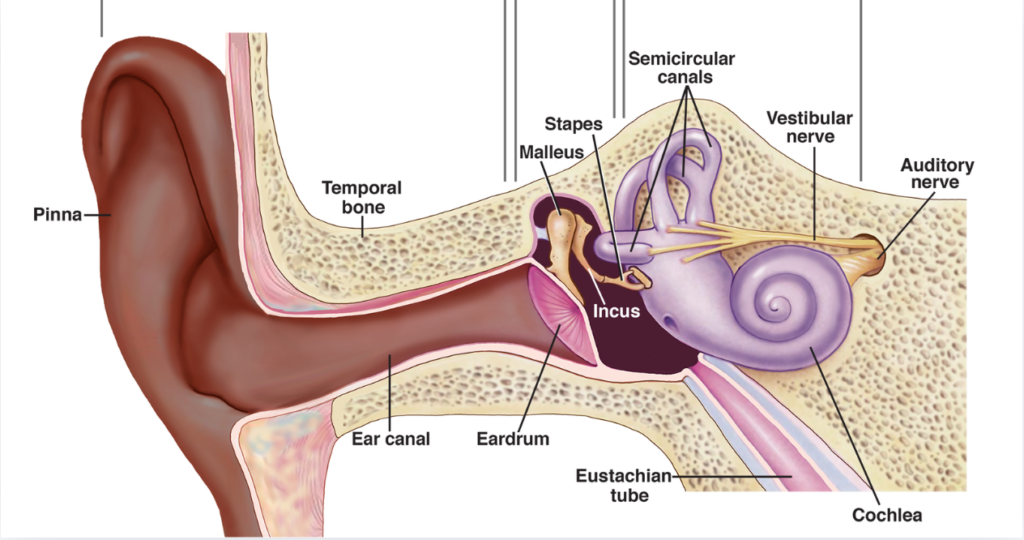
The ear is divided into three main parts, each playing a crucial role in hearing.
1. Outer ear: Capturing sound
Components
- Pinna (external ear)
- Ear canal
Function
- Collects sound waves
- Directs them inward toward the eardrum
2. Middle ear: Amplifying vibrations
Components
- Eardrum (tympanic membrane)
- Ossicles (tiny bones: malleus, incus, stapes)
Function
- Converts sound waves into mechanical vibrations
- Amplifies sound energy
3. Inner ear: Converting sound into neural signals
Key structure: the cochlea
- Spiral-shaped organ filled with fluid
- Contains hair cells that detect vibration
How Sound Becomes a Neural Signal
This is where hearing becomes electrical and neurological.
Step 1: Vibration of the eardrum
Sound waves cause the eardrum to vibrate.
Step 2: Movement of ossicles
The tiny bones amplify vibrations and transmit them to the cochlea.
Step 3: Fluid motion in the cochlea
- Vibrations move fluid inside the cochlea
- This stimulates sensory hair cells
Step 4: Conversion into electrical signals
Hair cells convert mechanical energy into electrical impulses.
Step 5: Transmission to the brain
Signals travel via the auditory nerve to the brainstem and auditory cortex.
Neural Perception of Sound in the Brain
The brain is where hearing becomes meaningful.
1. Auditory cortex processing
Located in the temporal lobe, it interprets:
- Pitch
- Volume
- Rhythm
2. Sound recognition
The brain identifies:
- Speech
- Music
- Environmental sounds
3. Sound localization
The brain determines where sound comes from using:
- Time differences
- Intensity differences
Featured Snippet: Where is sound processed in the brain?
Sound is processed in the auditory cortex of the temporal lobe, where neural signals from the auditory nerve are interpreted as recognizable sounds such as speech, music, and environmental noise.
The Role of Frequency and Pitch Perception
Different parts of the cochlea respond to different sound frequencies.
High vs low frequencies
- High frequencies: detected at the base of the cochlea
- Low frequencies: detected at the apex
Hearing and the Brain: Beyond Simple Sound Detection
Hearing is not passive—it is an active interpretation process.
1. Pattern recognition
The brain recognizes familiar sound patterns like:
- Language
- Music melodies
- Voices
2. Emotional processing
Sounds can trigger emotional responses via the limbic system.
3. Memory association
Certain sounds can activate memories instantly.
Step-by-Step: Summary of the Hearing Process
Step 1: Sound wave enters the ear
Captured by the outer ear.
Step 2: Mechanical transmission
Eardrum and ossicles amplify vibrations.
Step 3: Inner ear conversion
Cochlea transforms vibrations into electrical signals.
Step 4: Neural transmission
Signals travel through the auditory nerve.
Step 5: Brain interpretation
Auditory cortex decodes and assigns meaning.
Advanced Insights into Auditory Processing
1. Neural plasticity in hearing
The brain can adapt to changes in hearing ability.
2. Binaural hearing
Two ears allow:
- Directional sound detection
- Improved clarity in noisy environments
3. Auditory filtering
The brain filters irrelevant noise to focus on important sounds.
Common Hearing Problems
1. Conductive hearing loss
Caused by problems in the outer or middle ear.
2. Sensorineural hearing loss
Due to damage in the cochlea or auditory nerve.
3. Tinnitus
Perception of ringing or noise without external sound.
Internal Linking Opportunities
This topic connects well with:
- Nervous system and sensory perception
- Brain function and neural processing
- Anatomy of the ear and sensory organs
- Hearing disorders and auditory health
- Cognitive neuroscience and perception
Conclusion
Understanding human hearing from sound waves to neural perception reveals just how complex and remarkable the auditory system truly is. What begins as simple vibrations in the air becomes rich, meaningful perception in the brain through a finely tuned biological process.
From the outer ear capturing sound to the cochlea converting vibrations into electrical signals and the brain interpreting them as speech, music, or environmental cues, every step is essential for hearing.
This seamless integration between physics, biology, and neuroscience allows us to experience the world through sound—one of the most powerful human senses.