
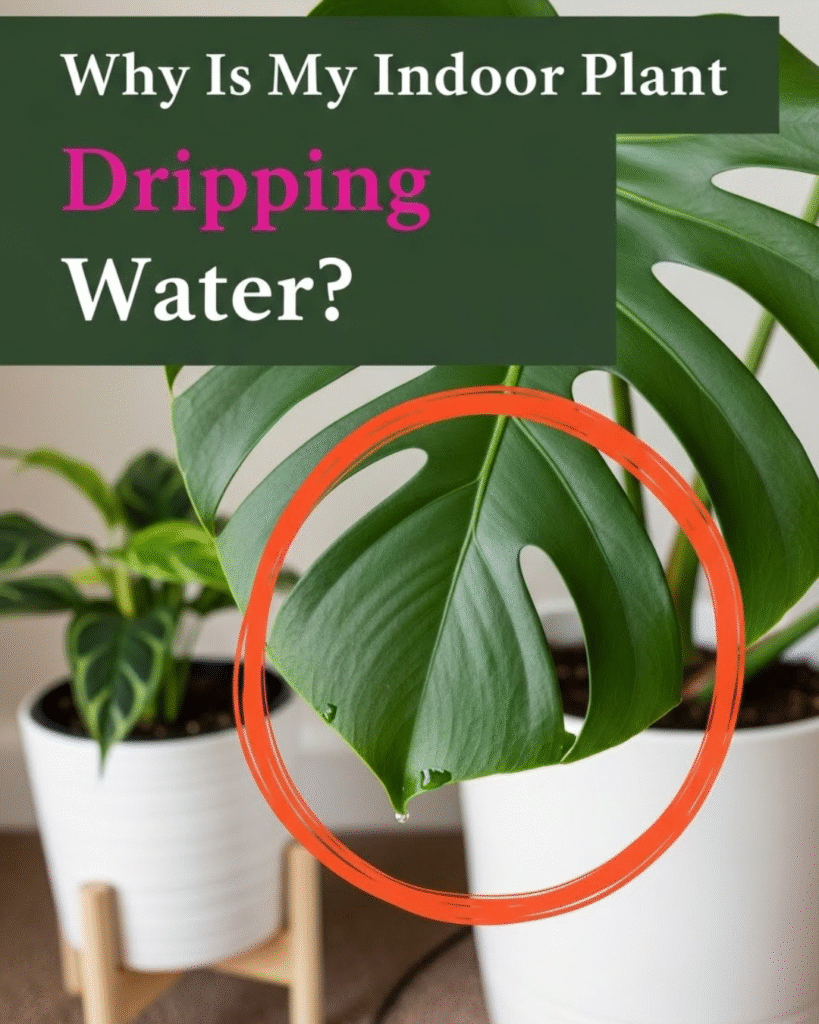
Have you ever walked past your beautiful fiddle-leaf fig or glossy philodendron in the morning and noticed tiny, clear drops of liquid glistening on the tips or edges of the leaves? Before you panic and wonder why is my indoor plant, dripping water, take a deep breath! This phenomenon, known as guttation, is usually a sign that your plant is healthy and actively doing its job. However, it can also be a helpful signal that your watering habits or environment need minor adjustments. This comprehensive guide will help you discover the science behind this watery mystery, empower you to transform your plant care routine, and provide achievable gardening topics solutions to stop the dripping without harming your green friend.
🔬 Section 1: Foundation First: The Science Behind Guttation
To confidently answer why is my indoor plant, dripping water, we must first build confidence with basic concepts about plant hydraulics and the difference between two common terms: guttation and condensation.
H3: Building Confidence with Basic Concepts: Guttation vs. Condensation
It’s easy to mistake a droplet of water for morning dew or condensation, but they are fundamentally different.
- Guttation: This is an active process where the plant exudes excess water through specialized pores called hydathodes, usually found along the leaf margins or tips. The liquid is often not pure water; it can contain sugars, salts, and minerals that the plant is actively pushing out.
- Condensation (Dew): This is a passive process where moisture from the air collects on the cool surface of the leaf. This water is pure and collects anywhere on the leaf, not just the margins.
- Encouraging Reassurance for Beginners: Guttation is proof that your plant’s root system is healthy and successfully absorbing water and nutrients. It’s a good sign that your plant is thriving!
H3: Addressing Common Concerns: The Role of Root Pressure
The real answer to why is my indoor plant, dripping water lies in a process called root pressure.
- The Mechanism: During the day, plants use transpiration (evaporation through leaves) to move water upwards. At night or in humid indoor environments, transpiration slows down significantly or stops. However, the roots continue to absorb water from the well-watered soil.
- The Result: This continuous absorption builds up pressure within the plant’s vascular system (the xylem). When the pressure gets high enough and there’s nowhere for the water vapor to escape (low transpiration), the plant forces the liquid water out through the hydathodes, resulting in the visible droplets.
💧 Section 2: Core Methods: Identifying and Adjusting the Cause
Guttation is a symptom of high root pressure, which is nearly always caused by an imbalance in the plant’s environment or watering schedule. This step-by-step guidance helps you target the imbalance.
Step 1: Evaluating Your Watering Schedule (Actionable Language)
The number one reason my indoor plant, dripping water is due to the soil being overly saturated when the plant isn’t actively transpiring.
- Water in the Morning: Practical Tips: If you water late in the day or at night, the plant has no time to use the water through transpiration before the process naturally shuts down overnight, leading to a build-up of root pressure. Shift your watering to the early morning hours.
- Check Soil Moisture: Before watering, always check the soil moisture $2 \text{ inches}$ deep (or use a moisture meter). If the soil is still moist, wait. Timing and planning considerations: Overwatering is the most common killer of houseplants; guttation is an early warning sign.
- Ensure Drainage: Make sure your pot has functional drainage holes and that water is never left standing in the decorative saucer for more than $30 \text{ minutes}$.
Step 2: Controlling Light and Temperature
Indoor environments, especially during certain seasonal considerations, can dramatically affect the plant’s ability to use water.
- Boost Light/Temperature: Transpiration increases with light and temperature. If the plant is guttating heavily, it may need to be moved to a brighter spot during the day to encourage the use of that excess water.
- Avoid Cold Drafts: Sudden drops in temperature can shock the plant and slow down its metabolism, leading to a backlog of water in the roots.
🧂 Section 3: Advanced Strategies: Guttation as a Warning Signal
While guttation is natural, the composition of the drops can reveal underlying issues with your feeding routine. Expert-level insights are necessary here.
H3: Creative Solutions: Mineral Burn and Fertilization
If the droplets dry to leave white, crusty marks on the leaves, this is a signal that the plant is excreting excess salts and minerals.
- The Issue: Commercial fertilizers contain salts that plants absorb. When the plant pushes out excess water through guttation, it pushes out these salts too. If the salt residue is excessive, it can build up and potentially burn the leaf margins.
- The Solution (The Flushing Technique): Every $4 \text{-} 6$ months, give your plant a “leaching” or flushing rinse. Pour a large volume of pure water (about four times the volume of the pot) slowly through the soil to dissolve and wash away built-up salts. This is a crucial preventive measure against mineral burn and an effective creative solution for addressing why is my indoor plant, dripping water due to mineral overload.
H3: Ways to Customize Approach: Adjusting Fertilizer Strength
You can directly address the salt overload by modifying your feeding habits.
- Dilute More: If you notice consistent salt residue, dilute your liquid fertilizer to half or even quarter strength, especially during seasonal considerations when light is low (winter). You can always feed more frequently at a lower dose.
- Use Slow-Release Fertilizers: These fertilizers provide a steady, lower dose of nutrients over a longer period, preventing the sudden “feast” of salts that often leads to heavy guttation and residue. This allows you to customize approach to a more consistent feeding schedule.
⚠️ Section 4: Troubleshooting and Common Challenges
Understanding the difference between harmless guttation and problematic moisture is key to successful gardening topics and plant care.
Featured Snippet Potential: “Is the liquid dripping from my houseplant dangerous or poisonous?”
The liquid dripping from a houseplant due to guttation is generally not poisonous to touch, but it is often slightly sticky and can contain salts and minerals. In certain toxic plant families (like Dieffenbachia or Philodendron), the guttation fluid may contain trace amounts of the plant’s irritants (calcium oxalate crystals). While the quantity is usually low, it’s a good practice to wipe it off if you have pets or small children, especially on known toxic species. It is primarily an issue for floors and furniture, as the mineral-heavy drops can leave stains.
Practical Troubleshooting Tips (Gardening Focus)
- Problem: Guttation liquid is sticky and attracts dust.
- Obstacle: The liquid is rich in plant-exuded sugars and minerals, making it sticky.
- Solution: Practical Troubleshooting Tips: The first step is to reduce the root pressure (water less frequently and shift watering time). Second, gently wipe the leaves with a damp cloth to remove the sticky residue before it dries and attracts mold or dust.
- Problem: The plant only drips after fertilization.
- Obstacle: The plant has an immediate, strong reaction to the higher concentration of salts/nutrients.
- Solution: Encouragement for Setbacks: This is a clear sign you should immediately dilute your fertilizer by 50% or more. Consider switching to a brand with lower salt index.
- Problem: The leaves are also turning yellow and mushy.
- Obstacle: This is not just guttation; the plant is severely overwatered, and the roots are starting to rot.
- Solution: Alternative Approaches: Immediately stop watering. Check the roots; if they are brown and mushy, they need to be trimmed. Repot the plant into fresh, dry soil and ensure better drainage immediately. (Internal Linking Opportunity: Read “Saving Your Plant from Root Rot: A Step-by-Step Guide.”)
💚 Section 5: Maximizing Results: Next Level Plant Hydration
Knowing why is my indoor plant, dripping water allows you to fine-tune your care for stronger, healthier plants.
- Show How to Build Upon Basic Success: Use the Weight Test. Instead of just checking the soil surface, lift the pot immediately after watering to feel how heavy it is. Lift it again 5-7 days later. When the pot feels noticeably light, that is the perfect time to water again. This allows for a more personalized maintenance and long-term consideration of your plant’s needs.
- Maintenance and Long-Term Considerations: If guttation is staining your wood or carpet, place the plant on a stand and use a stylish, waterproof tray underneath. This is a great Home Tips & DIY real-world scenario solution that protects your home furnishings while encouraging you to monitor the plant’s water output.
- Suggest Complementary Strategies: Consider using rainwater or distilled water for leaching and flushing. Tap water, especially if you live in an area with hard water, naturally contains higher levels of dissolved minerals, contributing to the salt buildup that causes crusty guttation residue. Switching to filtered water is a simple, cost-saving benefit in the long run by reducing the need for chemical fertilizers. (Internal Linking Opportunity: Check out “Is Your Tap Water Killing Your Plants? Understanding Hard Water Effects.”)
✅ Conclusion: Your Capability to Nurture Thriving Plants
You have now unlocked the science behind why your indoor plant, dripping water—guttation—and learned how to adjust your care to prevent it from causing issues. By taking actionable language steps to manage root pressure, refine your watering schedule, and monitor mineral buildup, you have achieved a deeper level of connection and care for your houseplants.
Embrace your role as an informed plant guardian! Will you adjust your watering time to the morning tomorrow, or are you going to check your fertilizer dilution strength first?