
The discovery of HD 131399Ab represents a paradigmatic expansion of exoplanetary science, challenging fundamental assumptions about planetary system architecture and orbital mechanics while simultaneously vindication theoretical predictions regarding the existence and stability of circumprimary orbits within hierarchical multiple-star configurations.
Located approximately 320 light-years from Earth in the constellation Centaurus, HD 131399Ab exists within a gravitationally complex environment unprecedented in confirmed exoplanetary detections: a triple-star system where the young gas giant traverses an orbital path influenced simultaneously by three stellar components. This extraordinary configuration—initially deemed improbable by classical orbital stability models—illuminates previously unexplored parameter space in planetary formation theory, revealing that gravitational architectures far more exotic than our heliocentric Solar System can indeed harbor planetary bodies across cosmological timescales. The planet’s discovery through direct imaging techniques, achieved by the SPHERE instrument on the Very Large Telescope in 2016, provided not merely another data point in the exoplanet catalog but a fundamental expansion of our understanding regarding where and how planets can form, persist, and evolve within the bewildering diversity of stellar multiplicities populating the galaxy.
What Characterizes the HD 131399 Triple-Star System Architecture?
The HD 131399 system exemplifies what astronomers classify as a hierarchical triple-star configuration, wherein gravitational interactions organize stellar components into nested binary subsystems rather than a chaotic three-body problem lacking stable solutions. Understanding this hierarchical structure proves essential for comprehending how a planetary body could maintain orbital stability within such a dynamically complex environment.
The primary star, HD 131399A, dominates the system with an estimated mass of approximately 1.82 solar masses and spectral classification A1V, indicating a main-sequence star substantially more massive and luminous than our Sun. This primary component exhibits characteristics typical of young A-type stars: high effective temperature (approximately 9,500 Kelvin), intense ultraviolet radiation output, and relatively short main-sequence lifetime compared to solar-type stars. The stellar age, estimated at 16 million years based on kinematic associations and evolutionary models, places HD 131399A in the earliest phases of main-sequence evolution, still contracting toward equilibrium while dissipating residual accretion energy.
The secondary stellar components, HD 131399B and HD 131399C, form a close binary pair orbiting their mutual center of mass at a separation of approximately 10 astronomical units (AU)—comparable to Saturn’s orbital radius in our Solar System. These companions, with estimated masses of 0.96 and 0.6 solar masses respectively, likely represent K-type main-sequence stars based on their mass-luminosity relationships. The B-C binary pair orbits the primary star at a projected separation of approximately 300-400 AU, though uncertainties in the three-dimensional orbital geometry complicate precise determination of the true semi-major axis.
This hierarchical configuration creates distinct gravitational zones within the system. The close B-C binary generates a gravitationally bound region where mutual interactions dominate over the primary star’s influence. At larger radii, the primary star’s gravitational potential governs dynamics, with the B-C binary functioning effectively as a single perturbing mass. The transition between these regimes—where neither simple two-body approximation adequately describes the dynamics—represents the region of maximum gravitational complexity, precisely where HD 131399Ab’s orbit appears to reside.
The youth of the HD 131399 system carries profound implications for planetary characterization. At 16 million years, the system remains embedded in or recently emerged from its natal molecular cloud environment. Residual circumstellar material, ongoing accretion processes, and incomplete thermal relaxation of planetary interiors all influence observational signatures. Additionally, the system’s youth places stringent constraints on formation timescales: HD 131399Ab must have formed, migrated to its current position, and achieved orbital stability within this brief cosmic interval, informing models of giant planet formation efficiency and migration mechanisms.
How Was HD 131399Ab Discovered and What Detection Methods Revealed Its Properties?
The detection of HD 131399Ab represents a triumph of direct imaging exoplanet detection—a technique that, despite constituting only a small fraction of confirmed discoveries, provides uniquely valuable information about planetary atmospheres, orbits, and formation environments that alternative methods cannot access. Understanding the technical achievements underlying this discovery illuminates both the planet’s properties and the observational challenges inherent to characterizing circumbinary planetary systems.
The Spectro-Polarimetric High-contrast Exoplanet REsearch (SPHERE) instrument on the European Southern Observatory’s Very Large Telescope (VLT) in Chile conducted the observations leading to HD 131399Ab’s identification. SPHERE employs sophisticated adaptive optics systems that correct atmospheric turbulence in real-time, achieving diffraction-limited imaging performance that approaches theoretical resolution limits. The instrument combines this wavefront correction with coronagraphic techniques that physically block starlight, suppressing the overwhelming brightness of stellar sources to reveal faint planetary companions separated by as little as several hundred milliarcseconds.
The detection strategy exploited HD 131399Ab’s youth, which translates into elevated effective temperature compared to field-age giant planets. Young planets retain heat from formation—gravitational potential energy released during accretion and core formation—causing them to radiate predominantly in near-infrared wavelengths where the contrast between dim planetary thermal emission and overwhelming stellar light becomes more favorable. SPHERE’s near-infrared imaging capabilities, particularly in H-band (1.6 micrometers) and K-band (2.2 micrometers) filters, proved optimal for detecting such self-luminous young planets.
The initial discovery observations in 2016 revealed a faint point source at approximately 82 AU projected separation from HD 131399A, exhibiting proper motion consistent with gravitational binding to the star system rather than a background object. Follow-up observations tracked the object’s position across multiple epochs, confirming orbital motion while constraining the orbital parameters within the degeneracies inherent to limited arc coverage.
Spectroscopic characterization provided crucial information about the planet’s physical properties. Low-resolution near-infrared spectroscopy revealed absorption features characteristic of water vapor, methane, and possibly ammonia—molecular species expected in the atmospheres of cool substellar objects. Comparison with atmospheric model grids suggested an effective temperature of approximately 850-1000 Kelvin and surface gravity consistent with a young giant planet rather than a brown dwarf.
Mass estimation for directly imaged planets relies on evolutionary models relating luminosity, temperature, age, and mass. For HD 131399Ab, comparison with planet cooling models appropriate for the system’s 16-million-year age yielded a mass estimate of approximately 4 Jupiter masses, though substantial uncertainties accompany this determination given uncertainties in system age, atmospheric properties, and formation history. This mass places HD 131399Ab firmly in the planetary regime, well below the deuterium-burning threshold (approximately 13 Jupiter masses) that conventionally distinguishes planets from brown dwarfs.
However, the detection and characterization story contains important complications and controversies. Subsequent observations and reanalysis of archival data raised questions about the planet’s orbital configuration and even its association with the triple-star system. Some investigations suggested orbital architectures inconsistent with long-term stability, while others proposed alternative interpretations of the observational data. These debates—ongoing within the exoplanet community—highlight the inherent challenges in characterizing planetary systems through limited observational coverage and the importance of sustained monitoring to establish definitive orbital solutions.
What Physical Characteristics Define HD 131399Ab as a Planetary Body?
Characterizing HD 131399Ab’s physical properties requires synthesizing observational data with theoretical models of giant planet structure, atmospheric composition, and thermal evolution. The resulting portrait reveals an object profoundly different from any planet in our Solar System, yet exhibiting features that connect it to broader populations of young, massive exoplanets.
Mass estimates, as noted, converge around 4 Jupiter masses (approximately 1,200 Earth masses or 0.004 solar masses), though uncertainties spanning factors of two remain given dependencies on poorly constrained system age and atmospheric properties. This mass positions HD 131399Ab among the more massive confirmed planets, approaching but not crossing the ambiguous boundary between super-Jovian planets and the lowest-mass brown dwarfs. The object’s formation mechanism—core accretion, gravitational instability, or some hybrid process—remains debated, with mass representing a key diagnostic: objects above approximately 10 Jupiter masses more likely formed through gravitational instability analogous to stellar formation, while lower-mass objects may represent core accretion outcomes.
Radius measurements for directly imaged planets prove challenging without spatially resolved observations or transit detections. For HD 131399Ab, radius estimates derive from luminosity and effective temperature through Stefan-Boltzmann relations, yielding values comparable to Jupiter’s radius (approximately 71,000 kilometers) or slightly larger. Young giant planets, still contracting gravitationally and not yet settled onto the main cooling sequence, often exhibit inflated radii compared to field-age analogs of equivalent mass. The combination of mass and radius determines mean density—a fundamental constraint on interior composition distinguishing hydrogen-helium dominated gas giants from more exotic compositions.
The effective temperature of approximately 850-1000 Kelvin indicates a warm, self-luminous object significantly hotter than Jupiter (effective temperature approximately 125 Kelvin). This elevated temperature reflects the planet’s youth: still radiating gravitational potential energy converted to heat during formation. As HD 131399Ab ages, it will cool progressively, following evolutionary tracks that relate time, mass, luminosity, and temperature through the physics of gravitational contraction, deuterium burning (if massive enough), and atmospheric heat transport.
Atmospheric characterization through spectroscopy reveals molecular absorption features indicative of water vapor, methane, and potentially carbon monoxide and ammonia. The relative abundances and vertical distributions of these species encode information about atmospheric temperature structure, metallicity, and potentially formation environment. Disequilibrium chemistry—where molecular abundances deviate from thermochemical equilibrium predictions due to vertical mixing—provides diagnostics of atmospheric dynamics. The atmospheric pressure-temperature profile, retrieved through spectroscopic forward modeling, shows temperatures decreasing with altitude in the photosphere (the visible atmospheric layer), consistent with expectations for giant planet atmospheres lacking strong external irradiation.
Cloud formation likely influences HD 131399Ab’s appearance and spectroscopic signatures. At temperatures near 1000 Kelvin, condensate clouds composed of iron, silicates, and magnesium-silicates can form, creating atmospheric opacity that affects emergent spectra and colors. The planet’s relatively red near-infrared colors—brighter at longer wavelengths—suggest significant atmospheric opacity, potentially from thick cloud decks or photochemical hazes.
The rapid rotation expected for young giant planets generates equator-to-pole temperature gradients, atmospheric circulation patterns, and potentially observable cloud bands analogous to Jupiter’s. However, spatially resolving such features remains beyond current observational capabilities for such distant objects. Future observations with larger telescopes and advanced instrumentation may enable atmospheric mapping, revealing circulation patterns, hot spots, and compositional variations across the planetary disk.
Which Orbital Dynamics Govern a Planet in a Triple-Star System?
The orbital mechanics governing HD 131399Ab’s motion represent perhaps the most fascinating and complex aspect of this system, challenging classical two-body intuition and requiring sophisticated numerical simulations to assess long-term stability. Understanding these dynamics illuminates fundamental questions about where planets can exist and persist within multiple-star systems.
In classical celestial mechanics, the gravitational three-body problem lacks general analytical solutions—trajectories cannot be expressed through simple equations but must be computed numerically, with outcomes exhibiting sensitive dependence on initial conditions. A planet orbiting within a triple-star system constitutes, in the most general case, a four-body problem of even greater complexity. However, hierarchical system architecture simplifies the dynamics: if stellar separations differ by factors of several or more, the system decomposes into nested two-body problems with perturbations from distant components.
For HD 131399Ab, the orbital configuration determines whether stable long-term motion remains possible. Several orbital architectures could, in principle, support planetary orbits in triple systems:
Circumprimary orbits, where the planet orbits a single stellar component with other stars acting as distant perturbers. If the planet’s orbital radius remains much smaller than the separation to other stars, perturbations remain manageable and quasi-stable orbits can persist. HD 131399Ab’s approximately 82 AU projected separation from the primary star, compared to the 300-400 AU separation between the primary and B-C binary, initially suggested this configuration.
Circumbinary orbits, where the planet orbits a close binary pair, experiencing effectively a single combined gravitational source at distances large compared to the binary separation. The HD 131399 B-C binary, with 10 AU separation, could potentially host circumbinary planets at radii exceeding approximately 30 AU.
Circumtriple orbits, where the planet orbits the entire triple-star system at radii large compared to all stellar separations. Such orbits would place the planet in the system’s outer regions, potentially hundreds to thousands of AU from the stellar components.
Initial characterization suggested HD 131399Ab occupied a circumprimary orbit around HD 131399A. However, detailed numerical simulations integrating the equations of motion forward in time revealed complications. The planet’s orbital period, estimated from limited arc coverage, combined with its semi-major axis and the gravitational perturbations from the B-C binary, generated potential instabilities. Certain orbital configurations resulted in the planet being ejected from the system or experiencing catastrophic close encounters with stellar components within timescales much shorter than the system age.
These stability concerns prompted reconsideration of the orbital interpretation. Alternative scenarios included:
- A circumbinary orbit around the B-C pair: If HD 131399Ab actually orbits the B-C binary rather than the primary, and the apparent proximity to HD 131399A results from projection effects, stability might be achievable. This scenario requires specific three-dimensional geometries explaining the observed angular separation.
- Orbital parameter revisions: If the planet’s true orbit differs from initial estimates due to limited observational coverage, a stable circumprimary configuration might exist within unexplored parameter space.
- Recent dynamical evolution: The planet might be evolving dynamically, having recently migrated from a formation location or captured from a different orbital configuration, explaining current unstable appearance while recognizing the system’s youth.
Resolving these ambiguities requires extended astrometric monitoring, tracking the planet’s position over multiple epochs to constrain the orbital elements with sufficient precision to distinguish between scenarios. As of recent analyses, debate continues within the astronomical community regarding HD 131399Ab’s true orbital configuration and long-term fate, illustrating the observational and theoretical challenges inherent to characterizing planets in dynamically complex environments.
The broader implications extend beyond this single system. Binary and higher-multiplicity stellar systems comprise substantial fractions of the stellar population—estimates suggest 50% or more of Sun-like stars reside in multiple systems. Understanding planetary occurrence rates and orbital architectures in such environments proves essential for comprehensive planet formation theory and for estimating the prevalence of potentially habitable environments in the galaxy.
How Do Triple Sunrises and Sunsets Occur on HD 131399Ab?
The visual phenomenology of multiple stellar components rising and setting as observed from HD 131399Ab’s surface—or, more accurately, from elevated atmospheric layers since the planet lacks a solid surface—captures popular imagination while illustrating fundamental concepts in positional astronomy and orbital dynamics. Quantifying this experience requires careful consideration of orbital geometries, stellar separations, and observational perspectives.
From a hypothetical vantage point in HD 131399Ab’s upper atmosphere, the appearance and motion of the three stellar components depends critically on several factors: the planet’s orbital position, the orbital phases of the stellar components, the planet’s rotation period and axial tilt, and the observer’s position on the planet. Each variable introduces complexity that precludes simple generalization, but illuminating specific scenarios reveals the potential diversity of experiences.
Consider the view when HD 131399Ab occupies a position in its orbit where the three stellar components are distributed across the sky rather than aligned. HD 131399A, the massive primary, would appear as an intensely brilliant point of light—far brighter than our Sun appears from Earth given the A-type star’s higher luminosity, though potentially dimmer if the planetary orbit places it at greater distance. The exact apparent brightness depends on the instantaneous separation, which varies across the orbit if eccentricity is non-zero.
The B-C binary pair, orbiting each other at 10 AU separation, would exhibit different apparent configurations depending on HD 131399Ab’s orbital position relative to their binary plane. When viewed perpendicular to their orbital plane, the two stars would appear to circle each other, separated by an angular distance determinable through the small-angle approximation: angular separation (in radians) approximately equals physical separation divided by distance to the observer.
If HD 131399Ab orbits at approximately 80 AU from the primary, and the B-C binary orbits at approximately 300 AU from the primary, then the separation between HD 131399Ab and the B-C binary ranges from approximately 220 AU (at closest approach) to 380 AU (at maximum separation), depending on orbital phases. At 220 AU, the 10 AU physical separation between B and C corresponds to an angular separation of approximately 2.6 degrees—about five times the angular diameter of the Sun as seen from Earth. The two stars would appear clearly resolved as distinct objects to the unaided eye, slowly orbiting each other over their orbital period.
The number and timing of sunrises and sunsets depends on the planet’s rotation period and the stellar components’ positions. If HD 131399Ab rotates rapidly—giant planets in our Solar System exhibit rotation periods from approximately 10 hours (Jupiter, Saturn) to 17 hours (Uranus)—then the stellar components would rise and set relatively quickly from a fixed surface location. During a single planetary day, each star would rise in the east and set in the west (assuming the planet’s rotation direction matches our terrestrial convention), creating potentially three distinct sunrise and sunset events if the stars occupy sufficiently different positions in the sky.
However, the specific configuration introduces variations from this idealized scenario. When two or more stellar components occupy similar positions (in angular terms), they might rise or set nearly simultaneously, reducing the number of distinct events. Conversely, if distributed across the sky, three separate sunrises would occur at different times within the planetary day, interspersed with three separate sunsets.
The stellar light environment on HD 131399Ab would differ profoundly from Earth’s experience. Multiple stellar sources create complex shadowing—an object illuminated by three stars would cast three distinct shadows in different directions, with penumbral regions of partial illumination where one or two stellar sources are occulted but others remain visible. The total illumination varies continuously as stellar components move relative to each other and the observer, creating potentially dramatic lighting variations impossible on single-star planets.
The spectral characteristics of the illumination differ as well. HD 131399A, an A-type star, emits predominantly blue-white light with substantial ultraviolet component. The B and C components, likely K-type stars, emit more orange-red light with reduced blue and ultraviolet fractions. The combined illumination spectrum would vary continuously as the relative contributions from each star change with their apparent positions and distances, potentially creating exotic color combinations and photobiological environments dramatically different from Earth’s.
For any hypothetical atmosphere-dwelling organisms or technological observers, this complex illumination environment would profoundly influence circadian rhythms, photosynthesis mechanisms (if applicable), and navigation strategies. The concept of “daytime” becomes ambiguous when one or more suns might always be above the horizon depending on orbital and rotational configurations.
What Does HD 131399Ab Reveal About Planet Formation in Multiple-Star Systems?
The existence of HD 131399Ab within a triple-star configuration provides critical observational constraints for planet formation theories, challenging models developed primarily to explain single-star planetary systems and forcing theorists to extend physical frameworks into new parameter regimes characterized by complex gravitational environments and dynamically evolving stellar components.
Classical core accretion theory—the dominant paradigm for giant planet formation—envisions planet building beginning with solid bodies (planetesimals) colliding and merging within a circumstellar disk of gas and dust. As these bodies grow, their increasing gravitational influence allows them to accrete both additional solids and, eventually, massive gaseous envelopes from the surrounding nebula. This process requires relatively quiescent disk conditions persisting for several million years to allow dust settling, planetesimal growth, and core formation to proceed before the gaseous disk disperses through photoevaporation and accretion.
Multiple-star environments potentially disrupt this orderly formation sequence through several mechanisms:
Disk truncation and tidal effects: Gravitational interactions with companion stars can truncate circumstellar disks, limiting their radial extent and potentially removing material from regions where planets might otherwise form. The tidal forces from close companions also induce disk warping, eccentric modes, and enhanced turbulence, all of which affect dust settling and planetesimal growth rates.
Dynamical excitation: Stellar companions perturb planetesimal and planetary orbits, increasing eccentricities and inclinations. Higher relative velocities between bodies lead to more destructive collisions that fragment rather than accrete, potentially preventing runaway growth to planetary scales.
Disk dispersal timescales: Multiple stars may alter disk dissipation rates through enhanced photoevaporation (from additional UV sources) or through dynamical clearing, reducing the time window available for planet formation.
Orbital migration: Gravitational interactions with the disk cause forming planets to migrate radially. In multiple-star systems, the combined influences of disk torques and stellar perturbations create complex migration pathways potentially different from single-star analogs.
Given these complications, the presence of HD 131399Ab requires either that formation proceeded despite these challenges—implying robust mechanisms that overcome dynamical disturbances—or that formation occurred under special circumstances that mitigated typical inhibitory factors.
Several formation scenarios could explain HD 131399Ab’s existence:
In situ formation: The planet formed at or near its current orbital location through core accretion or gravitational instability within a circumstellar disk around HD 131399A. If the disk possessed sufficient mass and the stellar perturbations from the B-C binary remained tolerable due to their large separation, formation might proceed comparably to single-star cases. The planet’s location at 80+ AU—well beyond typical terrestrial planet formation zones but consistent with locations where giant planets form in single-star systems—supports this possibility.
Formation followed by migration: The planet formed closer to HD 131399A where disk densities enabled rapid core growth, then migrated outward through gravitational interactions with the disk or other planets (if additional companions exist). Outward migration, while less common than inward migration in standard models, can occur through specific disk configurations or planet-planet scattering events.
Capture or exchange: In dense stellar environments like young clusters, close encounters between stellar systems enable planet exchange—planets formed around one star can be transferred to another through gravitational interactions. If HD 131399Ab formed around a different star and was subsequently captured by the HD 131399 system, its current orbital properties might reflect this complex history.
Gravitational instability formation: If HD 131399Ab formed through direct gravitational collapse of disk material rather than core accretion, the formation timescale would be much shorter (thousands rather than millions of years), potentially completing before stellar perturbations significantly disrupted the disk. Gravitational instability typically requires very massive disks and operates preferentially at large orbital radii—conditions potentially realized around massive young stars like HD 131399A.
Discriminating between these scenarios requires additional observational constraints: detection of additional planets within the system would provide information about architecture and scattering history; measurements of atmospheric metallicity and composition would constrain formation location and mechanisms; precise age dating would determine the timescales available for migration and dynamical evolution.
The broader context of planet occurrence in multiple-star systems informs interpretation of HD 131399Ab. Statistical studies combining radial velocity surveys, transit searches, and direct imaging campaigns suggest that planets do occur in binary systems, though possibly at reduced rates compared to single stars, with occurrence depending on binary separation and other system properties. Wide binary systems (separations exceeding hundreds of AU) appear capable of hosting planetary systems around one or both components with relatively little mutual interference. Close binaries (separations of a few AU or less) primarily host circumbinary planets orbiting both stars. Intermediate separation binaries represent dynamically complex regions where planet formation and stability remain most uncertain—precisely the regime HD 131399 occupies when considering the primary star and B-C binary pair.
Which Observational Challenges Complicate the Study of HD 131399Ab?
Characterizing HD 131399Ab presents observational difficulties that extend beyond the typical challenges confronting exoplanet science, arising from the system’s distance, the planet’s relative faintness, the dynamically complex stellar environment, and the limitations of current instrumentation. Understanding these challenges illuminates both what we know about the system and the significant uncertainties that persist.
Angular resolution limitations: At approximately 320 light-years distance, HD 131399Ab’s apparent separation from its host stars measures only tens to hundreds of milliarcseconds depending on orbital position—angular scales approaching the diffraction limits of even the largest ground-based telescopes. Resolving the planet from stellar glare requires exceptional adaptive optics performance and sophisticated coronagraphic techniques to suppress starlight by factors of 10^4 to 10^6. Minor imperfections in wavefront correction or coronagraph manufacturing degrade contrast and can create artifacts mimicking planetary signals.
Stellar multiplicity confusion: The presence of three stellar components complicates both detection and characterization. Each star contributes glare that must be suppressed, expanding the region where companions cannot be detected due to stellar speckle noise. Determining which stellar component the planet orbits requires precise astrometry across multiple epochs, tracking relative positions to distinguish bound orbital motion from chance alignment or background objects.
Limited temporal coverage: Direct imaging observations typically provide sparse temporal sampling—a few epochs separated by months or years—insufficient to fully constrain orbital elements without additional information. A planet on a century-scale orbit will exhibit only small angular motion between observations, creating degeneracies in orbital solutions. Multiple orbital configurations can fit the available astrometric data, leading to uncertainties in semi-major axis, eccentricity, inclination, and other parameters essential for stability analysis.
Age and evolutionary model uncertainties: Mass estimates for directly imaged planets rely on evolutionary models connecting luminosity, temperature, and mass for objects of given age. These models depend on understanding of formation mechanisms, atmospheric physics, and interior structure—all subject to theoretical uncertainties. The host system’s age carries particular importance: errors in age estimation propagate directly into mass uncertainties, with younger ages implying lower masses for given luminosity.
Atmospheric characterization limitations: Low-resolution spectroscopy reveals broad molecular features but lacks the spectral resolution necessary to measure precise abundances, constrain atmospheric temperature-pressure profiles, or detect minor species that encode formation environment information. High-resolution spectroscopy, which would enable more detailed atmospheric studies, remains challenging for faint, close-separation planets due to sensitivity limitations and contamination from stellar lines.
Photometric variability: Young giant planets potentially exhibit significant photometric and spectroscopic variability from atmospheric weather patterns, cloud evolution, or rotational modulation of inhomogeneous atmospheres. Time-series observations necessary to characterize such variability require substantial telescope time investment, challenging given high demand for limited facilities.
Stability assessment challenges: Determining whether HD 131399Ab’s orbit remains stable over relevant timescales requires accurate orbital elements as input to numerical integrations. The uncertainties and degeneracies in current orbital solutions propagate into stability assessments, yielding inconclusive results where some orbital configurations appear stable while others lead to ejection or catastrophic encounters within short timescales.
Overcoming these challenges motivates several observational strategies:
Continued astrometric monitoring: Additional imaging epochs over years to decades will accumulate sufficient orbital arc coverage to break degeneracies and precisely constrain orbital elements. Programs systematically monitoring directly imaged planets provide the long-baseline observations necessary for such analyses.
High-resolution spectroscopy: Next-generation spectrographs on extremely large telescopes will enable higher spectral resolution observations, revealing detailed atmospheric composition, isotopic ratios, and potentially detecting biosignature gases if present.
Interferometry: Combining light from multiple telescopes through interferometric techniques achieves angular resolution exceeding individual aperture diffraction limits, potentially enabling spatial resolution of the planet’s disk and detection of atmospheric inhomogeneities.
Space-based observations: Future space missions optimized for exoplanet direct imaging, potentially including starshades or advanced coronagraphs, will achieve contrast levels and angular resolutions impossible from ground-based facilities, enabling detection and characterization of fainter, closer-separation planets.
The HD 131399Ab case illustrates broader challenges in exoplanet science: transforming marginal detections into confident characterizations requires sustained observational investment, theoretical development to interpret complex data, and often decades-long monitoring programs to achieve definitive understanding.
What Future Observations Could Resolve Outstanding Questions?
The scientific questions surrounding HD 131399Ab—regarding its orbital configuration, formation history, atmospheric properties, and long-term dynamical evolution—remain partially answered, motivating specific observational and theoretical investigations that could resolve current ambiguities and expand understanding of this remarkable system.
Extended astrometric campaigns: Systematic monitoring of HD 131399Ab’s position relative to the stellar components across multiple years would provide the orbital arc coverage necessary to precisely constrain the semi-major axis, eccentricity, inclination, and other orbital elements. With sufficient baseline, the orbital period could be measured rather than inferred, enabling direct comparison with theoretical predictions and stability simulations. Such monitoring requires consistent observational strategy, ideally using the same instrument and data reduction procedures to minimize systematic errors that complicate inter-epoch comparisons.
Radial velocity detection: If HD 131399Ab induces measurable Doppler shifts in its host star’s spectrum, radial velocity measurements would provide the complementary information to direct imaging’s angular separation measurements. Combined astrometry and RV data break fundamental degeneracies between orbital inclination and eccentricity, yielding more complete orbital solutions. However, detecting RV signals from distant, young stars with intrinsic spectral line variability from stellar activity presents substantial technical challenges.
High-resolution spectroscopy: Observations at spectral resolving powers of R~50,000 or higher would reveal detailed atmospheric absorption features enabling measurement of molecular abundance ratios (C/O, N/O), isotopic ratios (^12C/^13C, ^16O/^18O), and potentially detection of disequilibrium chemistry signatures. Such measurements constrain formation location and mechanisms: planets forming beyond water ice-line locations exhibit different C/O ratios than those forming interior due to differential incorporation of oxygen-bearing ices versus carbon-bearing gases. Current facilities struggle to achieve sufficient signal-to-noise for such observations on faint, distant targets, but next-generation extremely large telescopes with collecting areas exceeding 20-30 meters will enable such studies.
Photometric monitoring: Time-series imaging and spectroscopy across hours to days would characterize atmospheric variability from rotation, weather patterns, or cloud evolution. Periodic variability with the rotation period would constrain the spin rate and enable atmospheric mapping through Doppler imaging techniques analogous to those used for stellar surfaces. Such observations require substantial telescope time but provide unique insights into atmospheric dynamics impossible from single-epoch observations.
Detection of additional planets: Deeper direct imaging observations or longer-term RV monitoring might reveal additional planetary companions within the HD 131399 system. Multiple planets would provide crucial information about formation and migration history: resonant configurations suggest in situ formation or gentle migration, while chaotic architectures might indicate planet-planet scattering or dynamical instabilities. The presence or absence of inner planets, detectable through RV or potential future transit observations, would constrain whether HD 131399Ab represents an isolated giant or part of a more complex planetary system.
Precise system age determination: Improved age estimates through additional techniques—lithium depletion boundary method in associated cluster populations, gyrochronology from stellar rotation periods, or asteroseismology of the primary star—would reduce evolutionary model uncertainties and improve mass estimates. Age represents the dominant uncertainty in mass determination for directly imaged planets, so reducing this uncertainty proportionally improves mass constraints.
Theoretical advances in stability analysis: More sophisticated orbital stability assessments incorporating stellar evolution, tidal effects, general relativistic corrections (potentially relevant for close-in configurations or long timescales), and realistic planet migration histories would improve predictions of which orbital configurations can persist across billion-year timescales. Machine learning approaches trained on large suites of numerical integrations might identify stable orbital regions more efficiently than brute-force parameter space exploration.
The coming decades promise transformative improvements in exoplanet characterization capabilities through next-generation facilities: the Extremely Large Telescope, Giant Magellan Telescope, and Thirty Meter Telescope will provide factors of several increase in collecting area and angular resolution; the James Webb Space Telescope’s infrared capabilities enable unique atmospheric characterization opportunities; and planned space missions like the Roman Space Telescope’s coronagraph technology demonstration will pioneer techniques enabling future direct imaging missions.
Within this evolving observational landscape, HD 131399Ab represents an ideal laboratory for testing planetary formation and orbital dynamics theories in extreme environments. The system’s youth, unusual architecture, and accessibility to direct imaging techniques position it as a key target for detailed characterization that will inform broader understanding of planetary system diversity across the galaxy.
Conclusion: HD 131399Ab’s Significance for Comparative Exoplanetology
The discovery and ongoing characterization of HD 131399Ab represents a inflection point in exoplanetary science, expanding the empirical parameter space of known planetary systems into previously unexplored territory while simultaneously challenging theoretical frameworks developed primarily from Solar System analogs and simpler exoplanetary architectures. This planet—orbiting within a gravitationally complex triple-star configuration at an age when formation processes remain ongoing and observable—provides unique insights into planetary formation mechanisms, orbital dynamics, and the diversity of environments where planets can exist across the galaxy.
From HD 131399Ab’s faint infrared glow emerging from stellar glare in SPHERE observations, we infer a young gas giant roughly four times Jupiter’s mass, orbiting at approximately 80 astronomical units from a massive A-type primary star while two additional stellar companions orbit at several hundred AU. The planet’s atmosphere exhibits molecular absorption consistent with water, methane, and other volatiles expected in giant planet atmospheres at approximately 1000 Kelvin effective temperature. These observational facts, while subject to refinements from future observations, establish HD 131399Ab as one of the most extreme confirmed exoplanets discovered through direct imaging.
The orbital dynamics governing this planet’s motion through three-body gravitational fields present analytical and computational challenges that continue to occupy theorists. Whether HD 131399Ab occupies a genuinely stable orbit on gigayear timescales or represents a transitional configuration destined for ejection or inward migration remains incompletely resolved, motivating ongoing numerical simulations and extended astrometric monitoring. The resolution of this question carries implications extending beyond this single system to inform general predictions about planetary occurrence rates and architectures in multiple-star systems comprising significant fractions of the stellar population.
Planet formation theories face the challenge of explaining HD 131399Ab’s existence despite mechanisms that should inhibit planet building in such dynamically complex environments—disk truncation, enhanced turbulence, shortened disk lifetimes, and orbital excitation all potentially impede the growth of planetesimals to planetary scales. That planets nonetheless form in at least some multiple-star systems reveals either that formation mechanisms prove more robust than theoretical models predict or that special circumstances—massive disks, formation through gravitational instability, unusual stellar encounter histories—enable planet formation in seemingly hostile environments.
The visual phenomenology of triple sunrises and sunsets as observed from HD 131399Ab captures popular imagination while illustrating fundamental concepts in celestial mechanics. The complex illumination environment—varying continuously as three stellar components move relative to each other and the observer—would profoundly influence any hypothetical atmospheric chemistry, potential photobiological processes, and observational strategies for technological civilizations inhabiting such systems.forward, HD 131399Ab motivates specific observational programs and theoretical investigations that promise to resolve outstanding ambiguities while expanding our understanding of planetary systems in multiple-star environments. Sustained astrometric monitoring will eventually determine the orbital configuration with sufficient precision to assess stability definitively, while spectroscopic advances will reveal atmospheric composition in detail sufficient to constrain formation mechanisms and migration history. The coming generation of extremely large telescopes and space-based direct imaging missions will enable characterization impossible with current facilities, potentially revealing additional companions, atmospheric weather patterns, and chemical signatures encoding formation environment information.
The broader significance of HD 131399Ab extends beyond this particular system to inform fundamental questions in comparative exoplanetology. Each discovery of a planet in an extreme or unusual configuration expands the known parameter space of planetary system architectures, revealing the full diversity of outcomes that planet formation processes can produce. Binary and multiple-star systems, far from representing exotic exceptions, comprise substantial fractions of stellar populations—understanding how frequently such systems host planets and what orbital architectures prove stable becomes essential for comprehensive theories of planet formation and for estimating the prevalence of potentially habitable environments throughout the galaxy.
The system also highlights the evolving capabilities and persistent challenges in exoplanet science. Direct imaging—while contributing only a small fraction of total exoplanet discoveries compared to transit and radial velocity methods—provides uniquely valuable information about planetary atmospheres, formation environments, and wide-separation architectures inaccessible to alternative techniques. Young, self-luminous planets like HD 131399Ab represent optimal targets for current direct imaging capabilities, yet their characterization still requires cutting-edge instrumentation, sophisticated data analysis, and sustained observational commitment spanning years to decades.
The debates and uncertainties surrounding HD 131399Ab’s orbital configuration and even its confirmed association with the triple-star system illustrate the scientific process in action. Initial discoveries based on limited data yield tentative conclusions that subsequent observations and theoretical analyses may revise or even overturn. Far from representing failure, this iterative refinement of understanding through accumulating evidence exemplifies how science progresses toward increasingly accurate models of natural phenomena. The willingness of the astronomical community to critically examine initial claims, propose alternative interpretations, and design observations discriminating between hypotheses ensures that eventual consensus rests on robust empirical foundations.
Implications for Habitability and Life in Multiple-Star Systems
While HD 131399Ab itself—a gas giant with effective temperature near 1000 Kelvin lacking solid surfaces—presents no habitat for life as we understand it, the system raises provocative questions about habitability in multiple-star environments more generally. If giant planets can form and maintain stable orbits in triple-star systems, might terrestrial planets similarly exist in such configurations? What constraints do multiple stellar components impose on habitable zone stability and climate patterns?
The habitable zone—the range of orbital distances where liquid water could persist on planetary surfaces given appropriate atmospheric composition and pressure—becomes geometrically complex in multiple-star systems. Unlike single-star cases where the habitable zone forms a simple annulus around the star, multiple stellar components create regions receiving varying irradiation depending on orbital phases. A planet in the habitable zone around one star might periodically receive excess irradiation when additional stellar components pass nearby, potentially triggering runaway greenhouse effects or atmospheric loss. Conversely, configurations exist where multiple stars cooperatively maintain habitable conditions across wider orbital ranges than single stars could support.
Circumbinary planets—orbiting close binary pairs—occupy particular interest for habitability studies. If the binary separation remains small (several stellar radii to a few AU), planets at larger distances experience approximately uniform irradiation from the combined binary, simplifying habitability assessment. The Kepler mission detected numerous circumbinary planets, some residing within or near habitable zones, demonstrating that planet formation around close binaries occurs with measurable frequency. Whether any host surface liquid water remains unknown, but their existence establishes that terrestrial-mass planets can form and persist in binary environments.
For triple-star systems like HD 131399, habitable zone analysis requires consideration of all three stellar components and their relative positions across orbital cycles. A planet orbiting sufficiently close to the primary star might experience relatively stable conditions with the secondary and tertiary components acting as distant perturbers. Alternatively, planets at larger distances might experience extreme seasonal variations as stellar components approach and recede, potentially precluding stable climates conducive to life.
The stellar evolutionary considerations further complicate long-term habitability. The massive A-type primary star in HD 131399 will evolve off the main sequence within approximately 2 billion years—an interval shorter than the time required for complex life to develop on Earth. Any hypothetical biosphere around such stars faces temporal constraints absent for solar-type stars with multi-billion-year main sequence lifetimes. The K-type secondary stars, with longer lifetimes, might provide more stable environments for biological evolution, though their lower luminosities reduce habitable zone extents.
Photobiological considerations introduce additional complexity. The stellar spectral energy distributions—spanning A-type blue-white, K-type orange, and potentially M-type red if lower-mass companions exist—create illumination environments profoundly different from Earth’s solar irradiation. Photosynthetic organisms would need to adapt to available wavelengths, potentially employing different pigments than terrestrial chlorophyll optimized for Sun-like spectra. The varying contributions from multiple stars with different spectral characteristics might enable or necessitate flexible photosynthetic machinery capable of utilizing whichever stellar source currently dominates local irradiation.
While HD 131399Ab itself remains inhospitable, its existence demonstrates that planetary system formation in multiple-star configurations succeeds despite theoretical complications. This raises the empirical probability that terrestrial planets similarly form in at least some fraction of multiple systems. Given that binary and higher-multiplicity systems comprise approximately half of all stellar systems, the question of habitability in such environments carries profound implications for estimating the prevalence of life in the galaxy. If only single-star systems could host habitable planets, the available real estate for life would be reduced by approximately a factor of two; conversely, if multiple-star systems prove equally capable of hosting habitable worlds, the number of potentially life-bearing environments remains undiminished.
HD 131399Ab in Cultural and Philosophical Context
Beyond its scientific significance, HD 131399Ab resonates with deeper human questions about our place in the cosmos and the diversity of worlds that exist beyond our direct experience. The evocative image of three suns arcing across an alien sky—a scene that would seem fantastical in fiction yet exists as physical reality 320 light-years distant—challenges Earth-centered intuitions about what “normal” planetary environments entail.
Science fiction has long explored worlds orbiting multiple stars, perhaps most famously in the binary sunset scene from Star Wars’ Tatooine. Such fictional worlds captured imagination while remaining speculative until exoplanet discoveries revealed that multiple-star systems indeed host planets. HD 131399Ab’s triple-star configuration exceeds even many fictional imaginings, demonstrating that nature’s creativity surpasses human invention in generating exotic planetary environments.
This system illustrates a profound philosophical point: the universe contains immense diversity beyond human experience or even imagination. Our understanding of “planet” derives from the nine (now eight) worlds orbiting our single Sun, yet the galaxy contains hundreds of billions of planetary systems exhibiting architectural variations we are only beginning to catalog. Each new discovery—from hot Jupiters orbiting closer to their stars than Mercury orbits the Sun, to circumbinary planets like Kepler-16b, to now HD 131399Ab in its triple-star dance—expands the empirical basis for understanding planetary possibilities.
The anthropic considerations prove equally thought-provoking. We observe the universe from a planet in a single-star system, in a relatively empty region of our galaxy, at a particular epoch in cosmic history. How would our scientific development differ if Earth orbited in a binary or triple system? Would the complex celestial mechanics have accelerated or retarded the development of physical theories? Would the night sky—populated by additional bright stellar companions rather than distant pinpoint stars—alter cultural mythologies, religious cosmologies, or philosophical frameworks that developed around Earth’s specific celestial environment?
These questions lack definitive answers but illustrate how astronomical discoveries interface with broader humanistic inquiries. HD 131399Ab exists as objective physical reality subject to scientific investigation through observation and theory, yet simultaneously serves as stimulus for philosophical reflection on contingency, diversity, and the relationship between cosmic environment and conscious experience.
Technological Implications and Future Exploration Scenarios
While HD 131399Ab’s distance of 320 light-years places it far beyond current or foreseeable spacecraft capabilities, contemplating future exploration scenarios illuminates both technological requirements and scientific motivations for eventual interstellar missions.
At the speeds achieved by current fastest spacecraft (Voyager probes at approximately 17 km/s relative to the Sun), reaching HD 131399Ab would require over 5 million years—clearly impractical for any conceivable mission architecture. Even hypothetical fusion-powered spacecraft achieving 10% of light speed would require over 3,000 years to reach the system, presenting formidable challenges for multi-generational missions or suspended animation scenarios.
More plausibly, future exploration might involve autonomous robotic probes launched as part of distributed interstellar exploration programs spanning centuries or millennia. Breakthrough Starshot concepts envision gram-scale spacecraft accelerated to relativistic speeds (0.1-0.2c) using powerful laser arrays, potentially reaching nearby star systems within decades. Scaling such concepts to HD 131399Ab’s distance and developing probes capable of meaningful scientific measurements upon arrival remains technologically distant but not physically impossible.
The scientific return from in situ exploration would be transformative. Close-approach observations could resolve atmospheric features, measure magnetic field configurations, detect any satellites or ring systems, and characterize the orbital dynamics with precision impossible from Earth-based remote sensing. Penetrating atmospheric probes could measure composition profiles, temperature-pressure structures, and potentially sample cloud particle compositions. Long-term orbital missions could monitor atmospheric variability, track weather patterns, and observe how illumination changes as the stellar components execute their mutual orbits.
The triple-star system itself would present unique navigational and operational challenges. Mission planners would need to account for gravitational perturbations from all three stellar components, solar radiation pressure varying as spacecraft moved relative to different stars, and thermal management challenges in an environment where solar input comes from multiple directions with different spectral characteristics.
Realistically, HD 131399Ab will remain a target for remote observation rather than in situ exploration for the foreseeable future—decades to centuries at minimum. Yet contemplating such scenarios serves valuable purposes: identifying technological requirements focuses research and development priorities, considering scientific objectives clarifies what measurements most urgently need advancement in remote observational capabilities, and engaging human imagination with concrete exploration possibilities motivates continued investment in space science and technology.
The Evolving Story: How Scientific Understanding Progresses
The HD 131399Ab narrative itself—from initial discovery announcement to subsequent debates about orbital stability to ongoing efforts at definitive characterization—provides valuable case study in how astronomical knowledge develops through iterative refinement, critical evaluation, and accumulating evidence.
The 2016 discovery paper reported the detection of a young giant planet candidate in a triple-star system at remarkably wide separation from the primary star. The results generated substantial interest: direct imaging detections remain relatively rare, and the triple-star configuration represented a unique discovery expanding known planetary system architectures. Popular media coverage emphasized the “three suns” phenomenology, while scientific discussions focused on formation mechanisms and orbital stability.
Subsequent investigations raised important questions. Detailed orbital stability simulations suggested that some orbital configurations consistent with initial observations would lead to planet ejection on timescales much shorter than the system age. Re-analysis of observational data explored whether alternative orbital interpretations—particularly circumbinary orbits around the B-C pair—might achieve better stability while remaining consistent with measured positions. Some researchers questioned whether the candidate might represent a background object rather than a gravitationally bound companion, requiring additional astrometric epochs to confirm common proper motion.
These debates occasioned neither surprise nor concern among practicing astronomers—such critical examination represents the normal scientific process. Initial discoveries based on limited data naturally carry uncertainties that only additional observations can resolve. The astronomical literature contains numerous examples of preliminary detections that failed to confirm upon follow-up, orbital parameters substantially revised by extended monitoring, or interpretations fundamentally reconsidered as theory and observations progressed.
What distinguishes science from other knowledge systems is precisely this commitment to empirical testing, willingness to revise conclusions based on new evidence, and insistence on reproducibility and confirmation before accepting claims as established. The HD 131399Ab case demonstrates these principles: the initial detection was not accepted uncritically but subjected to rigorous stability analysis and follow-up observation. When tensions emerged between observations and theoretical expectations, the community responded by developing alternative hypotheses and designing observations to discriminate between scenarios.
The eventual resolution—whatever form it takes—will rest on accumulated evidence rather than authority or consensus. If extended astrometric monitoring confirms a stable orbital configuration, theoretical models will need to explain how such orbits remain stable despite initial concerns. If the object proves to be unbound or background contamination, the original interpretation will be rejected based on empirical disproof. If the orbital configuration differs substantially from initial estimates, parameters will be revised to match observations.
This iterative refinement represents science functioning as designed: generating tentative models based on incomplete data, deriving testable predictions, conducting observations to evaluate predictions, and refining models based on outcomes. The process continues indefinitely, with each cycle producing closer approximations to physical reality without ever claiming final, absolute truth.
For HD 131399Ab specifically, the story remains incomplete. The system continues to be observed, theoretical analyses continue to explore parameter space, and our understanding continues to evolve. Perhaps in a decade, sufficient astrometric baseline will have accumulated to precisely constrain the orbit. Perhaps atmospheric characterization will reveal formation signatures pointing toward specific origins. Perhaps additional companions will be detected, transforming our understanding of the system architecture. Or perhaps fundamental ambiguities will persist, serving as reminder of the inherent challenges in characterizing distant worlds from limited, noisy observations.
Regardless of specific outcomes, HD 131399Ab has already contributed substantially to exoplanetary science by expanding the empirical catalog of planetary system diversity, motivating theoretical developments in formation and stability analysis, and demonstrating the capabilities and limitations of direct imaging techniques. Its place in astronomical history is secure, even as details of its characterization continue to evolve.
Conclusion: A Window Into Cosmic Diversity
The planet HD 131399Ab, orbiting within a triple-star system some 320 light-years from Earth, stands as testament to the universe’s remarkable capacity for generating environments that challenge human intuition and expand scientific understanding. From its discovery through direct imaging to ongoing debates about its orbital configuration and eventual fate, this young gas giant illuminates fundamental questions about how planets form, where they can exist, and what conditions govern stability in gravitationally complex environments.
The scientific significance encompasses multiple domains: observationally, HD 131399Ab demonstrates the capabilities of advanced adaptive optics and direct imaging in detecting faint companions within complex stellar environments; theoretically, it challenges planet formation models developed for single-star systems and motivates extensions addressing multiple-star scenarios; dynamically, it probes the boundaries of orbital stability in hierarchical systems where analytical solutions fail and numerical simulations become necessary.
Beyond immediate scientific questions, the system invites broader reflection on planetary diversity and the limitations of Earth-based intuitions. The possibility of standing on a world where three suns trace paths across the sky—each rising and setting at different times, casting triple shadows and creating continuously varying illumination—serves as vivid reminder that the universe contains environments profoundly different from our own experience yet governed by the same physical laws allowing scientific comprehension.
The ongoing investigation of HD 131399Ab exemplifies the patient, incremental process through which astronomical knowledge develops. Initial discoveries based on limited observations yield tentative conclusions; critical analysis reveals tensions and uncertainties; additional observations and theoretical developments progressively constrain possibilities; and eventually—sometimes after decades—definitive understanding emerges. This process, while slower than popular depictions of scientific breakthroughs might suggest, produces robust knowledge tested against multiple lines of evidence and capable of making accurate predictions about natural phenomena.
As next-generation facilities come online and observational techniques continue advancing, HD 131399Ab will yield increasingly detailed characterization. The precise orbital configuration will be determined, the atmospheric composition will be measured in detail, the formation history will be constrained through multiple diagnostics, and perhaps additional companions will be revealed. Each advance will refine our understanding not just of this particular system but of the broader population of planets in multiple-star environments, informing comprehensive theories of planetary system formation and evolution.
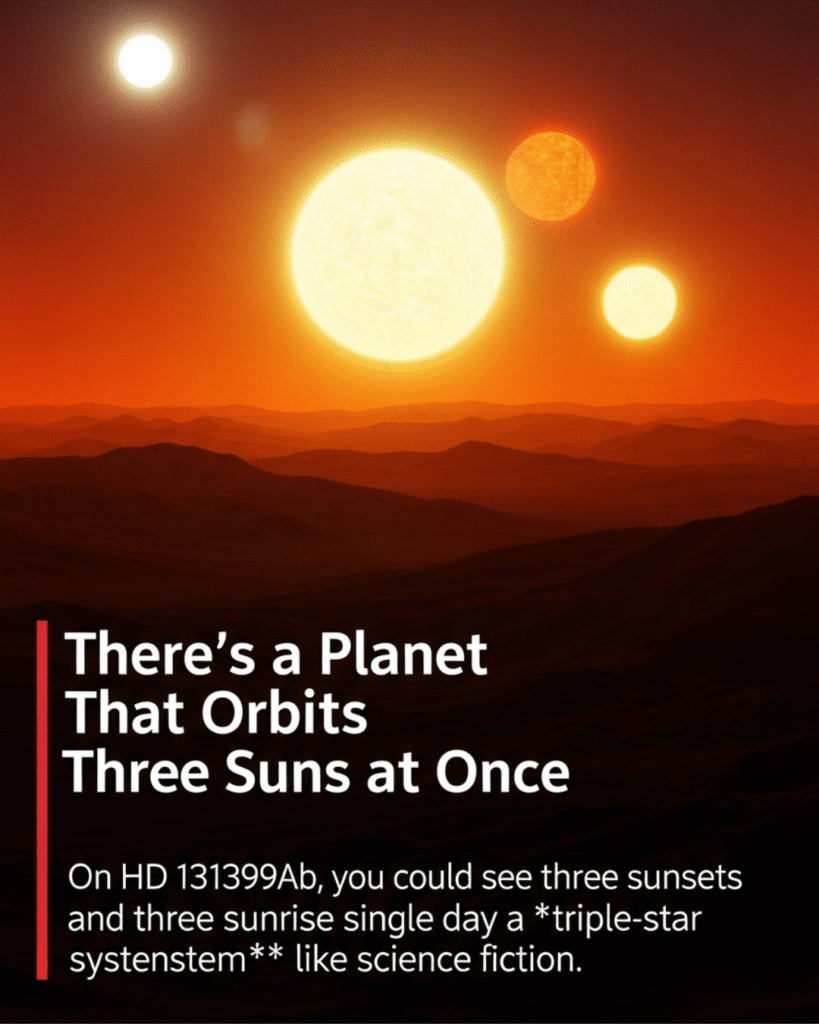
In the final analysis, HD 131399Ab represents far more than an isolated curiosity—it stands as exemplar of the ongoing project to catalog, characterize, and understand the full diversity of worlds populating our galaxy. Each new discovery expands the parameter space of known possibilities, constrains theoretical models, and reveals that the universe consistently proves more varied, more complex, and more wondrous than any single species’ imagination could encompass. The three suns of HD 131399Ab shine not just for any hypothetical observer in that distant system, but as beacons illuminating the richness of cosmic architecture awaiting human discovery and comprehension.